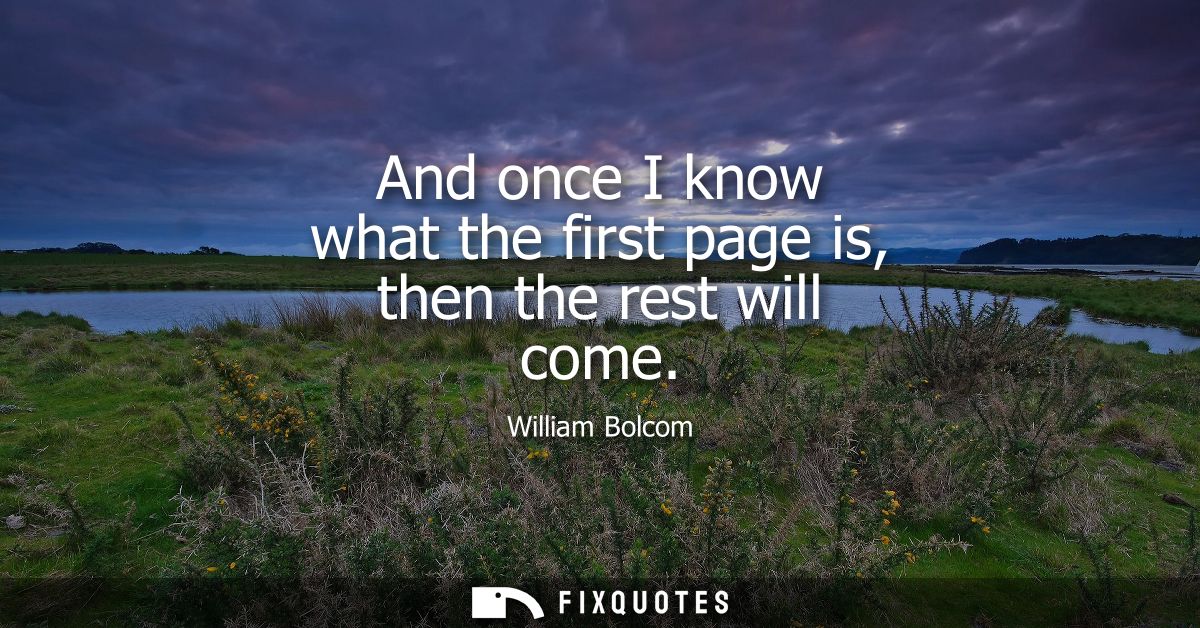
"And once I know what the first page is, then the rest will come"
About this Quote
The line flatters the myth of effortless inspiration, then quietly dismantles it. Bolcom, a composer who’s spent decades moving between concert hall seriousness and vernacular pleasures, frames creation not as a lightning strike but as a practical problem: find the first page. In music, that’s not just “the beginning.” It’s the governing premise - the tempo of the narrative, the harmonic weather, the density of the texture, the kind of time the piece wants to live in. Once that initial world is established, everything else becomes less a heroic act of invention than an act of consistency: composing is following the implications you’ve already baked into bar one.
The subtext is a veteran’s admission about friction. Bolcom isn’t claiming the rest is easy; he’s admitting the hardest part is choosing constraints you can trust. The “first page” is permission and trap at once: permission to proceed without second-guessing every measure, trap because a weak opening makes the rest feel like forced labor. His wording is tellingly modest - “know what it is,” not “perfect it” - suggesting that clarity beats virtuoso agonizing.
Context matters because composers face a peculiarly blank silence: before the first gesture, there is literally nothing to hear. Bolcom’s remark translates the romantic aura of composition into a craft insight recognizable in any medium. Start with a decisive first move, and you don’t eliminate uncertainty; you turn it into momentum.
The subtext is a veteran’s admission about friction. Bolcom isn’t claiming the rest is easy; he’s admitting the hardest part is choosing constraints you can trust. The “first page” is permission and trap at once: permission to proceed without second-guessing every measure, trap because a weak opening makes the rest feel like forced labor. His wording is tellingly modest - “know what it is,” not “perfect it” - suggesting that clarity beats virtuoso agonizing.
Context matters because composers face a peculiarly blank silence: before the first gesture, there is literally nothing to hear. Bolcom’s remark translates the romantic aura of composition into a craft insight recognizable in any medium. Start with a decisive first move, and you don’t eliminate uncertainty; you turn it into momentum.
Quote Details
| Topic | Writing |
|---|---|
| Source | Help us find the source |
| Cite |
Citation Formats
APA Style (7th ed.)
Bolcom, William. (2026, January 16). And once I know what the first page is, then the rest will come. FixQuotes. https://fixquotes.com/quotes/and-once-i-know-what-the-first-page-is-then-the-117948/
Chicago Style
Bolcom, William. "And once I know what the first page is, then the rest will come." FixQuotes. January 16, 2026. https://fixquotes.com/quotes/and-once-i-know-what-the-first-page-is-then-the-117948/.
MLA Style (9th ed.)
"And once I know what the first page is, then the rest will come." FixQuotes, 16 Jan. 2026, https://fixquotes.com/quotes/and-once-i-know-what-the-first-page-is-then-the-117948/. Accessed 20 Mar. 2026.
More Quotes by William
Add to List