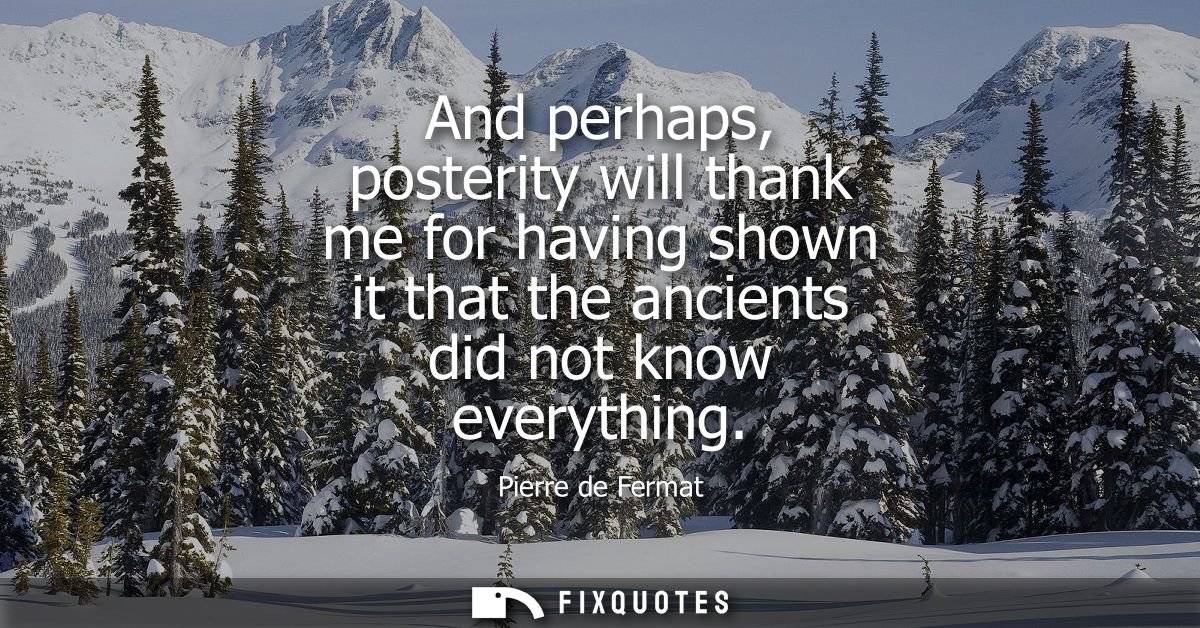
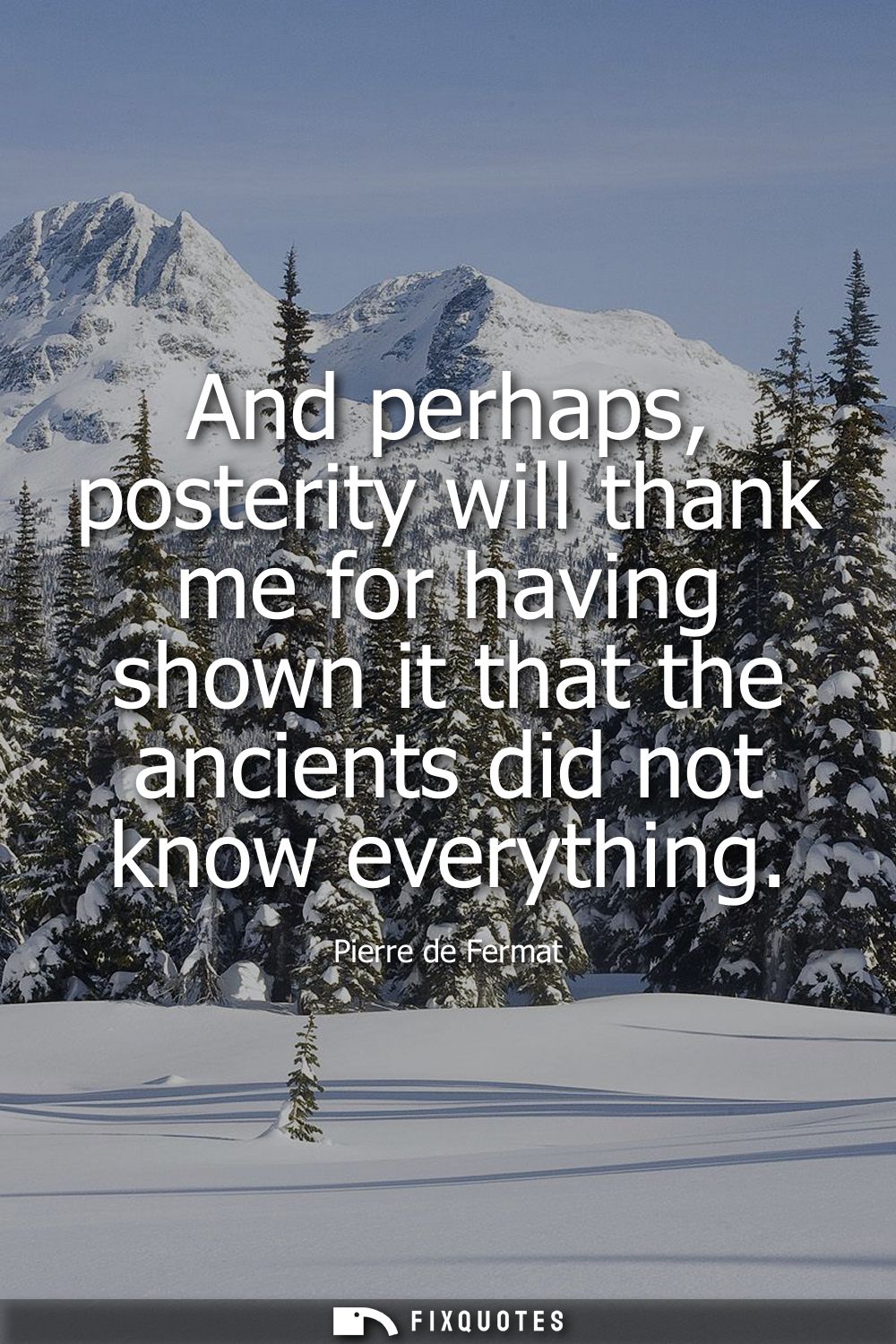
"And perhaps, posterity will thank me for having shown it that the ancients did not know everything"
About this Quote
The line works because it’s modest on the surface and insurgent underneath. “Posterity” is a courtroom term as much as a philosophical one: Fermat, the lawyer, imagines the ultimate appeal beyond contemporary squabbles, rivalries, and institutional gatekeeping. He’s wagering that time will be a fairer judge than his peers. The “thank me” is almost comically human - a request for credit smuggled into a supposedly disinterested pursuit.
Context matters: early modern Europe is shifting from reverent compilation to competitive discovery. New astronomy, new methods, new instruments - and new egos. Fermat sits at the hinge of that change, a celebrated amateur whose mathematics traveled through letters, not lectures. That delivery system makes the subtext sharper: he’s asserting authority without a chair, a title, or a sanctioned platform. The ancients become the safest target for a radical claim, because you can’t offend them directly - only the people using them as shields.
Quote Details
| Topic | Knowledge |
|---|---|
| Source | Help us find the source |
| Cite |
Citation Formats
APA Style (7th ed.)
Fermat, Pierre de. (2026, January 17). And perhaps, posterity will thank me for having shown it that the ancients did not know everything. FixQuotes. https://fixquotes.com/quotes/and-perhaps-posterity-will-thank-me-for-having-57800/
Chicago Style
Fermat, Pierre de. "And perhaps, posterity will thank me for having shown it that the ancients did not know everything." FixQuotes. January 17, 2026. https://fixquotes.com/quotes/and-perhaps-posterity-will-thank-me-for-having-57800/.
MLA Style (9th ed.)
"And perhaps, posterity will thank me for having shown it that the ancients did not know everything." FixQuotes, 17 Jan. 2026, https://fixquotes.com/quotes/and-perhaps-posterity-will-thank-me-for-having-57800/. Accessed 30 Mar. 2026.