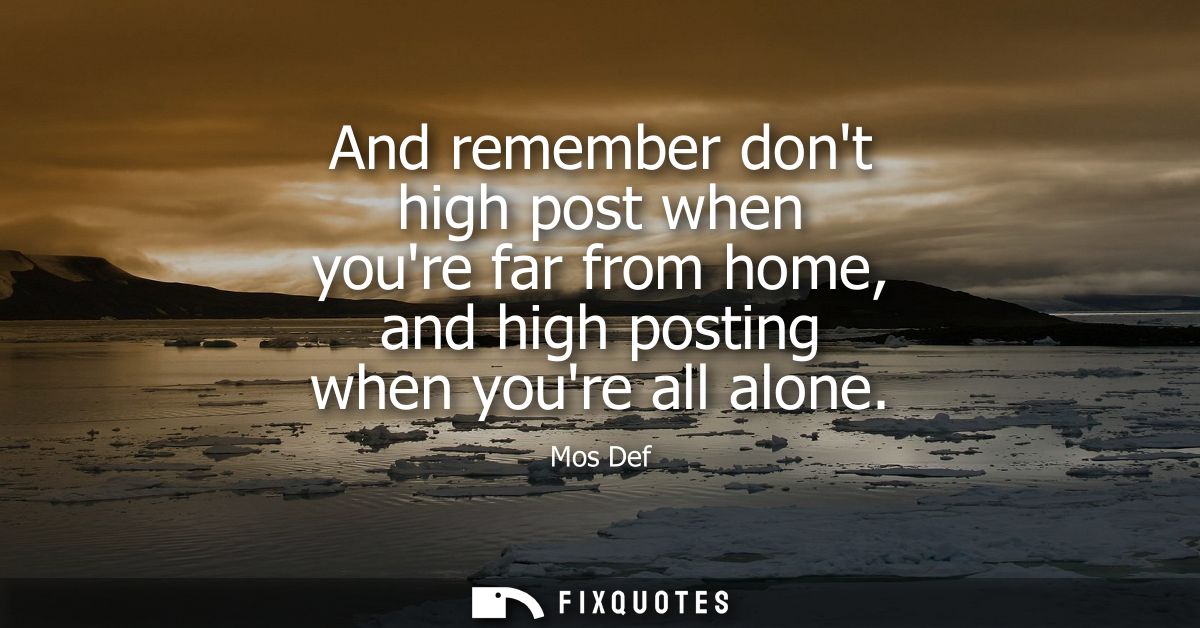
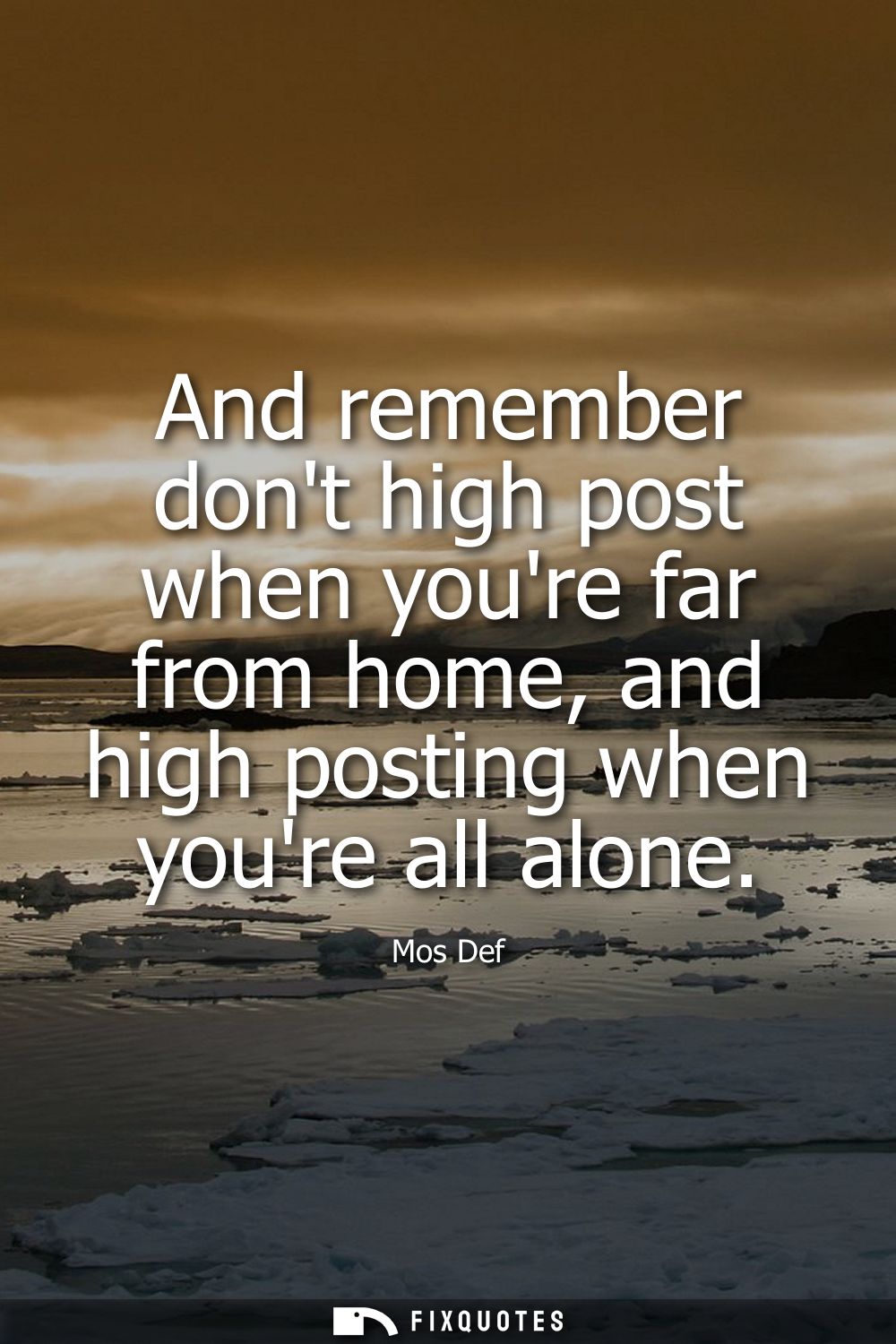
"And remember, don't high post when you're far from home, and high posting when you're all alone"
About this Quote
The line works because it treats self-presentation as strategy, not self-expression. Mos Def doesn’t moralize; he calculates. “Far from home” is geography and psychology at once: unfamiliar blocks, unfamiliar rules, unfamiliar people watching you. “All alone” lands like a second lock on the door. He’s pointing at a truth hip-hop has always carried: danger isn’t only physical, it’s informational. Who knows where you are, who knows you’re solo, who knows you’re trying to look untouchable?
Context matters. Coming out of late-90s/early-2000s rap, Mos Def often positioned himself as a lucid observer inside the culture, not just a participant. This feels like one of his quiet proverbs: community-minded, unsentimental, and modern before “oversharing” became the diagnosis. The cynicism isn’t despair; it’s care. He’s telling you to stop auditioning for an audience when the cost of being seen is being found.
Quote Details
| Topic | Wisdom |
|---|---|
| Source | Unverified source: Black on Both Sides (Mos Def, 1999)
Evidence: Certain shit you just don't do, like, high postin' when you far from home Or like, high postin' when you all alone (Track 5, "Got"). The wording in circulation appears to be a slightly altered quotation of Mos Def's song lyric from "Got" on the album Black on Both Sides, released October 12, 1999... Other candidates (1) Madame Swann at Home (Chapter 1) (Marcel Proust) primary60.0% Song: "Madame Swann at Home (Chapter 1)" by Marcel Proust |
| Cite |
Citation Formats
APA Style (7th ed.)
Def, Mos. (2026, March 8). And remember, don't high post when you're far from home, and high posting when you're all alone. FixQuotes. https://fixquotes.com/quotes/and-remember-dont-high-post-when-youre-far-from-155666/
Chicago Style
Def, Mos. "And remember, don't high post when you're far from home, and high posting when you're all alone." FixQuotes. March 8, 2026. https://fixquotes.com/quotes/and-remember-dont-high-post-when-youre-far-from-155666/.
MLA Style (9th ed.)
"And remember, don't high post when you're far from home, and high posting when you're all alone." FixQuotes, 8 Mar. 2026, https://fixquotes.com/quotes/and-remember-dont-high-post-when-youre-far-from-155666/. Accessed 29 Mar. 2026.