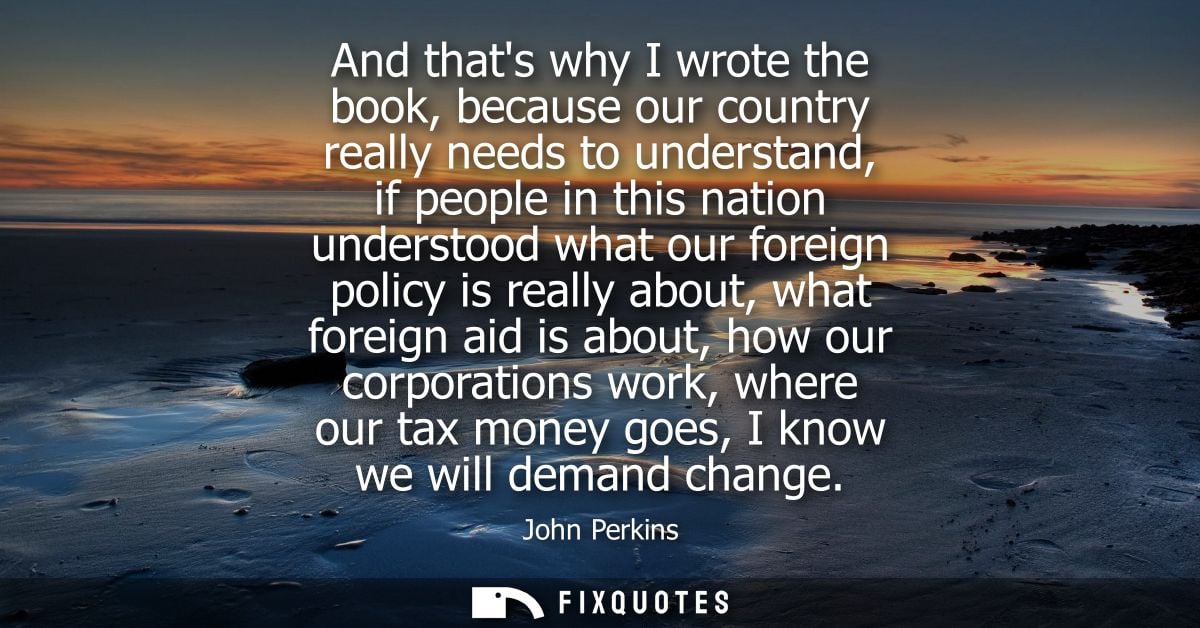
"And that's why I wrote the book, because our country really needs to understand, if people in this nation understood what our foreign policy is really about, what foreign aid is about, how our corporations work, where our tax money goes, I know we will demand change"
About this Quote
The subtext is that misunderstanding isn't accidental. The repetition of "understood... understood" and the escalating list (foreign policy, foreign aid, corporations, tax money) maps the architecture of plausible deniability: the public is allowed to know slogans, not supply chains of power. "Foreign aid" sits there as a particularly loaded term, a feel-good label Perkins implies is often a delivery system for corporate interests and geopolitical leverage. He doesn't need to argue it in the quote; he uses the cultural assumption that aid is benevolent as contrast, letting the listener feel the bait-and-switch.
Context matters because Perkins' persona is as central as his thesis. As an economist and former insider-turned-whistleblower figure, he's positioning the book as a leak from the engine room of empire. The rhetorical trick is moral inevitability: "I know we will demand change" turns a hope into a forecast, making inaction feel like a failure of courage rather than a difference of opinion. It's a populist appeal, but not the cheap kind; it aims its anger upstream, toward systems that depend on complexity, distance, and euphemism to stay politically untouchable.
Quote Details
| Topic | Justice |
|---|---|
| Source | Help us find the source |
| Cite |
Citation Formats
APA Style (7th ed.)
Perkins, John. (2026, January 17). And that's why I wrote the book, because our country really needs to understand, if people in this nation understood what our foreign policy is really about, what foreign aid is about, how our corporations work, where our tax money goes, I know we will demand change. FixQuotes. https://fixquotes.com/quotes/and-thats-why-i-wrote-the-book-because-our-74962/
Chicago Style
Perkins, John. "And that's why I wrote the book, because our country really needs to understand, if people in this nation understood what our foreign policy is really about, what foreign aid is about, how our corporations work, where our tax money goes, I know we will demand change." FixQuotes. January 17, 2026. https://fixquotes.com/quotes/and-thats-why-i-wrote-the-book-because-our-74962/.
MLA Style (9th ed.)
"And that's why I wrote the book, because our country really needs to understand, if people in this nation understood what our foreign policy is really about, what foreign aid is about, how our corporations work, where our tax money goes, I know we will demand change." FixQuotes, 17 Jan. 2026, https://fixquotes.com/quotes/and-thats-why-i-wrote-the-book-because-our-74962/. Accessed 31 Mar. 2026.