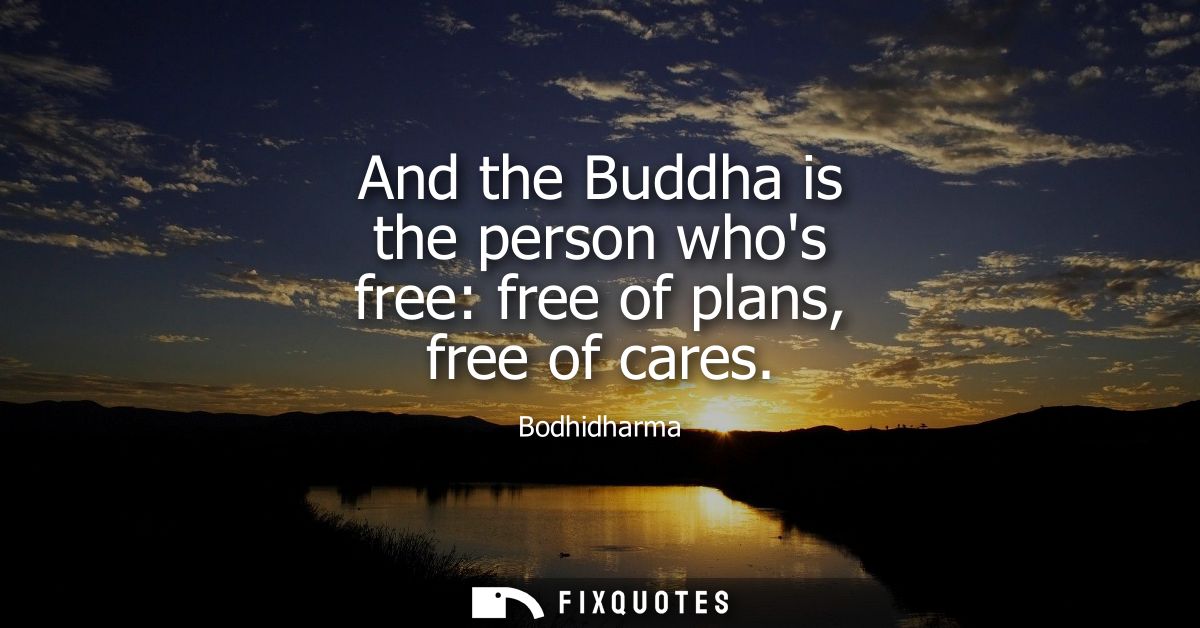
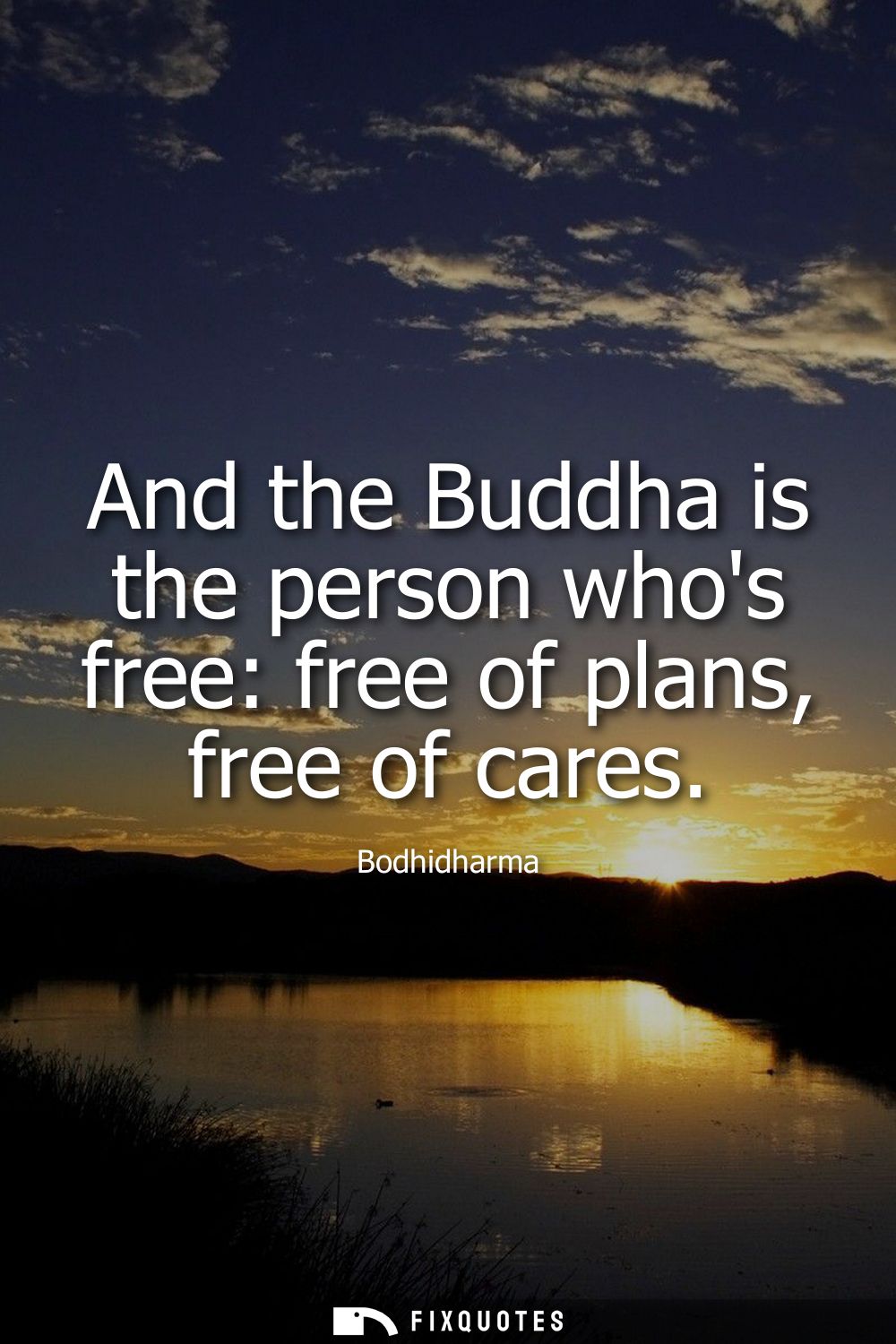
"And the Buddha is the person who's free: free of plans, free of cares"
About this Quote
Freedom, here, is a demolition job. Bodhidharma isn’t praising the Buddha as a serene manager of a well-organized life; he’s stripping away the very machinery that modern people mistake for stability. “Plans” and “cares” aren’t harmless accessories. In this Zen-inflected framing, they’re the twin engines of attachment: the future as a fix, the mind as a constant project. The line lands with the blunt authority of someone trying to break a student’s trance, not comfort them inside it.
The phrasing matters. “Free of plans” doesn’t mean improvisational or irresponsible; it means unhooked from the fantasy that control equals safety. “Free of cares” doesn’t mean numb or indifferent; it points to the end of compulsive self-concern, the kind that turns every moment into a referendum on Me. Bodhidharma’s Buddha is “free” in the way a person is free when they stop negotiating with reality.
Context sharpens the edge. Bodhidharma, the semi-legendary transmitter of Zen to China, teaches in a cultural world thick with ritual, merit-making, and philosophical system-building. Zen’s counter-move is to make liberation feel immediate and almost offensive: no ladders, no elaborate roadmaps, no spiritual capitalism. The subtext is a quiet provocation to the listener: if awakening required your carefully curated strategies, it would be just another product of the anxious mind. The point is not to perfect the self, but to see through it.
The phrasing matters. “Free of plans” doesn’t mean improvisational or irresponsible; it means unhooked from the fantasy that control equals safety. “Free of cares” doesn’t mean numb or indifferent; it points to the end of compulsive self-concern, the kind that turns every moment into a referendum on Me. Bodhidharma’s Buddha is “free” in the way a person is free when they stop negotiating with reality.
Context sharpens the edge. Bodhidharma, the semi-legendary transmitter of Zen to China, teaches in a cultural world thick with ritual, merit-making, and philosophical system-building. Zen’s counter-move is to make liberation feel immediate and almost offensive: no ladders, no elaborate roadmaps, no spiritual capitalism. The subtext is a quiet provocation to the listener: if awakening required your carefully curated strategies, it would be just another product of the anxious mind. The point is not to perfect the self, but to see through it.
Quote Details
| Topic | Wisdom |
|---|---|
| Source | Help us find the source |
| Cite |
Citation Formats
APA Style (7th ed.)
Bodhidharma. (2026, January 17). And the Buddha is the person who's free: free of plans, free of cares. FixQuotes. https://fixquotes.com/quotes/and-the-buddha-is-the-person-whos-free-free-of-26152/
Chicago Style
Bodhidharma. "And the Buddha is the person who's free: free of plans, free of cares." FixQuotes. January 17, 2026. https://fixquotes.com/quotes/and-the-buddha-is-the-person-whos-free-free-of-26152/.
MLA Style (9th ed.)
"And the Buddha is the person who's free: free of plans, free of cares." FixQuotes, 17 Jan. 2026, https://fixquotes.com/quotes/and-the-buddha-is-the-person-whos-free-free-of-26152/. Accessed 12 Feb. 2026.
More Quotes by Bodhidharma
Add to List