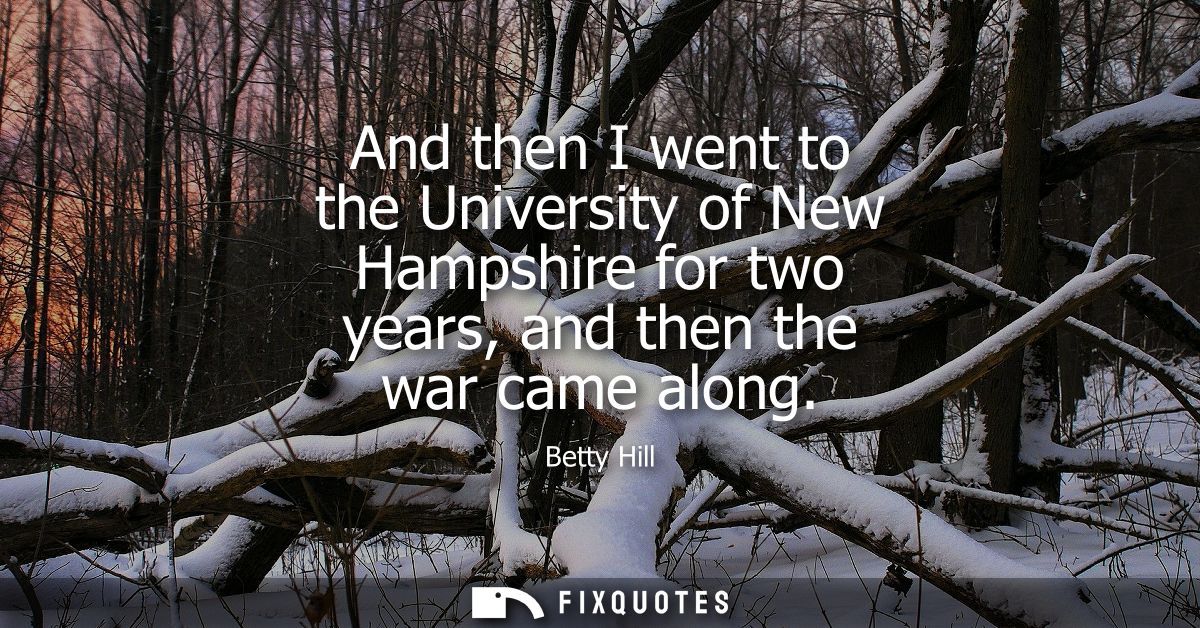
"And then I went to the University of New Hampshire for two years, and then the war came along"
About this Quote
The sentence structure performs the loss. Two beats of normalcy (“University… for two years, and then…”) create a rhythm of forward motion, the expected arc of2: school, then life. The war doesn’t “begin” or “erupt”; it simply arrives and takes over the narrative, stealing the verb from her agency. She doesn’t say what she chose, only what happened. That’s the subtext: a generation’s biography rewritten mid-sentence.
There’s also a cultural tell in the modesty. Hill, later famous in an entirely different register, speaks in the plainspoken idiom of mid-century America, where big experiences were often narrated small. The line reads like a memory trimmed for social acceptability: no melodrama, no self-mythologizing. Yet that restraint is exactly what gives it gravity. The war isn’t background; it’s the edit that made “two years” the limit of the life she’d planned.
Quote Details
| Topic | War |
|---|---|
| Source | Help us find the source |
| Cite |
Citation Formats
APA Style (7th ed.)
Hill, Betty. (2026, January 17). And then I went to the University of New Hampshire for two years, and then the war came along. FixQuotes. https://fixquotes.com/quotes/and-then-i-went-to-the-university-of-new-36435/
Chicago Style
Hill, Betty. "And then I went to the University of New Hampshire for two years, and then the war came along." FixQuotes. January 17, 2026. https://fixquotes.com/quotes/and-then-i-went-to-the-university-of-new-36435/.
MLA Style (9th ed.)
"And then I went to the University of New Hampshire for two years, and then the war came along." FixQuotes, 17 Jan. 2026, https://fixquotes.com/quotes/and-then-i-went-to-the-university-of-new-36435/. Accessed 7 Apr. 2026.