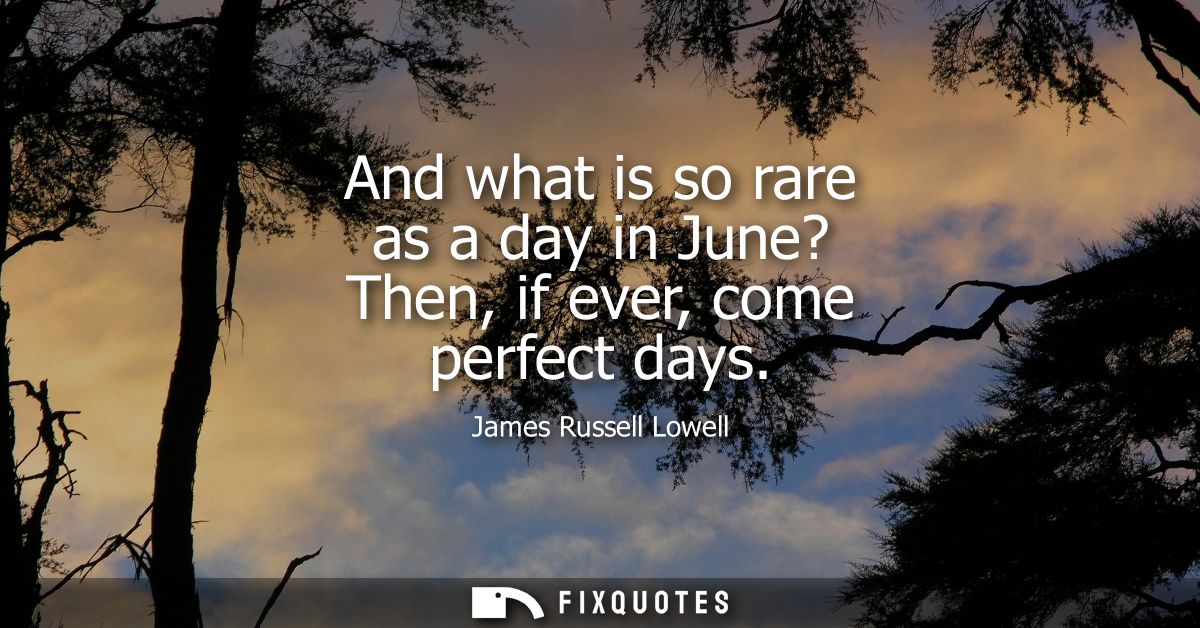
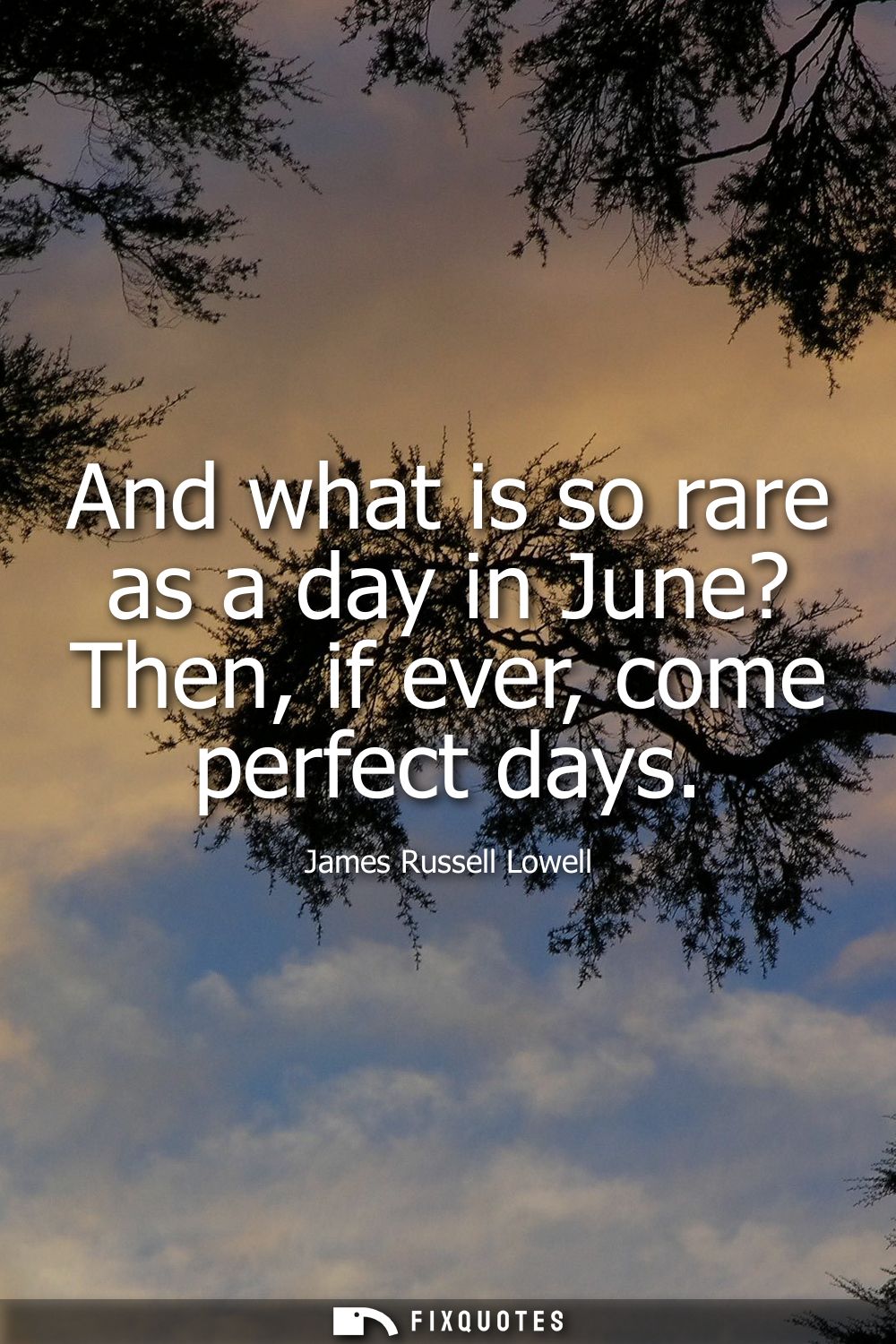
"And what is so rare as a day in June? Then, if ever, come perfect days"
About this Quote
The trick is in the timing. “Then, if ever” is a hedge disguised as confidence. It acknowledges the adult suspicion that perfection is mostly a story we tell ourselves, while still permitting the fantasy that it might be true for a few hours. Lowell’s subtext is almost stern: if you want “perfect days,” you don’t wait for them to happen; you train yourself to recognize their conditions, to be present when the light is right.
Context matters here. Lowell wrote in a 19th-century New England register where nature isn’t just scenery but a moral instrument, a place to test character and refine perception. June carries cultural freight: the hinge between restraint and release, school-year discipline and summer looseness, spring’s promise and heat’s excess. Lowell’s couplet works because it makes perfection feel both accessible and precarious, the kind of sweetness you can miss by being busy, cynical, or indoors. It’s pastoral, yes, but also pragmatic: happiness arrives like weather, and you’d better step outside.
Quote Details
| Topic | Nature |
|---|---|
| Source | Help us find the source |
| Cite |
Citation Formats
APA Style (7th ed.)
Lowell, James Russell. (2026, January 18). And what is so rare as a day in June? Then, if ever, come perfect days. FixQuotes. https://fixquotes.com/quotes/and-what-is-so-rare-as-a-day-in-june-then-if-ever-13928/
Chicago Style
Lowell, James Russell. "And what is so rare as a day in June? Then, if ever, come perfect days." FixQuotes. January 18, 2026. https://fixquotes.com/quotes/and-what-is-so-rare-as-a-day-in-june-then-if-ever-13928/.
MLA Style (9th ed.)
"And what is so rare as a day in June? Then, if ever, come perfect days." FixQuotes, 18 Jan. 2026, https://fixquotes.com/quotes/and-what-is-so-rare-as-a-day-in-june-then-if-ever-13928/. Accessed 27 Mar. 2026.