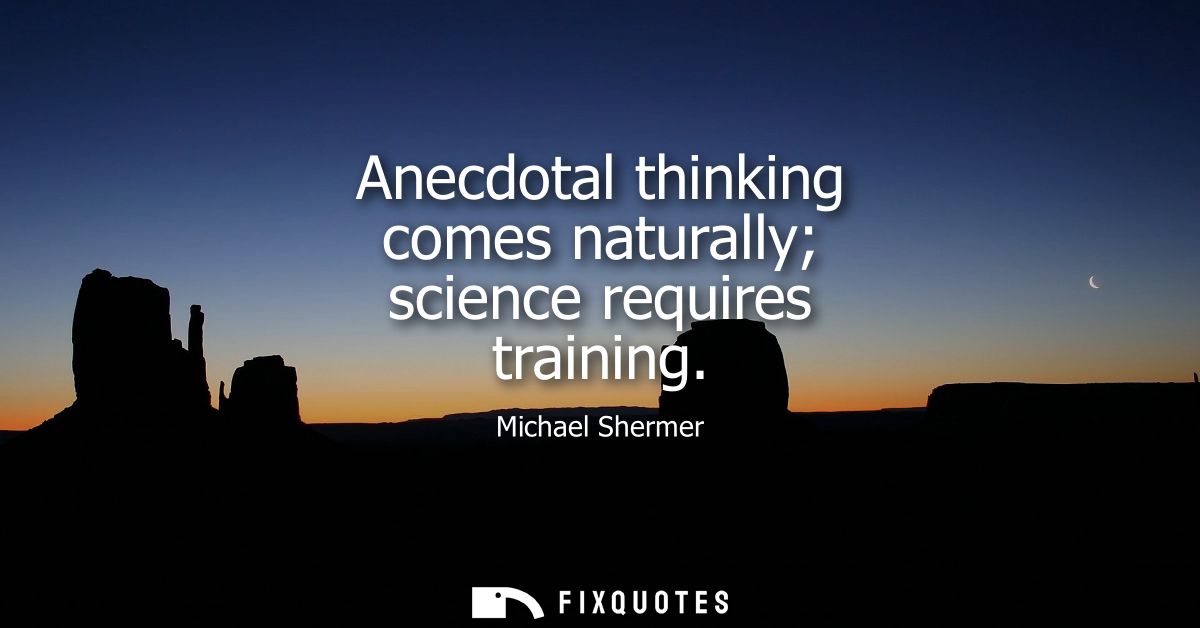
"Anecdotal thinking comes naturally; science requires training"
About this Quote
Anecdotes are the brain’s default setting: fast, sticky, emotionally satisfying. Shermer’s line works because it doesn’t just defend science; it diagnoses why science so often loses in the court of public opinion. “Comes naturally” is a quiet indictment. It implies that our most confident beliefs are often the ones that arrive without effort, delivered by personal experience, a neighbor’s story, a viral clip. “Requires training” flips the usual hierarchy. Science isn’t portrayed as a pile of facts smart people collect; it’s a discipline that has to be learned because it runs against human impulse.
The intent is partly pedagogical and partly political. Shermer, a prominent skeptic and popularizer, has spent decades watching people prefer testimonials over trials, narratives over numbers, certainty over error bars. The subtext: if you’re losing arguments to conspiracy theories, miracle cures, or culture-war “common sense,” it’s not because the other side has better evidence. It’s because they’re playing to cognition’s home-field advantage.
The line also smuggles in a moral posture without sounding moralistic. Training suggests humility, standards, and the willingness to be corrected. Anecdotal thinking suggests status, identity, and a demand to be believed. In an era of algorithmic outrage, where “I saw it” competes with “here’s the data,” Shermer is reminding readers that scientific literacy is less about memorizing conclusions than acquiring habits: skepticism toward vivid stories, comfort with probability, and the patience to let reality veto your favorite narrative.
The intent is partly pedagogical and partly political. Shermer, a prominent skeptic and popularizer, has spent decades watching people prefer testimonials over trials, narratives over numbers, certainty over error bars. The subtext: if you’re losing arguments to conspiracy theories, miracle cures, or culture-war “common sense,” it’s not because the other side has better evidence. It’s because they’re playing to cognition’s home-field advantage.
The line also smuggles in a moral posture without sounding moralistic. Training suggests humility, standards, and the willingness to be corrected. Anecdotal thinking suggests status, identity, and a demand to be believed. In an era of algorithmic outrage, where “I saw it” competes with “here’s the data,” Shermer is reminding readers that scientific literacy is less about memorizing conclusions than acquiring habits: skepticism toward vivid stories, comfort with probability, and the patience to let reality veto your favorite narrative.
Quote Details
| Topic | Reason & Logic |
|---|---|
| Source | Help us find the source |
| Cite |
Citation Formats
APA Style (7th ed.)
Shermer, Michael. (2026, January 16). Anecdotal thinking comes naturally; science requires training. FixQuotes. https://fixquotes.com/quotes/anecdotal-thinking-comes-naturally-science-89000/
Chicago Style
Shermer, Michael. "Anecdotal thinking comes naturally; science requires training." FixQuotes. January 16, 2026. https://fixquotes.com/quotes/anecdotal-thinking-comes-naturally-science-89000/.
MLA Style (9th ed.)
"Anecdotal thinking comes naturally; science requires training." FixQuotes, 16 Jan. 2026, https://fixquotes.com/quotes/anecdotal-thinking-comes-naturally-science-89000/. Accessed 24 Mar. 2026.
More Quotes by Michael
Add to List