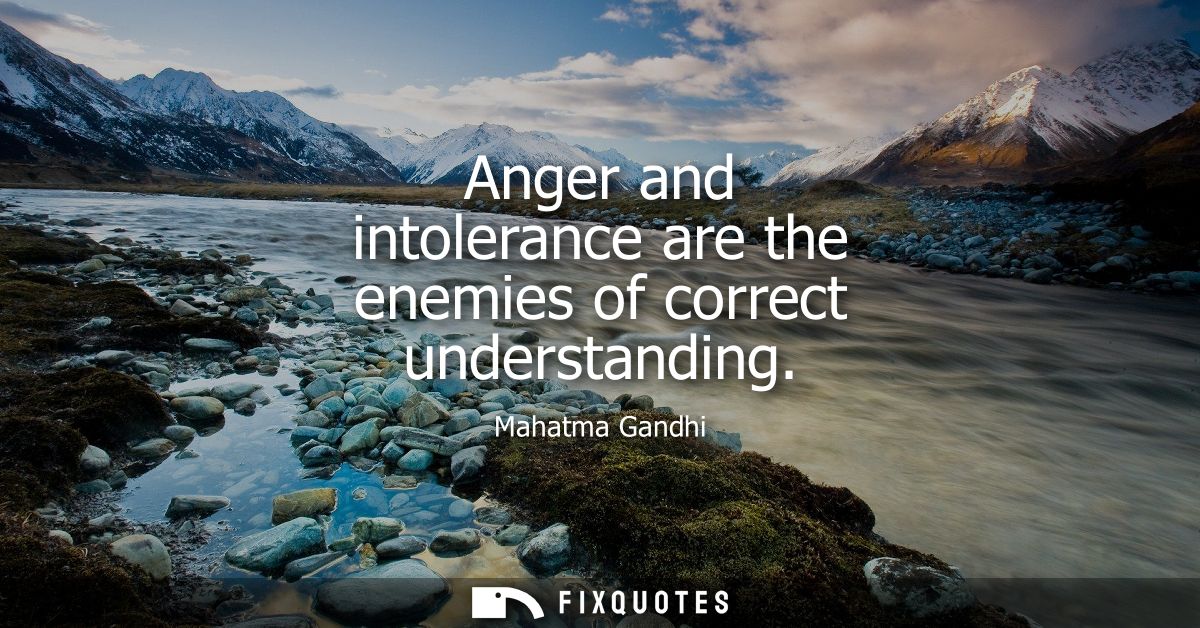
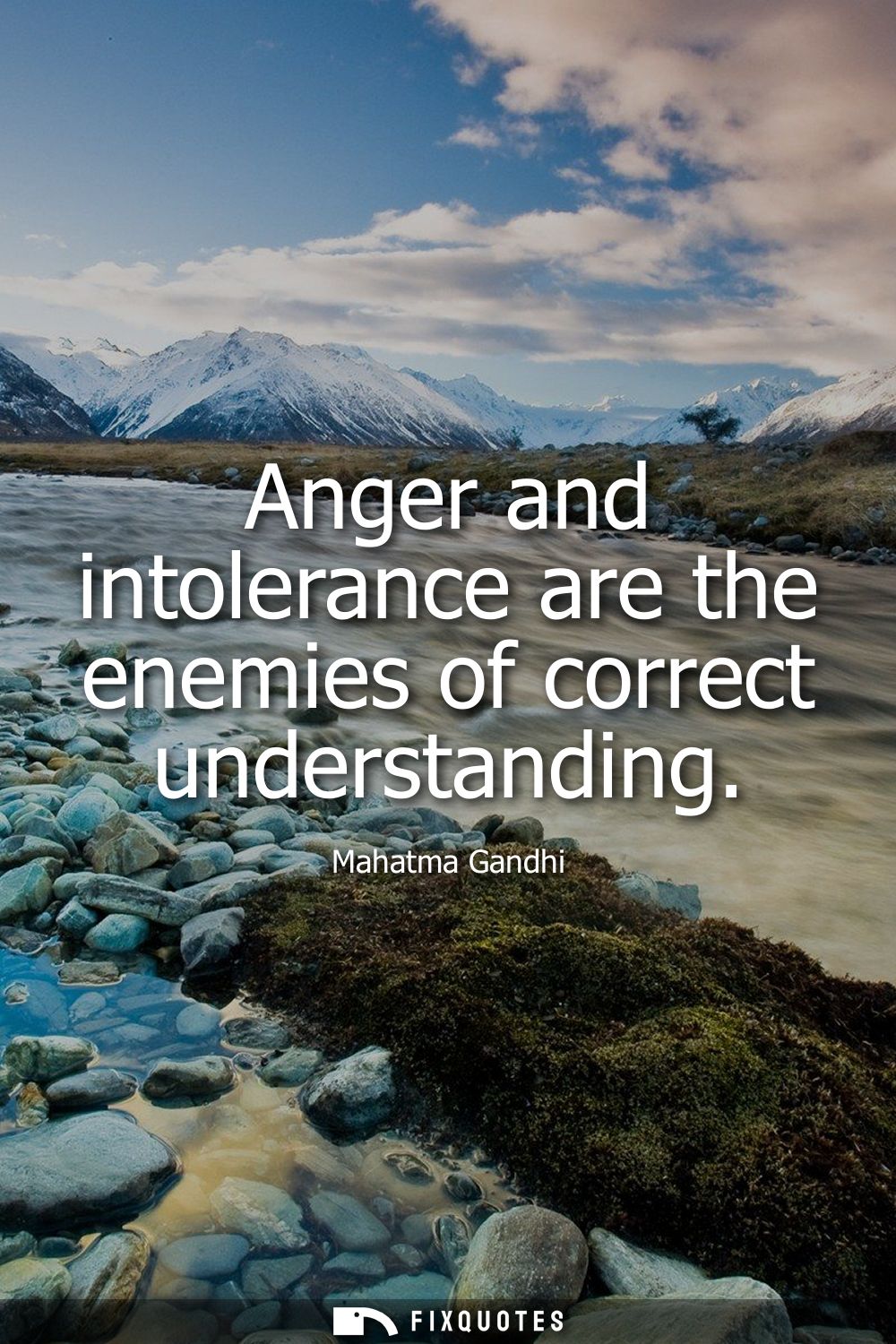
"Anger and intolerance are the enemies of correct understanding"
About this Quote
Gandhi is doing something deceptively forceful here: he reframes “understanding” as a moral achievement, not just an intellectual one. Anger and intolerance aren’t presented as regrettable emotions you should feel bad about; they’re cast as active adversaries, as if they sabotage perception itself. The line carries the cadence of a warning issued to a movement, not a meditation meant for private serenity.
The intent is strategic. Gandhi led a mass struggle that depended on discipline under provocation. British colonial power didn’t only operate through laws and police; it also relied on predictable backlash from the colonized, the kind that could be labeled “violent,” “irrational,” and therefore unfit for self-rule. By naming anger and intolerance as the enemies of “correct understanding,” Gandhi is protecting the political instrument of nonviolence: if your mind is hijacked by rage or by categorical hatred, you misread the situation, you misjudge your opponent, and you end up serving the script written for you.
The subtext is also inward-facing. “Correct understanding” implies there is a reality worth seeing clearly even in an adversary: the human being behind the uniform, the fears behind the ideology, the possibility of conversion or coalition. Intolerance, in this frame, is epistemic laziness masquerading as conviction.
As a leader who turned ethical posture into public power, Gandhi is insisting that clarity is a form of resistance. The fight is not only over territory and rights; it’s over who gets to define reality when emotions are weaponized.
The intent is strategic. Gandhi led a mass struggle that depended on discipline under provocation. British colonial power didn’t only operate through laws and police; it also relied on predictable backlash from the colonized, the kind that could be labeled “violent,” “irrational,” and therefore unfit for self-rule. By naming anger and intolerance as the enemies of “correct understanding,” Gandhi is protecting the political instrument of nonviolence: if your mind is hijacked by rage or by categorical hatred, you misread the situation, you misjudge your opponent, and you end up serving the script written for you.
The subtext is also inward-facing. “Correct understanding” implies there is a reality worth seeing clearly even in an adversary: the human being behind the uniform, the fears behind the ideology, the possibility of conversion or coalition. Intolerance, in this frame, is epistemic laziness masquerading as conviction.
As a leader who turned ethical posture into public power, Gandhi is insisting that clarity is a form of resistance. The fight is not only over territory and rights; it’s over who gets to define reality when emotions are weaponized.
Quote Details
| Topic | Anger |
|---|---|
| Source | Verified source: Harijan (7 June 1942): 'Anger' (quote appears there) (Mahatma Gandhi, 1942)
Evidence: ANGER and intolerance are the twin enemies of correct understanding, Harijan : June 7, 1942. (null). Your wording (“Anger and intolerance are the enemies of correct understanding”) appears to be a shortened/altered version. The earliest specific primary-publication attribution I could locate points to Gandhi’s journal Harijan dated 7 June 1942, with the wording including “twin enemies.” This is consistent with multiple later secondary attributions, but I have not (in this search pass) been able to open a definitive scan/transcript of the 7 June 1942 Harijan issue itself from an official Gandhi archive to confirm the surrounding context and page number. The linked source is a scanned compilation ('Teachings of Mahatma Gandhi') that cites Harijan as the original appearance/date. Other candidates (1) Google Books compilation95.0% ... by the opinion of the others but should continually judge the actions or the policies of the governments . ( b ) ... |
| Cite |
Citation Formats
APA Style (7th ed.)
Gandhi, Mahatma. (2026, March 4). Anger and intolerance are the enemies of correct understanding. FixQuotes. https://fixquotes.com/quotes/anger-and-intolerance-are-the-enemies-of-correct-26043/
Chicago Style
Gandhi, Mahatma. "Anger and intolerance are the enemies of correct understanding." FixQuotes. March 4, 2026. https://fixquotes.com/quotes/anger-and-intolerance-are-the-enemies-of-correct-26043/.
MLA Style (9th ed.)
"Anger and intolerance are the enemies of correct understanding." FixQuotes, 4 Mar. 2026, https://fixquotes.com/quotes/anger-and-intolerance-are-the-enemies-of-correct-26043/. Accessed 28 Mar. 2026.
More Quotes by Mahatma
Add to List