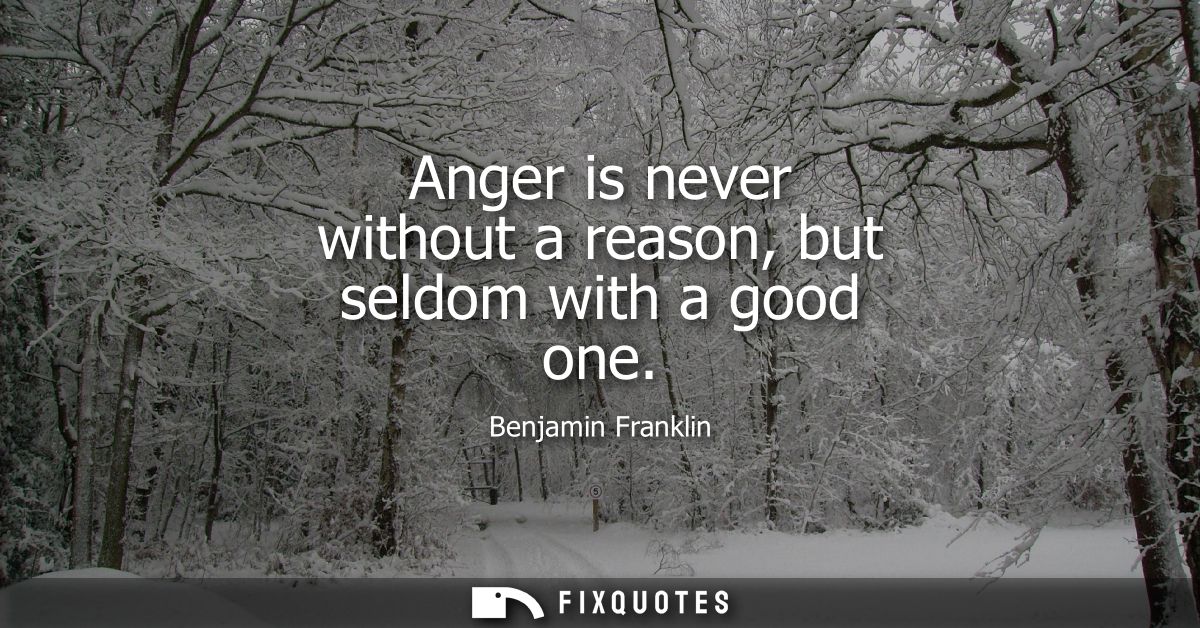
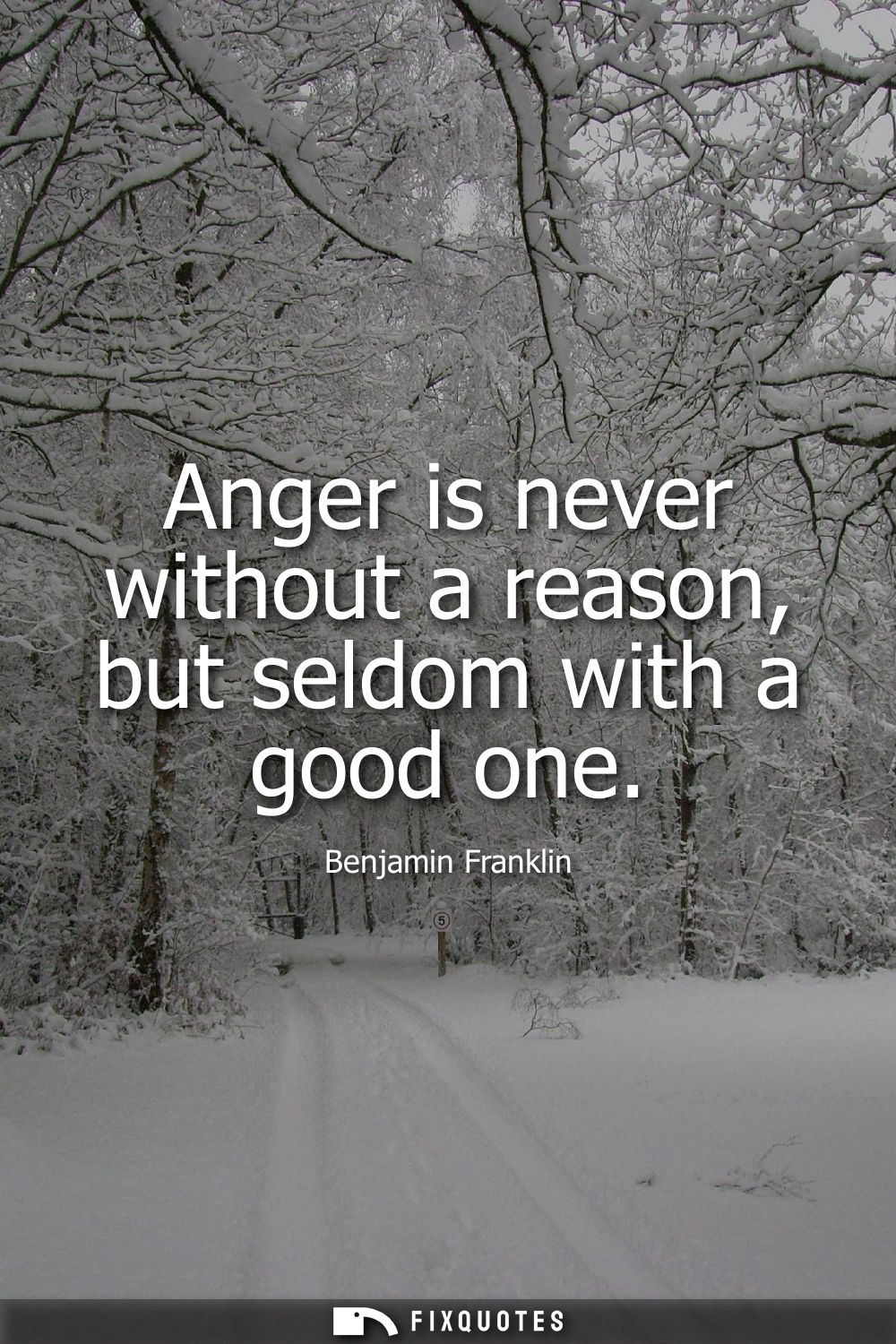
"Anger is never without a reason, but seldom with a good one"
About this Quote
Franklin’s line lands like a moral skewer: it grants anger its dignity, then quietly pulls the chair out from under it. “Never without a reason” sounds like validation, a nod to the lived reality that outrage usually has a trigger - insult, injustice, fear. But the second clause, “seldom with a good one,” is where the Enlightenment pragmatist shows his hand. He’s not denying causes; he’s interrogating quality. Anger may be explainable, even predictable, yet still a poor guide for action.
The subtext is political as much as personal. Franklin helped engineer coalitions, manage rivalries, and keep a fractious revolutionary project from splintering. In that world, anger was plentiful and often useful as fuel, but disastrous as strategy. The quote reads like advice to citizens and statesmen: don’t confuse being provoked with being right. “Reason” can mean justification in a courtroom sense; “good” smuggles in ethics and long-term consequence. You can win an argument, torch a relationship, and still be wrong in the only way that matters.
Rhetorically, the sentence is built to be remembered and repeated: a clean antithesis, almost symmetrical, with the pivot on “but.” Franklin’s genius was making self-government sound like self-management. He frames anger as an understandable impulse that becomes suspect the moment it starts steering the ship. That’s not softness; it’s an early warning about how easily righteous heat turns into bad decisions, and how quickly public passions can be recruited by people with terrible aims.
The subtext is political as much as personal. Franklin helped engineer coalitions, manage rivalries, and keep a fractious revolutionary project from splintering. In that world, anger was plentiful and often useful as fuel, but disastrous as strategy. The quote reads like advice to citizens and statesmen: don’t confuse being provoked with being right. “Reason” can mean justification in a courtroom sense; “good” smuggles in ethics and long-term consequence. You can win an argument, torch a relationship, and still be wrong in the only way that matters.
Rhetorically, the sentence is built to be remembered and repeated: a clean antithesis, almost symmetrical, with the pivot on “but.” Franklin’s genius was making self-government sound like self-management. He frames anger as an understandable impulse that becomes suspect the moment it starts steering the ship. That’s not softness; it’s an early warning about how easily righteous heat turns into bad decisions, and how quickly public passions can be recruited by people with terrible aims.
Quote Details
| Topic | Anger |
|---|---|
| Source | Verified source: Poor Richard improved … for the Year of our Lord 1753 (Benjamin Franklin, 1753)
Evidence: Anger is never without a Reason, but seldom with a good One. (July. VII Month (monthly sayings section; exact page not given in the Founders Online transcription)). This wording appears in Benjamin Franklin’s almanac under the pseudonym Richard Saunders (“Poor Richard Improved … for 1753”), printed in Philadelphia by Benjamin Franklin and David Hall. In the Founders Online transcription, the sentence is listed under “July. VII Month.” (line 80). This is a primary-source appearance in Franklin’s own publication. Note: Many modern attributions point to “Poor Richard’s Almanack” generally; this specific, verifiable instance is the 1753 issue (“Poor Richard Improved”). Other candidates (1) Benjamin Franklin's Intellectual World (Paul E. Kerry, Matthew S. Holland, 2012) compilation91.7% ... Anger is never without a Reason, but seldom with a good One.”7 Franklin never explicitly makes the Socratic argum... |
| Cite |
Citation Formats
APA Style (7th ed.)
Franklin, Benjamin. (2026, February 16). Anger is never without a reason, but seldom with a good one. FixQuotes. https://fixquotes.com/quotes/anger-is-never-without-a-reason-but-seldom-with-a-22148/
Chicago Style
Franklin, Benjamin. "Anger is never without a reason, but seldom with a good one." FixQuotes. February 16, 2026. https://fixquotes.com/quotes/anger-is-never-without-a-reason-but-seldom-with-a-22148/.
MLA Style (9th ed.)
"Anger is never without a reason, but seldom with a good one." FixQuotes, 16 Feb. 2026, https://fixquotes.com/quotes/anger-is-never-without-a-reason-but-seldom-with-a-22148/. Accessed 26 Mar. 2026.
More Quotes by Benjamin
Add to List