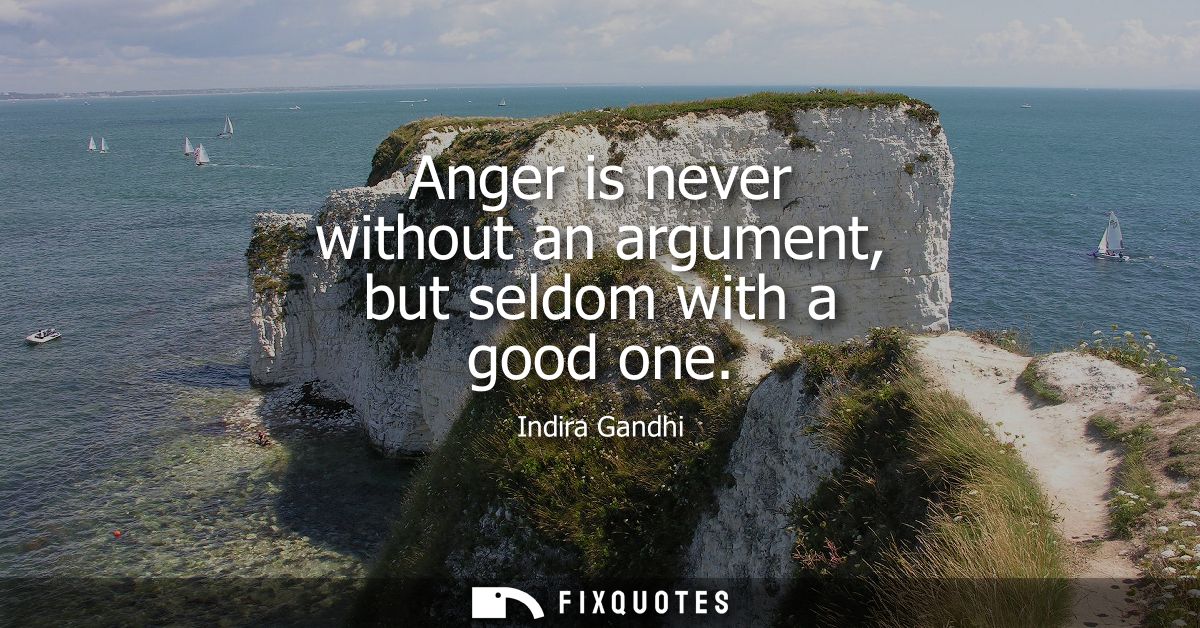
"Anger is never without an argument, but seldom with a good one"
About this Quote
Anger, in Indira Gandhi's framing, is not a lapse into pure irrationality; it is an impulse that arrives already lawyered-up. You can always build a case for outrage. The sting is in the second clause: that case is usually flimsy. Gandhi isn’t moralizing about temper so much as diagnosing a political hazard: emotion will reliably supply its own justification, and that self-justification is precisely what makes it dangerous.
The line works because it acknowledges anger’s seduction. Calling it “never without an argument” grants dignity to the angry person’s inner narrative - the sense of having been wronged, ignored, cornered. But “seldom with a good one” flips the knife. It exposes how quickly argument becomes pretext: a selective brief assembled from grievance, ego, and the need to feel clean in the aftermath of aggression. The syntax is also telling: “argument” in the singular suggests a thin, repeated script rather than a careful weighing of facts.
As a statesman speaking from a century defined by mass movements, insurgencies, partition’s aftershocks, and hard-edged governance, Gandhi’s subtext reads like counsel to leaders and citizens alike: don’t confuse intensity with validity. In politics, anger is renewable fuel; it can mobilize crowds and authorize crackdowns with equal ease. Her caution lands as both personal discipline and public warning: the presence of a rationale is not evidence of reason, only evidence of how quickly humans can dress passion up as principle.
The line works because it acknowledges anger’s seduction. Calling it “never without an argument” grants dignity to the angry person’s inner narrative - the sense of having been wronged, ignored, cornered. But “seldom with a good one” flips the knife. It exposes how quickly argument becomes pretext: a selective brief assembled from grievance, ego, and the need to feel clean in the aftermath of aggression. The syntax is also telling: “argument” in the singular suggests a thin, repeated script rather than a careful weighing of facts.
As a statesman speaking from a century defined by mass movements, insurgencies, partition’s aftershocks, and hard-edged governance, Gandhi’s subtext reads like counsel to leaders and citizens alike: don’t confuse intensity with validity. In politics, anger is renewable fuel; it can mobilize crowds and authorize crackdowns with equal ease. Her caution lands as both personal discipline and public warning: the presence of a rationale is not evidence of reason, only evidence of how quickly humans can dress passion up as principle.
Quote Details
| Topic | Anger |
|---|---|
| Source | Help us find the source |
| Cite |
Citation Formats
APA Style (7th ed.)
Gandhi, Indira. (2026, January 17). Anger is never without an argument, but seldom with a good one. FixQuotes. https://fixquotes.com/quotes/anger-is-never-without-an-argument-but-seldom-50765/
Chicago Style
Gandhi, Indira. "Anger is never without an argument, but seldom with a good one." FixQuotes. January 17, 2026. https://fixquotes.com/quotes/anger-is-never-without-an-argument-but-seldom-50765/.
MLA Style (9th ed.)
"Anger is never without an argument, but seldom with a good one." FixQuotes, 17 Jan. 2026, https://fixquotes.com/quotes/anger-is-never-without-an-argument-but-seldom-50765/. Accessed 27 Mar. 2026.
More Quotes by Indira
Add to List