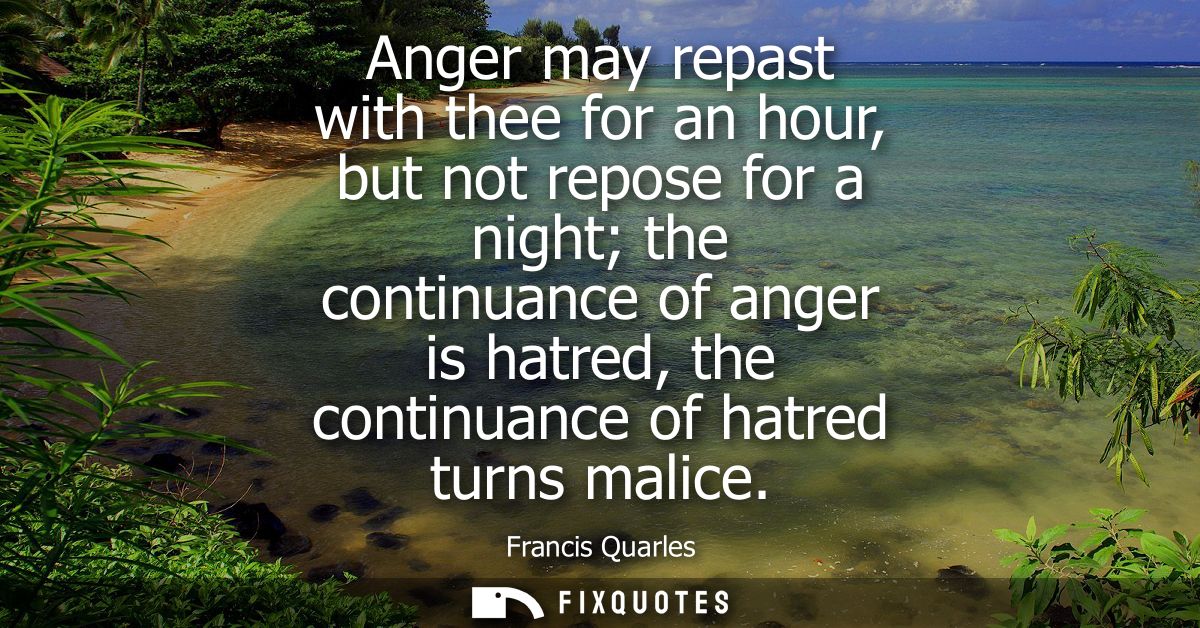
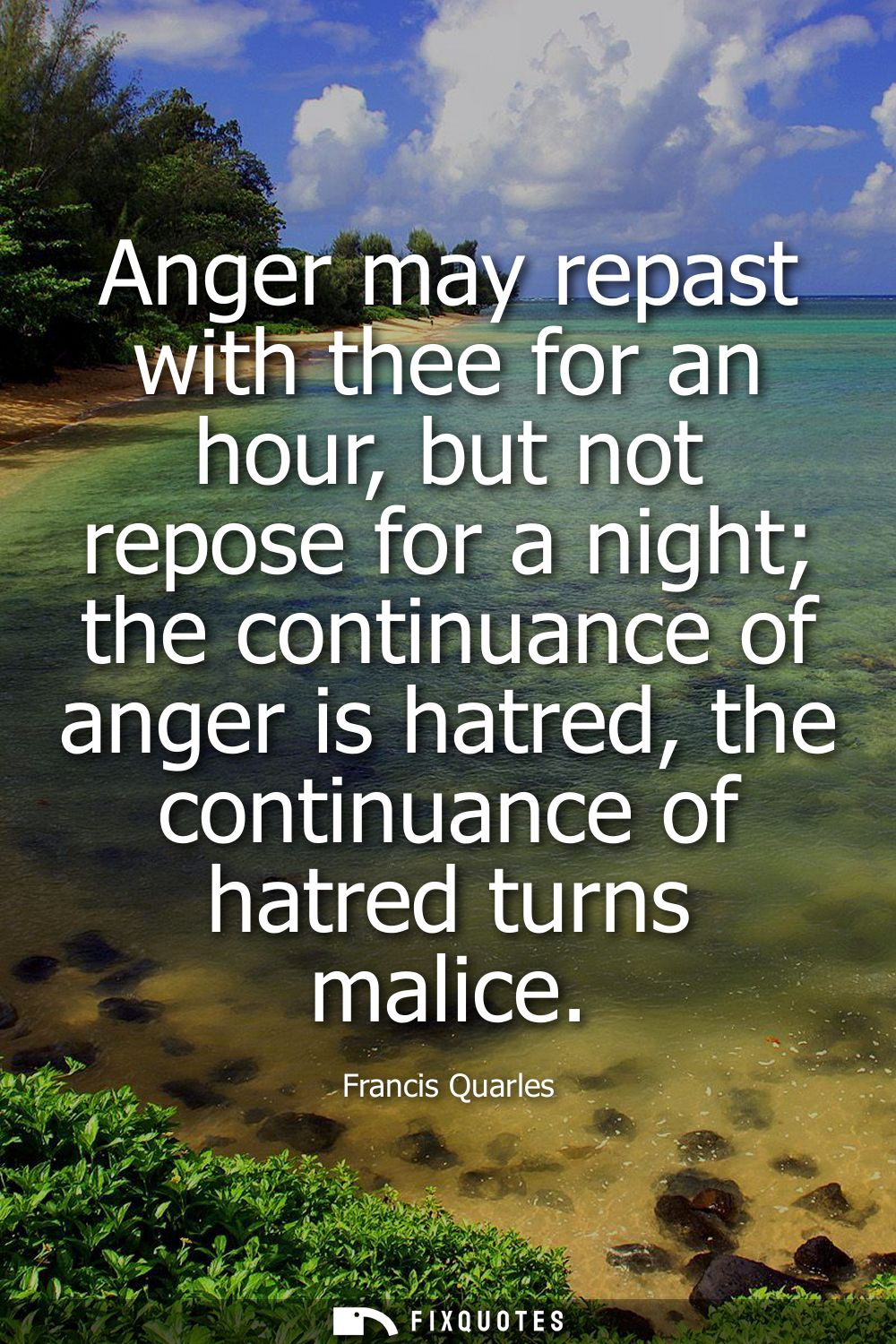
"Anger may repast with thee for an hour, but not repose for a night; the continuance of anger is hatred, the continuance of hatred turns malice"
About this Quote
The subtext is Puritan-era moral psychology, the kind that treats the inner life as a domestic economy where small indulgences compound into vice. Quarles, a devotional poet writing in a Britain fraying toward civil war, isn’t offering a self-help tip; he’s policing the border between human reaction and spiritual corruption. Anger that lingers becomes hatred, hatred that persists curdles into malice: the escalation reads like a theological chain reaction, sin metabolizing itself into something colder and more deliberate.
It’s also a savvy piece of social engineering. By defining “continuance” as the turning point, Quarles shifts responsibility from what happens to you to what you choose to nurture. The line doesn’t deny that anger arrives uninvited; it insists you decide whether it gets a plate or a bed. In an age obsessed with conscience, that’s a sharp form of accountability disguised as proverb.
Quote Details
| Topic | Anger |
|---|---|
| Source | Help us find the source |
| Cite |
Citation Formats
APA Style (7th ed.)
Quarles, Francis. (2026, January 15). Anger may repast with thee for an hour, but not repose for a night; the continuance of anger is hatred, the continuance of hatred turns malice. FixQuotes. https://fixquotes.com/quotes/anger-may-repast-with-thee-for-an-hour-but-not-142274/
Chicago Style
Quarles, Francis. "Anger may repast with thee for an hour, but not repose for a night; the continuance of anger is hatred, the continuance of hatred turns malice." FixQuotes. January 15, 2026. https://fixquotes.com/quotes/anger-may-repast-with-thee-for-an-hour-but-not-142274/.
MLA Style (9th ed.)
"Anger may repast with thee for an hour, but not repose for a night; the continuance of anger is hatred, the continuance of hatred turns malice." FixQuotes, 15 Jan. 2026, https://fixquotes.com/quotes/anger-may-repast-with-thee-for-an-hour-but-not-142274/. Accessed 27 Mar. 2026.