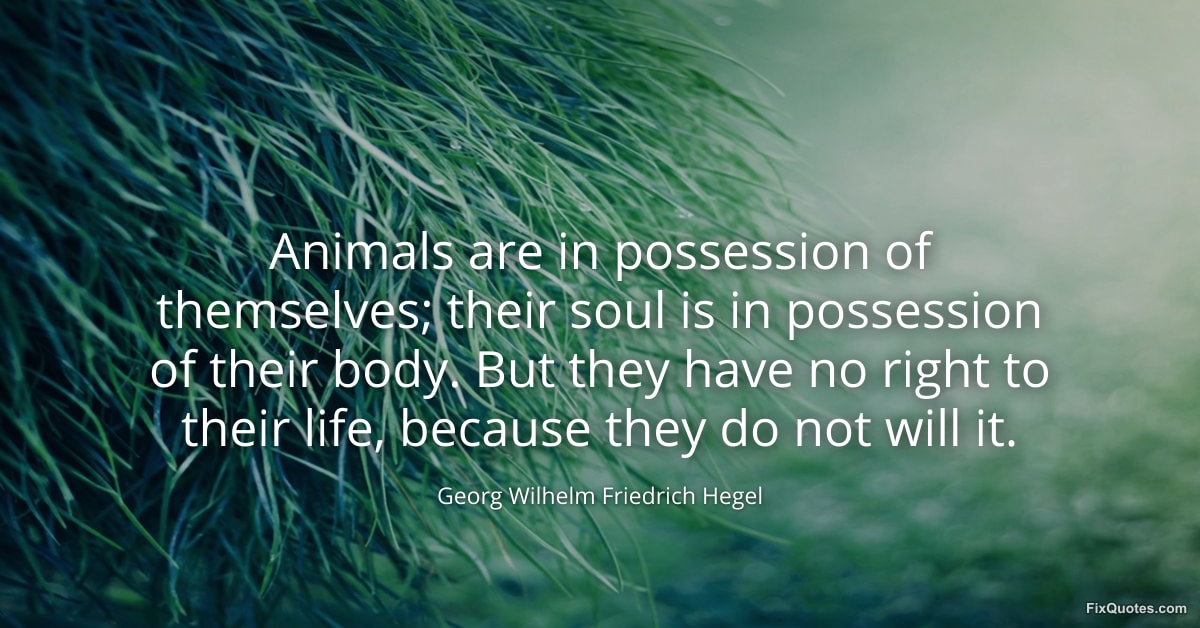
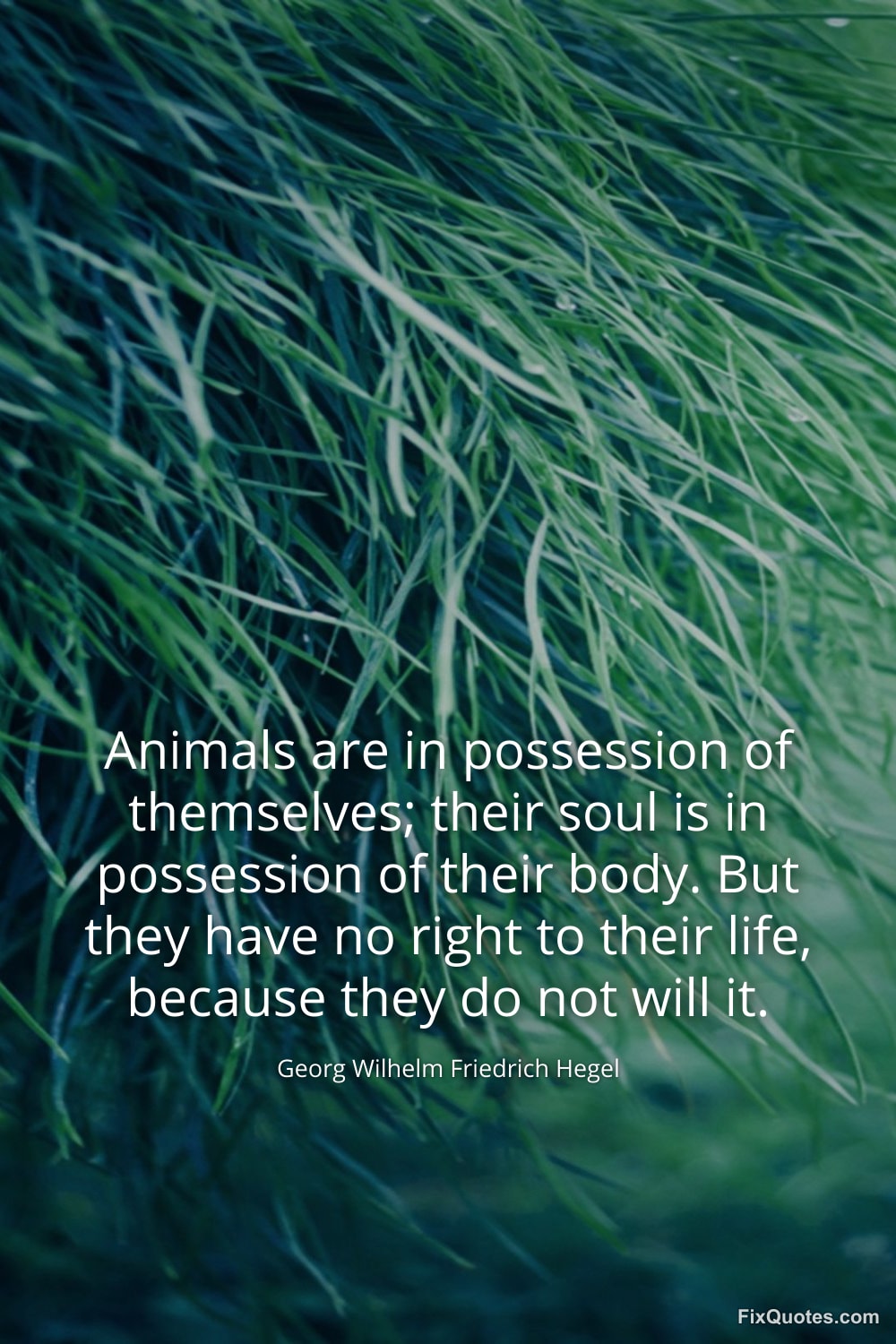
"Animals are in possession of themselves; their soul is in possession of their body. But they have no right to their life, because they do not will it"
About this Quote
Then comes the turn that gives the sentence its bite: "no right to their life, because they do not will it". Hegel is smuggling in his larger project: freedom is not a feeling but an achievement, and "right" is not a warm moral aura but the public, rational shape of willing. In his philosophy of right, to have a right is to be a bearer of a will that can recognize itself in norms, take ownership, bind itself, and be accountable. Animals, in this frame, live, but they do not posit their life as a project; they do not stand back from life to choose it, affirm it, or risk it in the way Hegel thinks a self does.
The subtext is less about animals than about us. If rights hinge on reflective willing, then personhood becomes a status earned through a specific model of rational agency. That elevates human freedom, but it also narrows the door: infants, the severely cognitively disabled, even the senile start to look philosophically awkward. Hegel's line exposes the cold spine of a tradition that equates dignity with self-conscious autonomy, and treats mere sentience as insufficient for claims on the world.
Quote Details
| Topic | Free Will & Fate |
|---|---|
| Source | Unverified source: Philosophy of Right (Georg Wilhelm Friedrich Hegel, 1820)
Evidence: Addition., Animals do in a manner jjossess them- selves. Their soul is in possession of their body. But they have no right to their life, because they do not will it. (§47 (Addition); p. 91 in the 1896 Dyde translation). Primary source: G. W. F. Hegel’s Grundlinien der Philosophie des Rechts (com... Other candidates (1) 100 Great Quotes by Georg Wilhelm Friedrich Hegel (Farhad Hemmatkhah Kalibar) compilation97.5% ... Animals are in possession of themselves ; their soul is in possession of their body . But they have no right to t... |
| Cite |
Citation Formats
APA Style (7th ed.)
Hegel, Georg Wilhelm Friedrich. (2026, February 18). Animals are in possession of themselves; their soul is in possession of their body. But they have no right to their life, because they do not will it. FixQuotes. https://fixquotes.com/quotes/animals-are-in-possession-of-themselves-their-466/
Chicago Style
Hegel, Georg Wilhelm Friedrich. "Animals are in possession of themselves; their soul is in possession of their body. But they have no right to their life, because they do not will it." FixQuotes. February 18, 2026. https://fixquotes.com/quotes/animals-are-in-possession-of-themselves-their-466/.
MLA Style (9th ed.)
"Animals are in possession of themselves; their soul is in possession of their body. But they have no right to their life, because they do not will it." FixQuotes, 18 Feb. 2026, https://fixquotes.com/quotes/animals-are-in-possession-of-themselves-their-466/. Accessed 11 Mar. 2026.