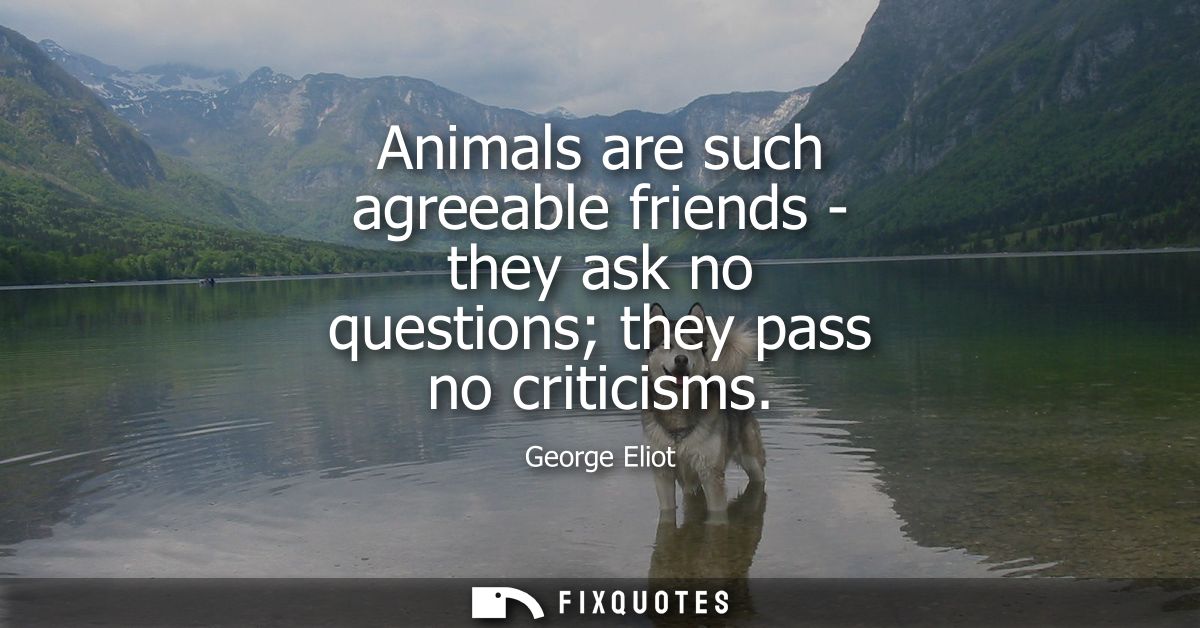
"Animals are such agreeable friends - they ask no questions; they pass no criticisms"
About this Quote
The craft here is in the compact contrast. “Friends” usually implies reciprocity and judgment: you are known, you are seen, you are weighed. Eliot flips that expectation. Agreeableness isn’t a lofty virtue; it’s the relief of not being cross-examined. The paired clauses (“they ask no questions; they pass no criticisms”) read like a courtroom transcript, turning everyday social interaction into interrogation and sentencing. It’s funny in its bluntness, but not cute. It’s a writer admitting how exhausting the human gaze can be.
Context matters: Eliot was a master of moral realism, obsessed with sympathy, consequences, and the way small choices calcify into reputations. She also lived with scandal attached to her name because of her relationship with George Henry Lewes. When your private life becomes public currency, “no questions” isn’t laziness; it’s mercy.
Underneath the pastoral glow is a modern impulse: opting out. The quote anticipates today’s craving for non-performative intimacy - companionship without hot takes, without the constant pressure to explain yourself. Animals don’t absolve you. They simply don’t prosecute you.
Quote Details
| Topic | Pet Love |
|---|---|
| Source | Help us find the source |
| Cite |
Citation Formats
APA Style (7th ed.)
Eliot, George. (2026, January 15). Animals are such agreeable friends - they ask no questions; they pass no criticisms. FixQuotes. https://fixquotes.com/quotes/animals-are-such-agreeable-friends-they-ask-no-25801/
Chicago Style
Eliot, George. "Animals are such agreeable friends - they ask no questions; they pass no criticisms." FixQuotes. January 15, 2026. https://fixquotes.com/quotes/animals-are-such-agreeable-friends-they-ask-no-25801/.
MLA Style (9th ed.)
"Animals are such agreeable friends - they ask no questions; they pass no criticisms." FixQuotes, 15 Jan. 2026, https://fixquotes.com/quotes/animals-are-such-agreeable-friends-they-ask-no-25801/. Accessed 5 Apr. 2026.