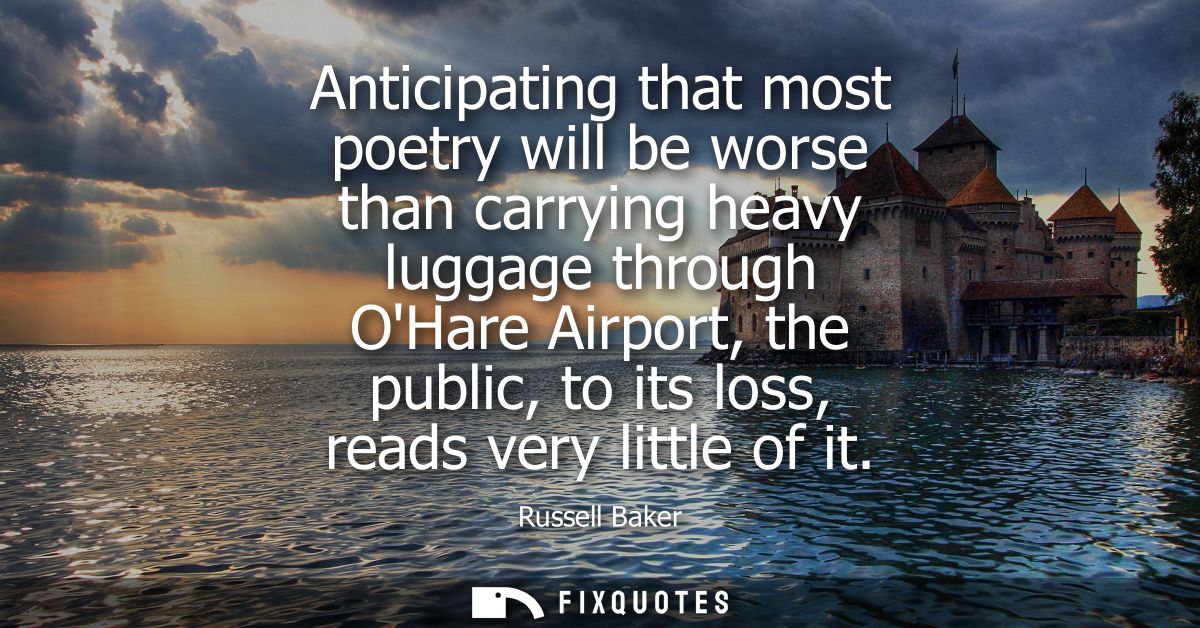
"Anticipating that most poetry will be worse than carrying heavy luggage through O'Hare Airport, the public, to its loss, reads very little of it"
About this Quote
Russell Baker turns a literary lament into a travel gripe, and the move is doing more than fishing for laughs. By comparing “most poetry” to lugging a suitcase through O’Hare, he drags the conversation out of the seminar room and into the fluorescent misery of modern life: delays, crowds, friction, the sense that everything takes longer than it should. It’s a smart insult because it’s specific. O’Hare isn’t “an airport.” It’s a cultural shorthand for hassle. Baker isn’t arguing that poetry is irrelevant; he’s arguing that the average reader expects it to be work without payoff.
The subtext is less “poetry is bad” than “poetry has a branding problem.” He assumes an audience that’s been trained to approach poems like chores assigned by a joyless authority: dense, coded, faintly scolding. The jab at “most poetry” also shields him from the predictable counterexample (“But what about…”). Sure, there’s great poetry; his target is the lived reality of how poetry is encountered in public life: as an intimidating gatekeeping ritual, not a pleasure technology.
“As a journalist” matters. Baker wrote for broad readerships; he’s suspicious of cultural products that demand suffering as an entry fee. The line “to its loss” flips the satire back on the public: people opt out because they anticipate tedium, and that anticipation becomes self-fulfilling. The joke is a diagnosis of a feedback loop - poets write as if no one’s coming, readers stay away because the door looks heavy.
The subtext is less “poetry is bad” than “poetry has a branding problem.” He assumes an audience that’s been trained to approach poems like chores assigned by a joyless authority: dense, coded, faintly scolding. The jab at “most poetry” also shields him from the predictable counterexample (“But what about…”). Sure, there’s great poetry; his target is the lived reality of how poetry is encountered in public life: as an intimidating gatekeeping ritual, not a pleasure technology.
“As a journalist” matters. Baker wrote for broad readerships; he’s suspicious of cultural products that demand suffering as an entry fee. The line “to its loss” flips the satire back on the public: people opt out because they anticipate tedium, and that anticipation becomes self-fulfilling. The joke is a diagnosis of a feedback loop - poets write as if no one’s coming, readers stay away because the door looks heavy.
Quote Details
| Topic | Poetry |
|---|
More Quotes by Russell
Add to List