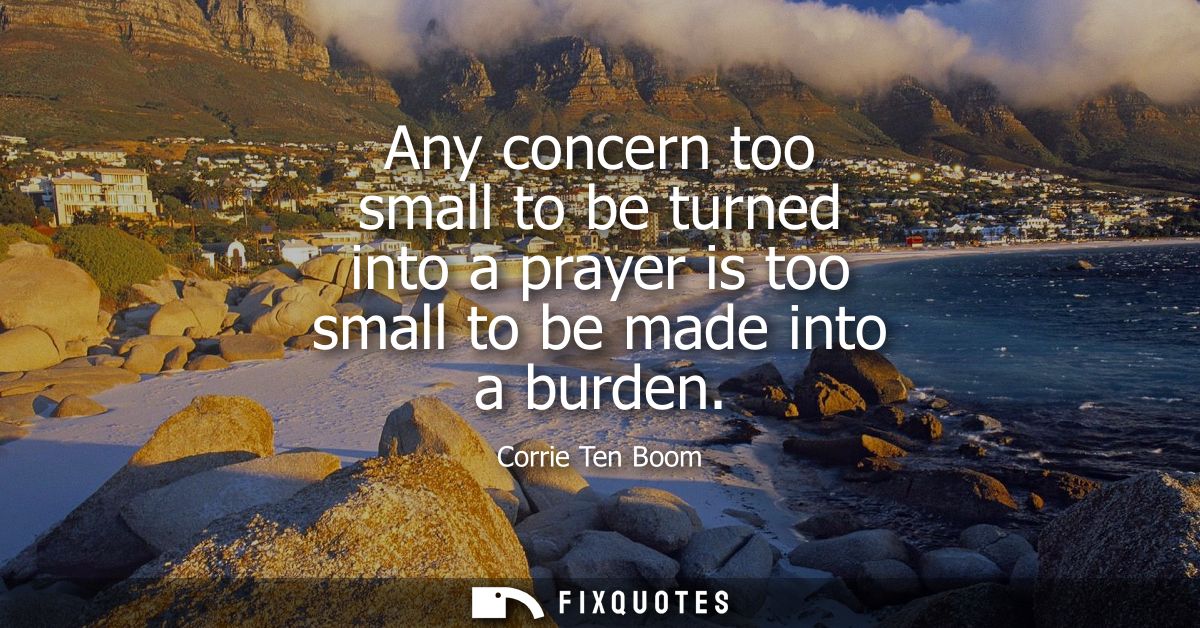
"Any concern too small to be turned into a prayer is too small to be made into a burden"
About this Quote
Ten Boom’s line isn’t trying to make your problems disappear; it’s trying to reassign where you store them. The phrasing is deliberately domestic: “concern,” “prayer,” “burden” are small, ordinary words, the vocabulary of someone who’s lived long enough to know anxiety rarely arrives as a single earthquake. It arrives as a thousand pebbles in your shoe. Her intent is a kind of triage for the soul: if something is genuinely too minor to warrant bringing into the intimate space of prayer, it has no business squatting in your mind as a weight you drag around all day.
The subtext is sharper than the gentle tone suggests. It draws a boundary between responsibility and rumination. Ten Boom isn’t dismissing the “small stuff”; she’s warning how easily small concerns metastasize when they’re nursed privately. Prayer, in her framing, is not a mystical vending machine but an act of externalization: naming the worry, placing it somewhere larger than the self, and refusing the self-image of the competent sufferer who handles everything silently.
Context matters because Ten Boom’s authority wasn’t produced by a stage persona; it was forged in extremity. A Dutch Christian who helped Jews escape the Nazis and survived Ravensbruck, she writes like someone for whom “burden” is not metaphor. That history tightens the line’s moral pressure: if she’s insisting on lightening the load, it’s because she knows what real weight feels like and how easily unnecessary suffering piggybacks on necessary pain.
The subtext is sharper than the gentle tone suggests. It draws a boundary between responsibility and rumination. Ten Boom isn’t dismissing the “small stuff”; she’s warning how easily small concerns metastasize when they’re nursed privately. Prayer, in her framing, is not a mystical vending machine but an act of externalization: naming the worry, placing it somewhere larger than the self, and refusing the self-image of the competent sufferer who handles everything silently.
Context matters because Ten Boom’s authority wasn’t produced by a stage persona; it was forged in extremity. A Dutch Christian who helped Jews escape the Nazis and survived Ravensbruck, she writes like someone for whom “burden” is not metaphor. That history tightens the line’s moral pressure: if she’s insisting on lightening the load, it’s because she knows what real weight feels like and how easily unnecessary suffering piggybacks on necessary pain.
Quote Details
| Topic | Prayer |
|---|
More Quotes by Corrie
Add to List