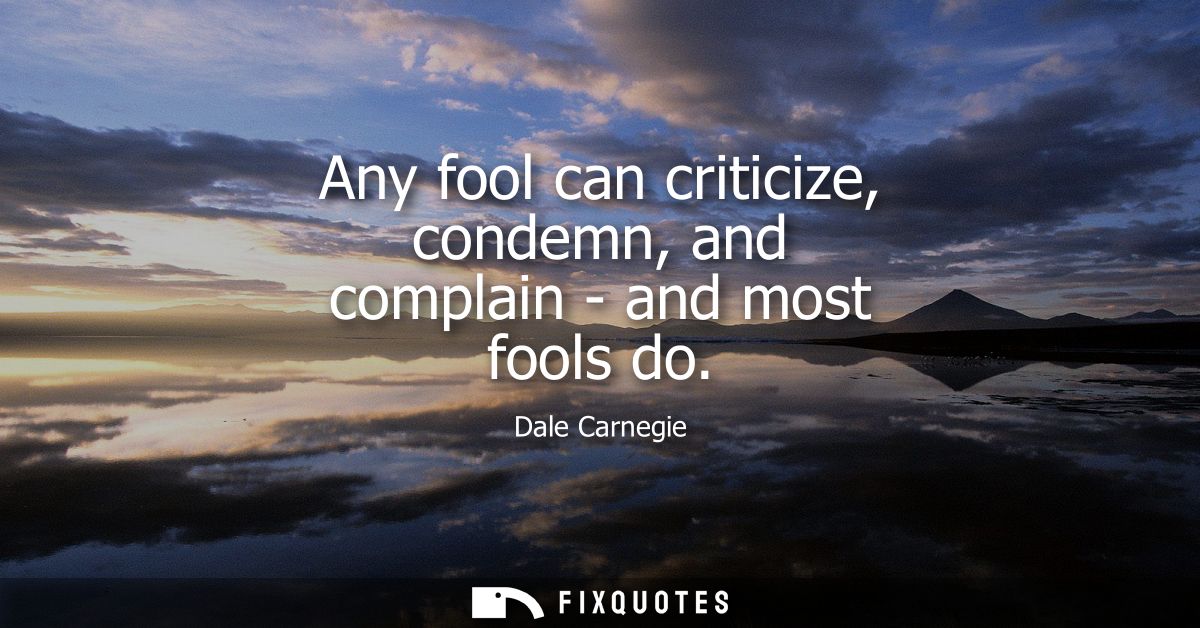
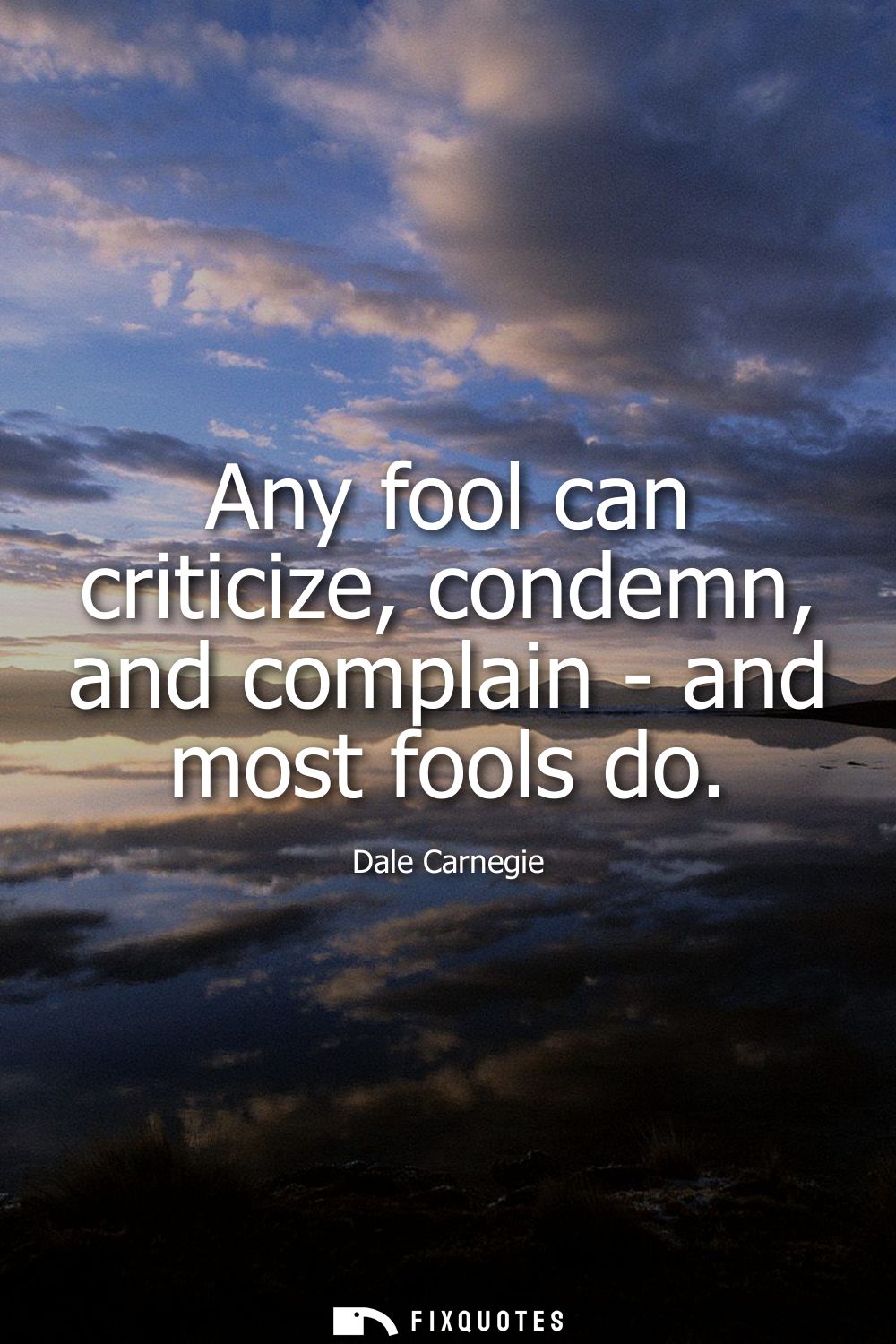
"Any fool can criticize, condemn, and complain - and most fools do"
About this Quote
Carnegie’s line lands like a polite slap: criticism isn’t proof of intelligence, it’s often proof of impulse. The dash does the heavy lifting. It swings from a tidy triad - “criticize, condemn, and complain” - into the punchline that exposes a social norm we’re meant to stop treating as sophistication. He’s not arguing that critique is always wrong; he’s demoting it from a badge of discernment to a default setting. You can almost hear the room Carnegie addressed: salesmen, managers, strivers in a jittery early-20th-century America where personal charm was becoming an economic tool.
The intent is behavioral, not philosophical. Carnegie, the patron saint of self-improvement-as-social strategy, is coaching people out of emotional reflex and into influence. Criticism is “easy” because it costs nothing upfront: no vulnerability, no responsibility, no solution. Condemnation adds moral theater; complaining adds communal bonding. Together, they form a cheap social currency - you can spend it anywhere and still feel rich.
The subtext is power. People criticize to claim altitude. Carnegie reframes that as low-status behavior, something “most fools” do, and in one stroke makes restraint aspirational. It’s an early diagnosis of what we’d now call outrage culture or comment-section bravado: condemnation as entertainment, complaint as identity.
Context matters: Carnegie wrote during a boom in corporate life and mass persuasion. His premise is pragmatic: if you want to move people, don’t start by making them defensive. The real flex is not having an opinion; it’s having the discipline to be constructive.
The intent is behavioral, not philosophical. Carnegie, the patron saint of self-improvement-as-social strategy, is coaching people out of emotional reflex and into influence. Criticism is “easy” because it costs nothing upfront: no vulnerability, no responsibility, no solution. Condemnation adds moral theater; complaining adds communal bonding. Together, they form a cheap social currency - you can spend it anywhere and still feel rich.
The subtext is power. People criticize to claim altitude. Carnegie reframes that as low-status behavior, something “most fools” do, and in one stroke makes restraint aspirational. It’s an early diagnosis of what we’d now call outrage culture or comment-section bravado: condemnation as entertainment, complaint as identity.
Context matters: Carnegie wrote during a boom in corporate life and mass persuasion. His premise is pragmatic: if you want to move people, don’t start by making them defensive. The real flex is not having an opinion; it’s having the discipline to be constructive.
Quote Details
| Topic | Wisdom |
|---|---|
| Source | Help us find the source |
| Cite |
Citation Formats
APA Style (7th ed.)
Carnegie, Dale. (2026, January 17). Any fool can criticize, condemn, and complain - and most fools do. FixQuotes. https://fixquotes.com/quotes/any-fool-can-criticize-condemn-and-complain-and-30681/
Chicago Style
Carnegie, Dale. "Any fool can criticize, condemn, and complain - and most fools do." FixQuotes. January 17, 2026. https://fixquotes.com/quotes/any-fool-can-criticize-condemn-and-complain-and-30681/.
MLA Style (9th ed.)
"Any fool can criticize, condemn, and complain - and most fools do." FixQuotes, 17 Jan. 2026, https://fixquotes.com/quotes/any-fool-can-criticize-condemn-and-complain-and-30681/. Accessed 12 Mar. 2026.
More Quotes by Dale
Add to List