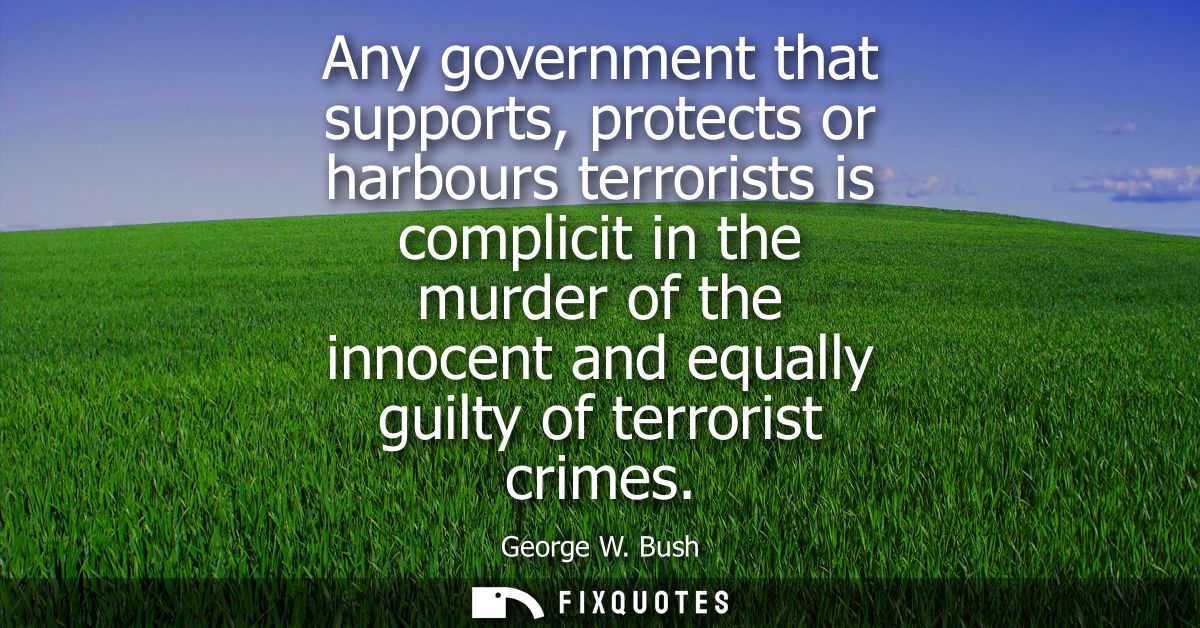
"Any government that supports, protects or harbours terrorists is complicit in the murder of the innocent and equally guilty of terrorist crimes"
About this Quote
The specific intent was to create a doctrine-ready standard after 9/11, one that could justify pressure, sanctions, and ultimately military action against regimes deemed to be sheltering terrorist networks. By framing the issue as “the murder of the innocent,” Bush aligns U.S. policy with a universalized victimhood that is hard to contest without sounding monstrous. “Harbours” in particular does heavy lifting: it implies intent and welcome, not merely a failure of control.
The subtext is an ultimatum: pick a side, now. It signals that neutrality will be treated as hostility, and that evidentiary thresholds will be political as much as forensic. In the early War on Terror context - Afghanistan, the Taliban’s relationship to al-Qaeda, the broader push to reshape international norms - the quote functions as both warning and permission slip. It doesn’t just describe complicity; it manufactures it, widening the category of legitimate targets while moralizing the consequences.
Quote Details
| Topic | Justice |
|---|---|
| Source | Help us find the source |
| Cite |
Citation Formats
APA Style (7th ed.)
Bush, George W. (2026, January 18). Any government that supports, protects or harbours terrorists is complicit in the murder of the innocent and equally guilty of terrorist crimes. FixQuotes. https://fixquotes.com/quotes/any-government-that-supports-protects-or-harbours-17789/
Chicago Style
Bush, George W. "Any government that supports, protects or harbours terrorists is complicit in the murder of the innocent and equally guilty of terrorist crimes." FixQuotes. January 18, 2026. https://fixquotes.com/quotes/any-government-that-supports-protects-or-harbours-17789/.
MLA Style (9th ed.)
"Any government that supports, protects or harbours terrorists is complicit in the murder of the innocent and equally guilty of terrorist crimes." FixQuotes, 18 Jan. 2026, https://fixquotes.com/quotes/any-government-that-supports-protects-or-harbours-17789/. Accessed 12 Feb. 2026.