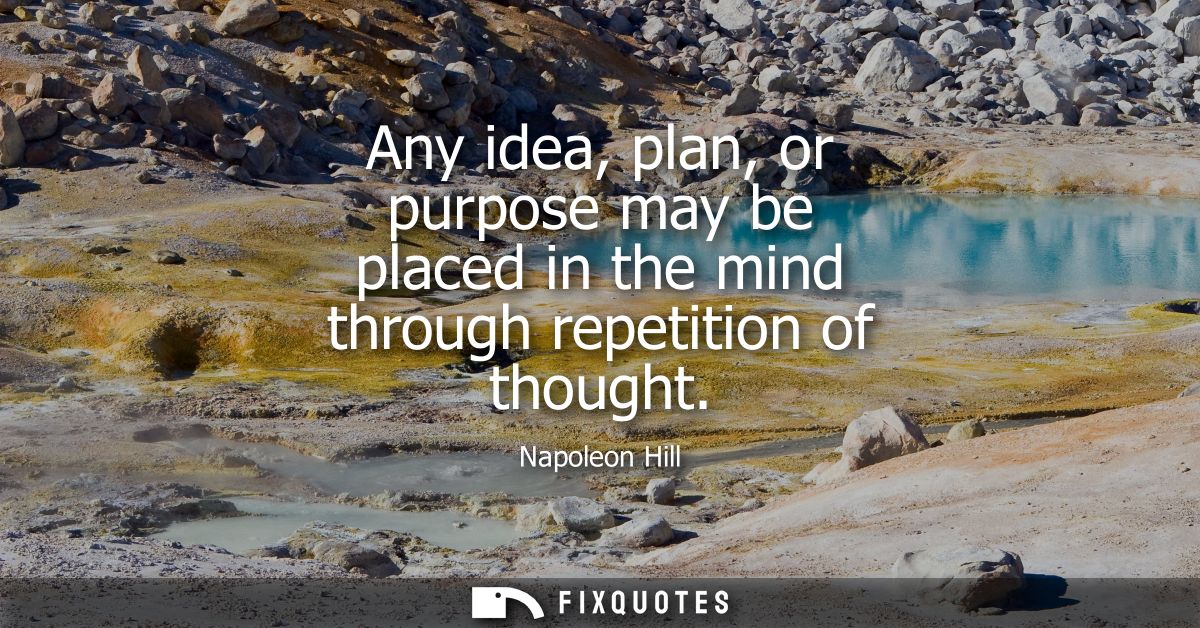
"Any idea, plan, or purpose may be placed in the mind through repetition of thought"
About this Quote
Hill’s line is an infomercial for the mind, packaged as a spiritual truth: keep saying something to yourself and it will move in, rearrange the furniture, and start paying rent. The phrasing is deliberately broad - “any idea, plan, or purpose” - which gives the promise its seductive reach. It’s not just about forming habits; it’s about importing destiny. “May be placed” even dodges responsibility. No messy struggle, no structural limits, no bad luck; just a mechanism. Repeat, install, proceed.
The subtext is pure early-20th-century self-help capitalism: you are both the factory and the product. In Hill’s world, success isn’t negotiated with institutions or circumstance; it’s engineered internally, then projected outward. That’s why repetition matters here less as psychology than as moral discipline. If you fail, the implication goes, you didn’t keep the thought on a tight enough loop.
Context helps explain the confidence. Hill rose during an era obsessed with efficiency, salesmanship, and “scientific” personal improvement - a period when advertising learned how to manufacture desire through repeated exposure. His claim borrows that logic and turns it inward: the mind becomes its own billboard.
It “works” rhetorically because it offers agency without complexity. It’s empowering in the way a slogan is empowering: small enough to carry, sharp enough to motivate, vague enough to survive contact with reality. It’s also a quiet warning. If repetition can plant “any” purpose, then other people - employers, politicians, media - are planting, too.
The subtext is pure early-20th-century self-help capitalism: you are both the factory and the product. In Hill’s world, success isn’t negotiated with institutions or circumstance; it’s engineered internally, then projected outward. That’s why repetition matters here less as psychology than as moral discipline. If you fail, the implication goes, you didn’t keep the thought on a tight enough loop.
Context helps explain the confidence. Hill rose during an era obsessed with efficiency, salesmanship, and “scientific” personal improvement - a period when advertising learned how to manufacture desire through repeated exposure. His claim borrows that logic and turns it inward: the mind becomes its own billboard.
It “works” rhetorically because it offers agency without complexity. It’s empowering in the way a slogan is empowering: small enough to carry, sharp enough to motivate, vague enough to survive contact with reality. It’s also a quiet warning. If repetition can plant “any” purpose, then other people - employers, politicians, media - are planting, too.
Quote Details
| Topic | Motivational |
|---|
More Quotes by Napoleon
Add to List