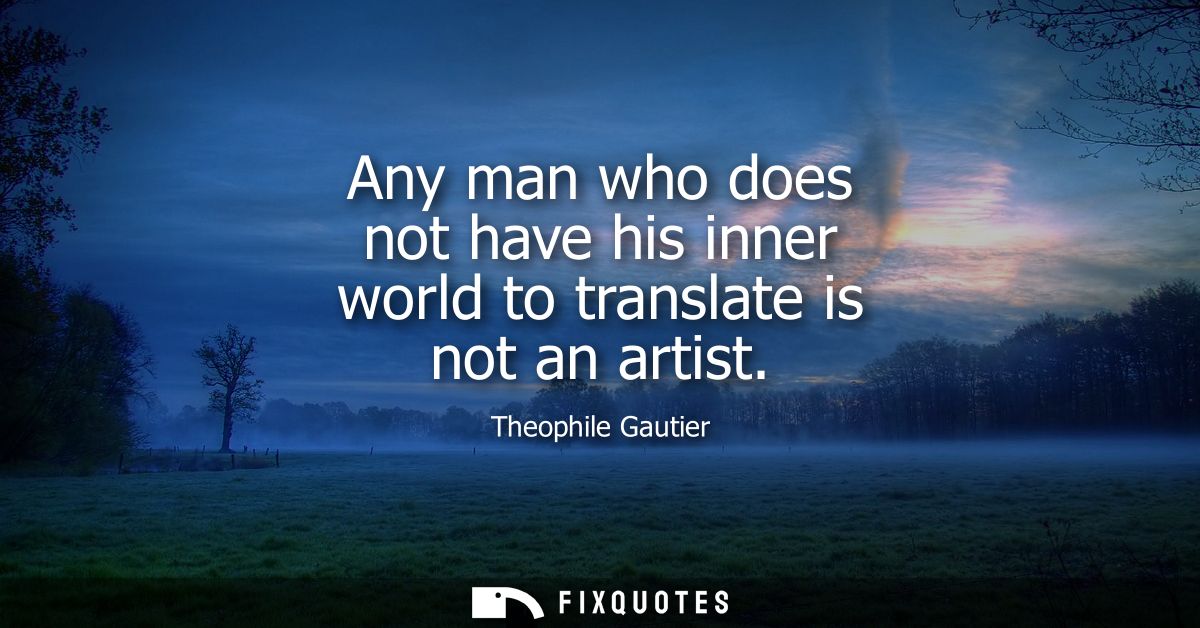
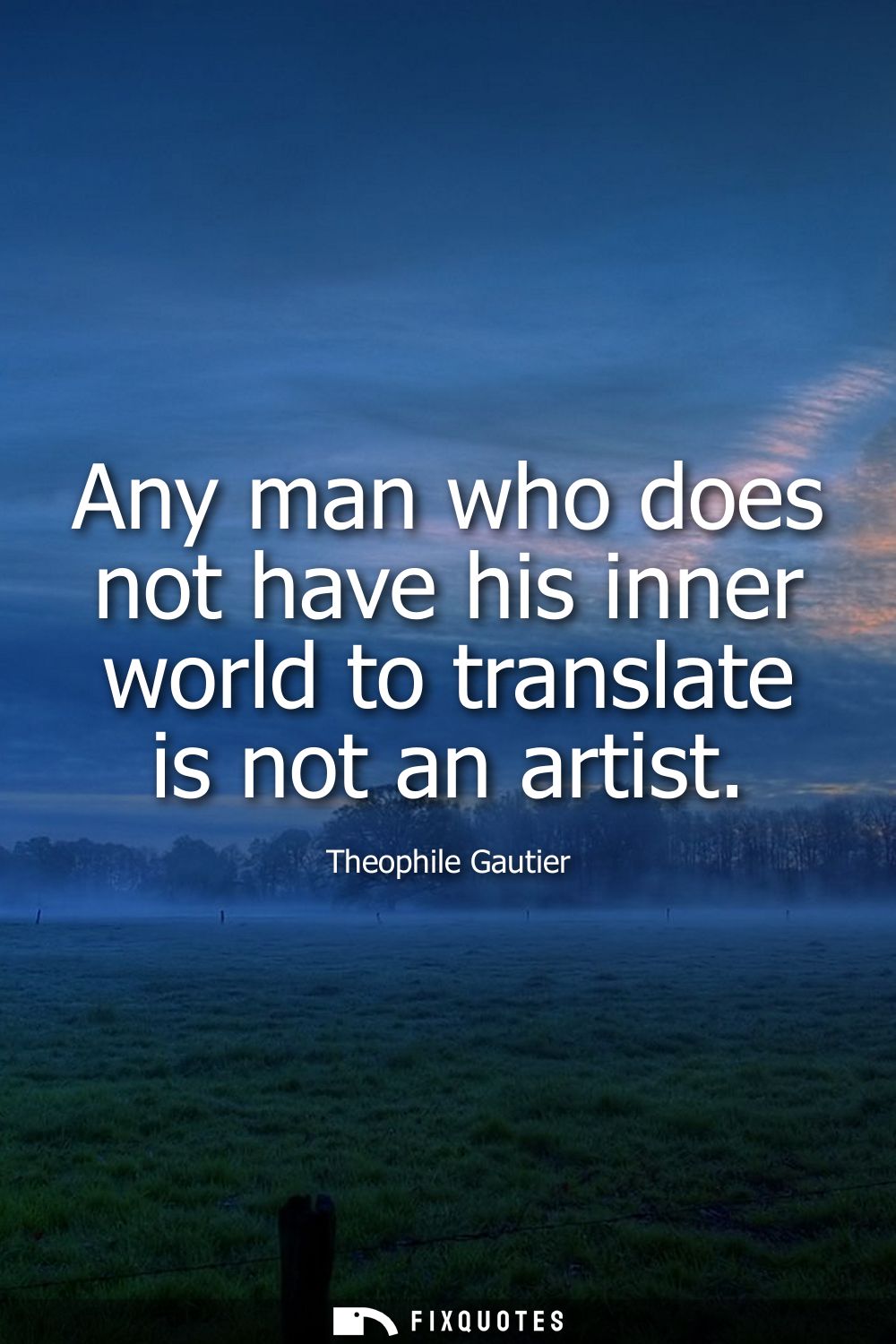
"Any man who does not have his inner world to translate is not an artist"
About this Quote
The intent carries the signature confidence of 19th-century aestheticism, Gautier’s “art for art’s sake” posture against the era’s moralizing and utilitarian demands. In a France hungry for political literature and social instruction, he insists that the artist’s authority comes from imaginative sovereignty, not civic usefulness. The subtext is quietly elitist but also protective: art isn’t a megaphone for slogans or a mirror held up to whatever the crowd already believes. It’s an act of refinement, where the interior life is the raw material and the medium is the discipline that makes it shareable.
There’s also a warning embedded in the gendered “Any man”: the artist who merely copies surfaces, imitates fashion, or performs competence is a technician of appearances. Gautier’s artist, by contrast, must have something irreducible to report from inside, and the seriousness lies in the verb. Translation can fail. That risk is the point.
Quote Details
| Topic | Art |
|---|---|
| Source | Help us find the source |
| Cite |
Citation Formats
APA Style (7th ed.)
Gautier, Theophile. (2026, January 15). Any man who does not have his inner world to translate is not an artist. FixQuotes. https://fixquotes.com/quotes/any-man-who-does-not-have-his-inner-world-to-89554/
Chicago Style
Gautier, Theophile. "Any man who does not have his inner world to translate is not an artist." FixQuotes. January 15, 2026. https://fixquotes.com/quotes/any-man-who-does-not-have-his-inner-world-to-89554/.
MLA Style (9th ed.)
"Any man who does not have his inner world to translate is not an artist." FixQuotes, 15 Jan. 2026, https://fixquotes.com/quotes/any-man-who-does-not-have-his-inner-world-to-89554/. Accessed 12 Feb. 2026.