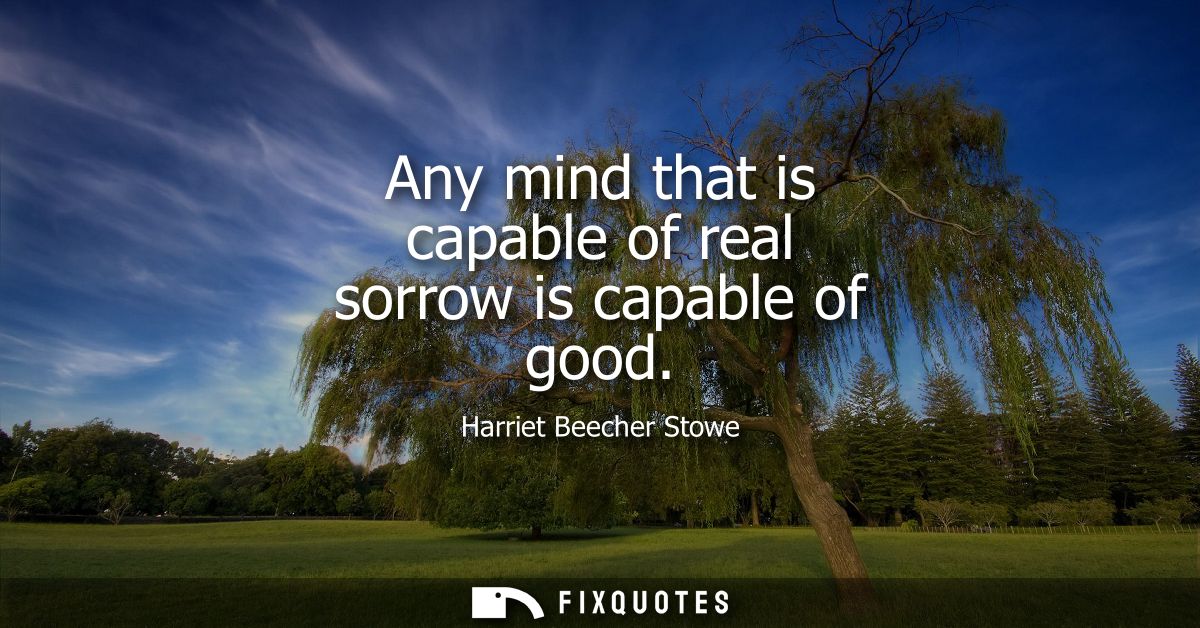
"Any mind that is capable of real sorrow is capable of good"
About this Quote
Stowe links morality to vulnerability, not virtue-signaling. “Any mind that is capable of real sorrow” isn’t sentimental wallpaper; it’s a litmus test. Real sorrow implies an imagination strong enough to cross the border of the self: you can feel the cost of what happens to other people, not as spectacle, but as injury. That capacity is exactly what slavery, in Stowe’s era, depended on suppressing - in the enslaved, through terror; in the comfortable, through denial.
The phrasing is strategic. “Any mind” widens the net, pushing against the convenient belief that some people are simply “made” for suffering or immune to it. “Capable” matters too: she’s not praising constant weeping, she’s identifying a latent moral instrument. Sorrow becomes evidence of an intact conscience, a sign that cruelty hasn’t fully calcified someone from the inside.
The subtext is almost prosecutorial. If you can read about brutality and feel nothing, the problem isn’t a lack of information; it’s a damaged moral sensorium. Stowe’s abolitionist project relied on that premise. Uncle Tom’s Cabin aimed to force “real sorrow” in Northern readers - not to win a debate, but to trigger the kind of discomfort that makes complicity harder to live with.
There’s also a quiet challenge here: sorrow is not the endpoint. It’s the doorway. Feeling pain doesn’t automatically produce justice, but Stowe argues it creates the conditions for it - the emotional readiness to choose good when good is costly.
The phrasing is strategic. “Any mind” widens the net, pushing against the convenient belief that some people are simply “made” for suffering or immune to it. “Capable” matters too: she’s not praising constant weeping, she’s identifying a latent moral instrument. Sorrow becomes evidence of an intact conscience, a sign that cruelty hasn’t fully calcified someone from the inside.
The subtext is almost prosecutorial. If you can read about brutality and feel nothing, the problem isn’t a lack of information; it’s a damaged moral sensorium. Stowe’s abolitionist project relied on that premise. Uncle Tom’s Cabin aimed to force “real sorrow” in Northern readers - not to win a debate, but to trigger the kind of discomfort that makes complicity harder to live with.
There’s also a quiet challenge here: sorrow is not the endpoint. It’s the doorway. Feeling pain doesn’t automatically produce justice, but Stowe argues it creates the conditions for it - the emotional readiness to choose good when good is costly.
Quote Details
| Topic | Kindness |
|---|---|
| Source | Help us find the source |
| Cite |
Citation Formats
APA Style (7th ed.)
Stowe, Harriet Beecher. (2026, January 14). Any mind that is capable of real sorrow is capable of good. FixQuotes. https://fixquotes.com/quotes/any-mind-that-is-capable-of-real-sorrow-is-105347/
Chicago Style
Stowe, Harriet Beecher. "Any mind that is capable of real sorrow is capable of good." FixQuotes. January 14, 2026. https://fixquotes.com/quotes/any-mind-that-is-capable-of-real-sorrow-is-105347/.
MLA Style (9th ed.)
"Any mind that is capable of real sorrow is capable of good." FixQuotes, 14 Jan. 2026, https://fixquotes.com/quotes/any-mind-that-is-capable-of-real-sorrow-is-105347/. Accessed 3 Apr. 2026.
More Quotes by Harriet
Add to List