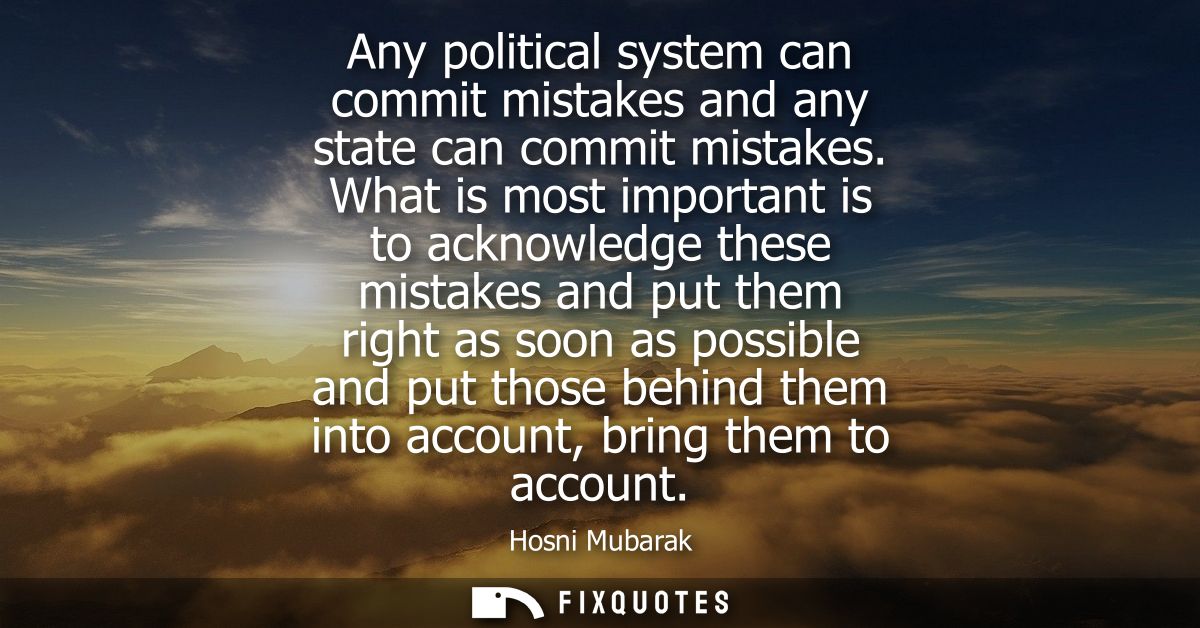
"Any political system can commit mistakes, and any state can commit mistakes. What is most important is to acknowledge these mistakes and put them right as soon as possible and put those behind them into account, bring them to account"
About this Quote
The rhetorical trick is the pivot from inevitability to virtue. If mistakes are universal, then the leader who “acknowledges” them becomes the mature adult in the room. Yet the sentence never identifies who must acknowledge them, who has the authority to “put them right,” or what “bring them to account” actually entails: courts, parliament, a free press, elections? In authoritarian contexts, accountability is often staged, selective, or aimed downward. The quote keeps those mechanisms conveniently abstract.
Context matters because Mubarak governed Egypt for nearly three decades under emergency laws that normalized arbitrary detention and narrowed political life. Read against that record, the statement sounds less like a commitment and more like reputational insurance: a democratic-sounding ethic that can be invoked whenever criticism mounts, without conceding structural wrongdoing. It’s the language of reform without the risk of reform, calibrated to satisfy international audiences and domestic moderates alike.
Its intent, then, is stabilizing: preserve the state’s legitimacy by admitting fallibility in theory while avoiding culpability in practice. The subtext is simple: trust the system - and, by extension, trust the man overseeing it - to correct itself.
Quote Details
| Topic | Justice |
|---|---|
| Source | Verified source: Mubarak Defies Resignation Anticipation, Protesters Pledg... (Hosni Mubarak, 2011)
Evidence:
Any political system can commit mistakes and any state can commit mistakes. What is most important is to acknowledge these mistakes and put them right as soon as possible and put those behind them to account, bring them to account.. The earliest primary-source match I found is Hosni Mubarak's televised speech to the Egyptian people on February 10, 2011, during the Egyptian uprising. PBS NewsHour's transcript attributes the line directly to 'HOSNI MUBARAK, Egyptian president (through translator).' A secondary contemporary source, Global News, also says its excerpts are from Mubarak's speech on Feb. 10, 2011 and includes a shortened version of the same line. I did not find evidence that this wording appeared earlier in a book, interview, or article by Mubarak. Because the accessible source is an English translation/transcript of a speech rather than the original Arabic text or an official Egyptian state transcript, confidence is medium rather than high. |
| Cite |
Citation Formats
APA Style (7th ed.)
Mubarak, Hosni. (2026, March 10). Any political system can commit mistakes, and any state can commit mistakes. What is most important is to acknowledge these mistakes and put them right as soon as possible and put those behind them into account, bring them to account. FixQuotes. https://fixquotes.com/quotes/any-political-system-can-commit-mistakes-and-any-144397/
Chicago Style
Mubarak, Hosni. "Any political system can commit mistakes, and any state can commit mistakes. What is most important is to acknowledge these mistakes and put them right as soon as possible and put those behind them into account, bring them to account." FixQuotes. March 10, 2026. https://fixquotes.com/quotes/any-political-system-can-commit-mistakes-and-any-144397/.
MLA Style (9th ed.)
"Any political system can commit mistakes, and any state can commit mistakes. What is most important is to acknowledge these mistakes and put them right as soon as possible and put those behind them into account, bring them to account." FixQuotes, 10 Mar. 2026, https://fixquotes.com/quotes/any-political-system-can-commit-mistakes-and-any-144397/. Accessed 24 Mar. 2026.