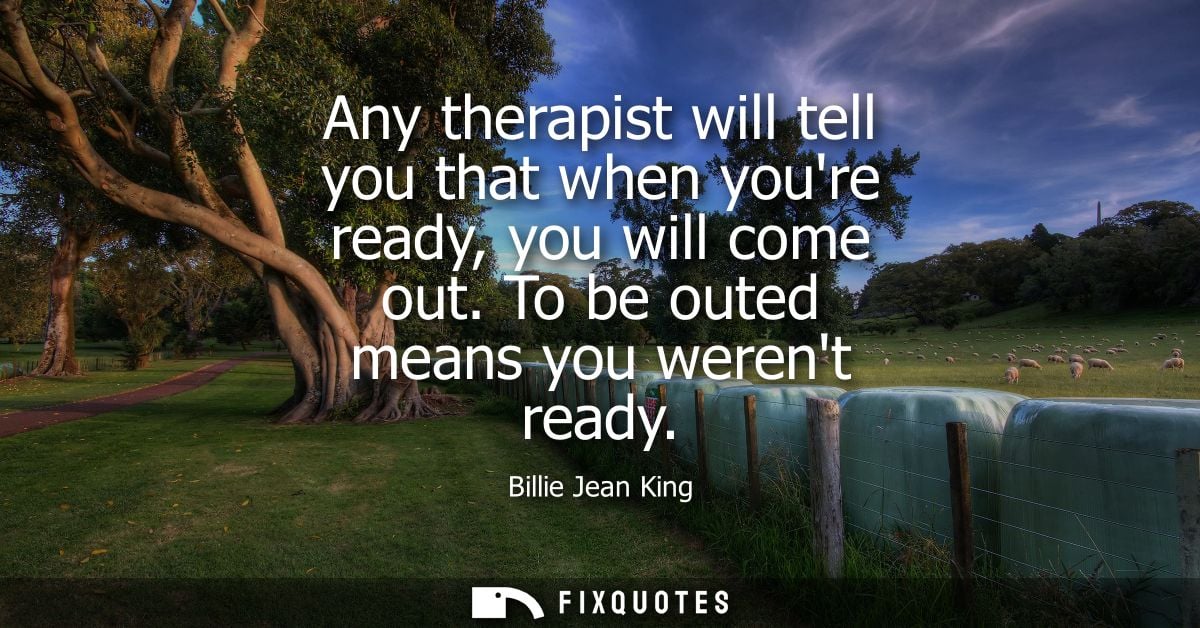
"Any therapist will tell you that when you're ready, you will come out. To be outed means you weren't ready"
About this Quote
The second sentence does the real work. “To be outed means you weren’t ready” is blunt, almost contractual: outing is defined as a violation. There’s no romanticizing visibility, no neat arc where exposure automatically equals liberation. King separates “being out” (self-authored, chosen) from “being outed” (imposed, extracted). The subtext is consent: identity is not communal property, and access to it is not earned by curiosity, activism, or even the belief that visibility helps the cause.
Context matters because King didn’t theorize this from the stands. As a gay icon who was outed in 1981, she experienced how public disclosure can be weaponized - through tabloid economics, sponsorship panic, and the punitive morality of sports culture. The quote is also a corrective to a certain activist impatience: the well-meaning pressure that treats closet doors as obstacles to be kicked down. King’s point is harder and more compassionate: safety isn’t symbolic, and autonomy is the first win.
Quote Details
| Topic | Confidence |
|---|---|
| Source | Help us find the source |
| Cite |
Citation Formats
APA Style (7th ed.)
King, Billie Jean. (2026, January 17). Any therapist will tell you that when you're ready, you will come out. To be outed means you weren't ready. FixQuotes. https://fixquotes.com/quotes/any-therapist-will-tell-you-that-when-youre-ready-43942/
Chicago Style
King, Billie Jean. "Any therapist will tell you that when you're ready, you will come out. To be outed means you weren't ready." FixQuotes. January 17, 2026. https://fixquotes.com/quotes/any-therapist-will-tell-you-that-when-youre-ready-43942/.
MLA Style (9th ed.)
"Any therapist will tell you that when you're ready, you will come out. To be outed means you weren't ready." FixQuotes, 17 Jan. 2026, https://fixquotes.com/quotes/any-therapist-will-tell-you-that-when-youre-ready-43942/. Accessed 12 Feb. 2026.