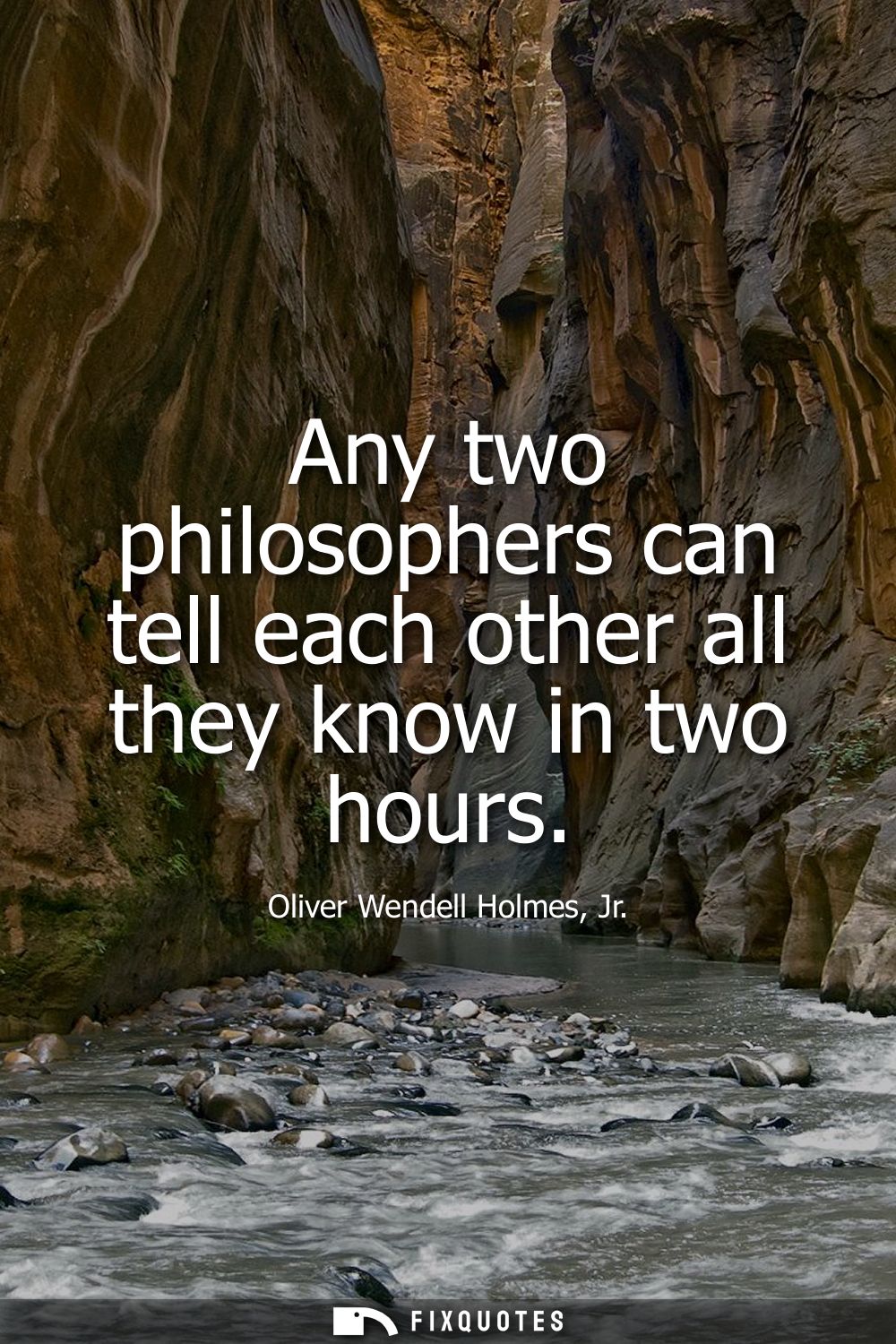
"Any two philosophers can tell each other all they know in two hours"
About this Quote
The line works because it compresses a courtroom lesson into a parlor jab. In law, the slow part isn't stating principles; it's applying them under pressure, in messy situations with real consequences. Holmes implies that abstract systems are fast to recite and easy to trade, while the hard-won knowledge lives elsewhere: in judgment, in experience, in the institutional grind of deciding what happens to other people. Two hours is the tell. It's not a serious estimate; it's a provocation meant to shrink philosophy down to something like a party trick.
Context matters: Holmes served on the Supreme Court during an era when American society was industrializing, stratifying, and litigating its way through modernity. In that world, metaphysical certainty looks like a luxury good. The subtext is a warning to intellectuals and reformers who want to route policy through first principles: ideas are cheap; consequences are not. Holmes isn't anti-thought. He's anti-overconfidence, especially the kind that arrives dressed as a system.
Quote Details
| Topic | Witty One-Liners |
|---|---|
| Source | Later attribution: Spice Up Your Speechifying (RAJJAN SHINGHAL, 2020) modern compilationISBN: 9789390011445 · ID: uzX8DwAAQBAJ
Evidence:
... Any two philosophers can tell each other all they know in two hours . Oliver Wendell Holmes , Jr ( 1841-1935 ) , American jurist . The American writer Henry Louis Mencken ( 1880-1956 ) observed , " Philosophy consists very largely of ... |
| Cite |
Citation Formats
APA Style (7th ed.)
Jr., Oliver Wendell Holmes. (2026, February 14). Any two philosophers can tell each other all they know in two hours. FixQuotes. https://fixquotes.com/quotes/any-two-philosophers-can-tell-each-other-all-they-90097/
Chicago Style
Jr., Oliver Wendell Holmes. "Any two philosophers can tell each other all they know in two hours." FixQuotes. February 14, 2026. https://fixquotes.com/quotes/any-two-philosophers-can-tell-each-other-all-they-90097/.
MLA Style (9th ed.)
"Any two philosophers can tell each other all they know in two hours." FixQuotes, 14 Feb. 2026, https://fixquotes.com/quotes/any-two-philosophers-can-tell-each-other-all-they-90097/. Accessed 21 Mar. 2026.