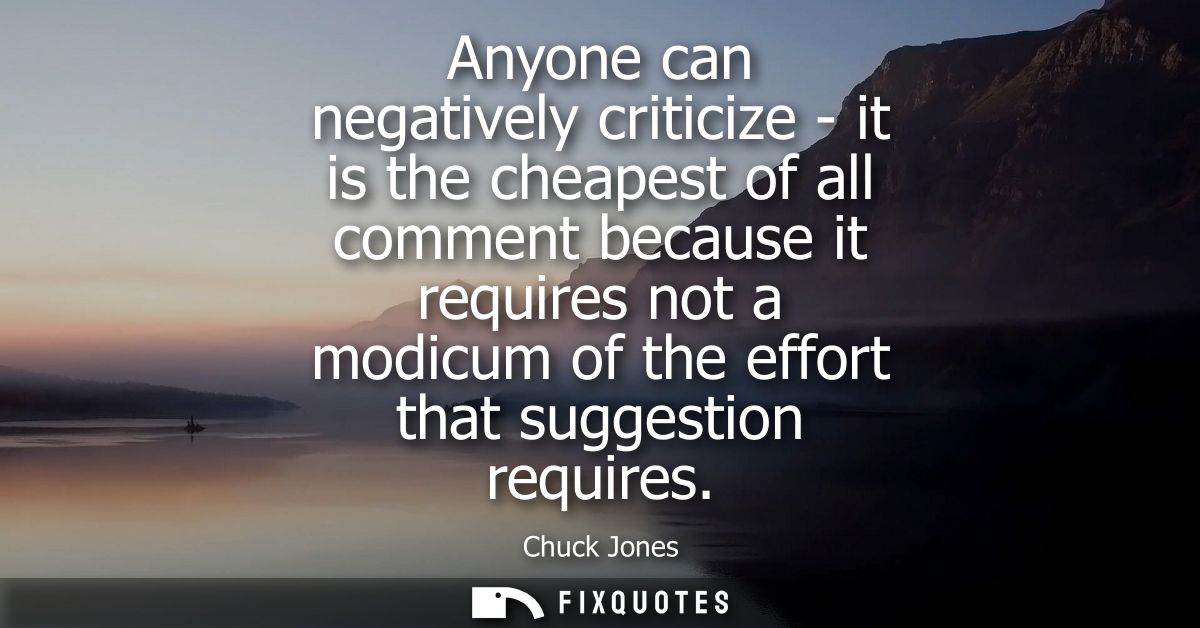
"Anyone can negatively criticize - it is the cheapest of all comment because it requires not a modicum of the effort that suggestion requires"
About this Quote
Chuck Jones, the legendary animator behind Bugs Bunny, Daffy Duck, and the Road Runner, draws a line between easy put-downs and the harder work of helping something improve. Negative criticism demands little: it can be tossed from the sidelines without understanding the problem, the constraints, or the intent. Suggestion, by contrast, forces the speaker to enter the arena. To offer a concrete alternative, you must grasp timing, character, budget, and audience; you must imagine a better gag, a different camera angle, a tighter beat. That intellectual and empathetic effort is the cost Jones calls for when he labels mere negativity the cheapest comment.
His career context gives the observation bite. At Warner Bros.’ Termite Terrace, films were built collaboratively through story conferences, boards, and relentless revision. A director like Jones had to coax the best from writers, layout artists, and animators. A remark such as That does not work stalled a meeting; a remark such as Cut four frames from the anticipation, then hold the eye dart pointed to a way forward. In that environment, criticism without suggestion wasted time and morale, while suggestion signaled shared responsibility for the outcome.
There is also a moral stance embedded here. Fault-finding is a status move that risks nothing. Proposing a fix risks being wrong. It requires humility, craft knowledge, and the willingness to be accountable. Jones often preached discipline and iteration, believing that growth comes through making and remaking. Suggestion fits that ethic because it participates in the making.
The distinction remains timely beyond animation. Online and in the workplace, hot takes are abundant precisely because they cost so little. The more scarce and valuable act is to pair judgment with a workable alternative. Jones’s standard asks us to earn the right to critique by doing the harder thing: contribute ideas that move the work ahead.
His career context gives the observation bite. At Warner Bros.’ Termite Terrace, films were built collaboratively through story conferences, boards, and relentless revision. A director like Jones had to coax the best from writers, layout artists, and animators. A remark such as That does not work stalled a meeting; a remark such as Cut four frames from the anticipation, then hold the eye dart pointed to a way forward. In that environment, criticism without suggestion wasted time and morale, while suggestion signaled shared responsibility for the outcome.
There is also a moral stance embedded here. Fault-finding is a status move that risks nothing. Proposing a fix risks being wrong. It requires humility, craft knowledge, and the willingness to be accountable. Jones often preached discipline and iteration, believing that growth comes through making and remaking. Suggestion fits that ethic because it participates in the making.
The distinction remains timely beyond animation. Online and in the workplace, hot takes are abundant precisely because they cost so little. The more scarce and valuable act is to pair judgment with a workable alternative. Jones’s standard asks us to earn the right to critique by doing the harder thing: contribute ideas that move the work ahead.
Quote Details
| Topic | Kindness |
|---|
More Quotes by Chuck
Add to List