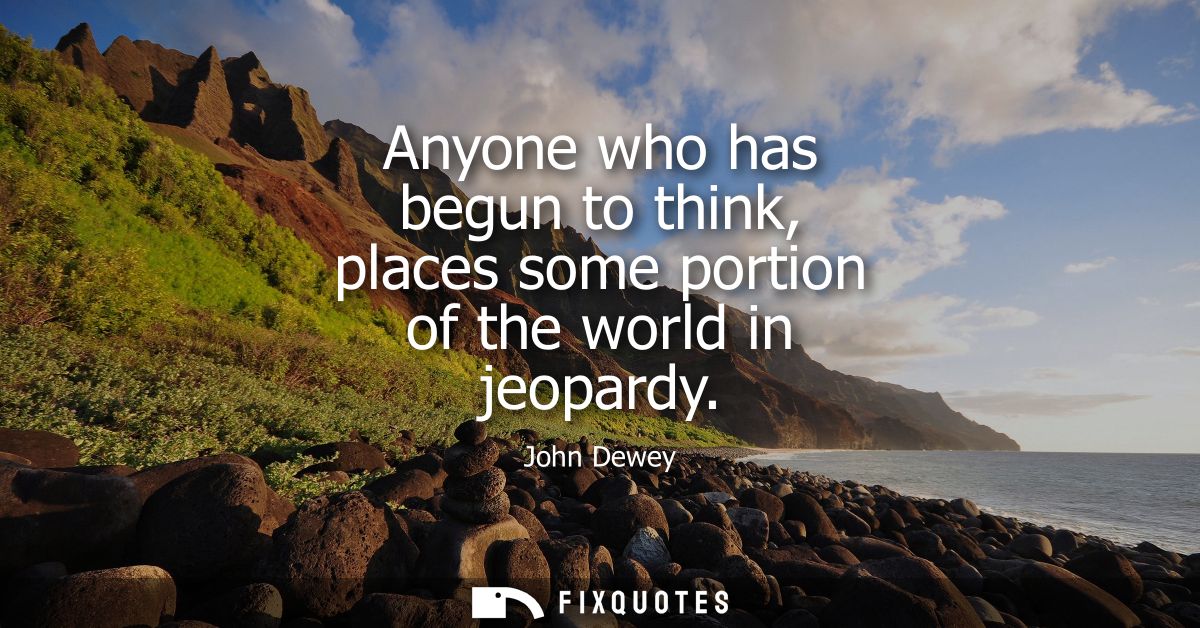
"Anyone who has begun to think, places some portion of the world in jeopardy"
About this Quote
Thinking, for Dewey, isn’t a private hobby; it’s a destabilizing force. “Jeopardy” is the tell. He’s not praising contemplation as a polite enrichment activity. He’s warning that the moment you start really thinking - testing assumptions, tracing consequences, asking who benefits - you put some chunk of the inherited order at risk. Customs depend on autopilot. Reflection interrupts the script.
The line carries Dewey’s core wager: societies run on habits, and habits don’t surrender willingly. To “begin to think” is to loosen the grip of tradition, family lore, patriotic catechisms, even the quiet tyrannies of “common sense.” That’s why the sentence is both moral and political. Dewey is smuggling in a theory of power: the world that feels natural is often the world that has won. Critical thought threatens winners first, which is why institutions so often try to domesticate it - turning education into credentialing, dissent into “civility,” curiosity into a multiple-choice skill.
Context matters. Dewey wrote as industrial capitalism reorganized daily life, as mass schooling expanded, as propaganda and public opinion became modern technologies. His pragmatism treats ideas as instruments: to think is to experiment, and experiments create losers as well as improvements. “Some portion of the world” is deliberately modest, almost wry. You won’t topple everything. You’ll just make one small certainty tremble - and that’s enough to start a chain reaction.
The line carries Dewey’s core wager: societies run on habits, and habits don’t surrender willingly. To “begin to think” is to loosen the grip of tradition, family lore, patriotic catechisms, even the quiet tyrannies of “common sense.” That’s why the sentence is both moral and political. Dewey is smuggling in a theory of power: the world that feels natural is often the world that has won. Critical thought threatens winners first, which is why institutions so often try to domesticate it - turning education into credentialing, dissent into “civility,” curiosity into a multiple-choice skill.
Context matters. Dewey wrote as industrial capitalism reorganized daily life, as mass schooling expanded, as propaganda and public opinion became modern technologies. His pragmatism treats ideas as instruments: to think is to experiment, and experiments create losers as well as improvements. “Some portion of the world” is deliberately modest, almost wry. You won’t topple everything. You’ll just make one small certainty tremble - and that’s enough to start a chain reaction.
Quote Details
| Topic | Deep |
|---|
More Quotes by John
Add to List