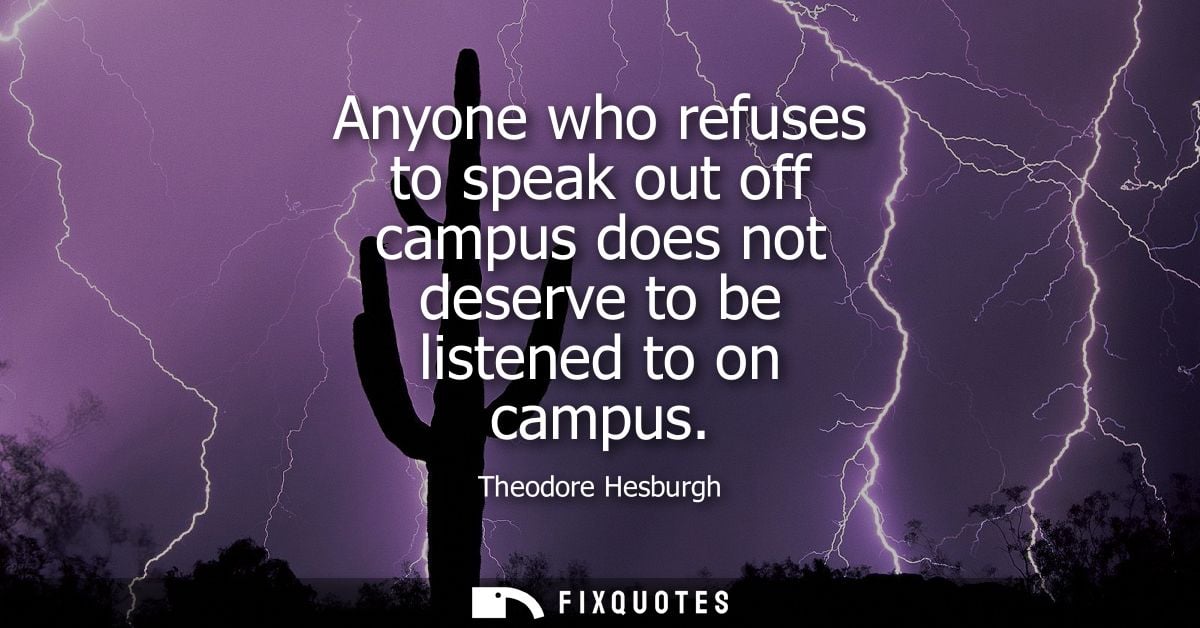
"Anyone who refuses to speak out off campus does not deserve to be listened to on campus"
About this Quote
The specific intent is disciplinary: to shame selective courage and to redefine what campus speech is for. In his frame, the university is not a retreat from the world but a training ground for it. If you cannot test your convictions where power pushes back, then your campus pronouncements are performance - applause without consequence.
The subtext is sharper. Hesburgh is also warning institutions against mistaking internal debate for impact. Universities love speech because it is measurable, schedulable, and safely branded. Off-campus speech is messy: it jeopardizes donors, invites backlash, complicates careers. That is exactly why he treats it as the real proof of seriousness.
Context matters: Hesburgh built his reputation during eras when speaking out carried tangible costs - civil rights, Vietnam, church politics. Read today, the quote doubles as a critique of social-media activism too: its not just about speaking loudly, but about showing up where your words can change conditions rather than just win arguments.
Quote Details
| Topic | Freedom |
|---|---|
| Source | Help us find the source |
| Cite |
Citation Formats
APA Style (7th ed.)
Hesburgh, Theodore. (2026, January 15). Anyone who refuses to speak out off campus does not deserve to be listened to on campus. FixQuotes. https://fixquotes.com/quotes/anyone-who-refuses-to-speak-out-off-campus-does-163255/
Chicago Style
Hesburgh, Theodore. "Anyone who refuses to speak out off campus does not deserve to be listened to on campus." FixQuotes. January 15, 2026. https://fixquotes.com/quotes/anyone-who-refuses-to-speak-out-off-campus-does-163255/.
MLA Style (9th ed.)
"Anyone who refuses to speak out off campus does not deserve to be listened to on campus." FixQuotes, 15 Jan. 2026, https://fixquotes.com/quotes/anyone-who-refuses-to-speak-out-off-campus-does-163255/. Accessed 21 Mar. 2026.