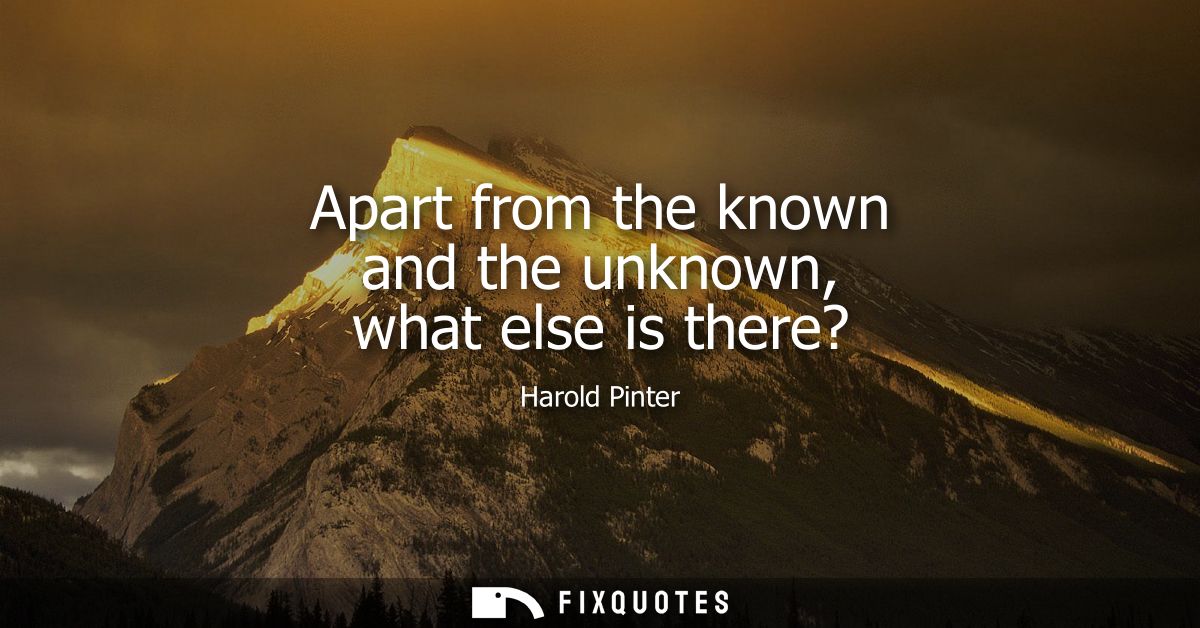
"Apart from the known and the unknown, what else is there?"
About this Quote
Pinter’s question lands like a deadpan heckle aimed at philosophy itself: you’ve sorted the world into “known” and “unknown,” so what exactly are you imagining lives outside that tidy pair? It’s a trapdoor of a line. On the surface it’s commonsense logic. Underneath, it’s Pinter’s signature menace: the suspicion that our categories are less about truth than about control.
As a playwright, Pinter spent a career staging how people use language to fence off uncertainty. His characters cling to facts, routines, and verbal tics not because they clarify reality, but because they keep the panic at bay. So the “intent” here isn’t to win a metaphysical argument; it’s to expose the emotional theater behind certainty. The joke is that the question sounds profound while also being aggressively anti-profound. It punctures the inflated tone of grand inquiry with a shrugging, almost comic literalism.
The subtext is political as much as existential. Pinter, especially in his later public life, was obsessed with what governments call “known” and how power manufactures “unknowns”: deniability, secrecy, plausible narratives that convert violence into paperwork. The line prods that machinery. If you insist everything is either known or unknown, you’ve left no room for the murky middle where most human experience actually sits: half-truths, suppressed knowledge, things everyone “knows” but cannot safely say.
It works because it weaponizes simplicity. The sentence is small, but it makes certainty feel embarrassing.
As a playwright, Pinter spent a career staging how people use language to fence off uncertainty. His characters cling to facts, routines, and verbal tics not because they clarify reality, but because they keep the panic at bay. So the “intent” here isn’t to win a metaphysical argument; it’s to expose the emotional theater behind certainty. The joke is that the question sounds profound while also being aggressively anti-profound. It punctures the inflated tone of grand inquiry with a shrugging, almost comic literalism.
The subtext is political as much as existential. Pinter, especially in his later public life, was obsessed with what governments call “known” and how power manufactures “unknowns”: deniability, secrecy, plausible narratives that convert violence into paperwork. The line prods that machinery. If you insist everything is either known or unknown, you’ve left no room for the murky middle where most human experience actually sits: half-truths, suppressed knowledge, things everyone “knows” but cannot safely say.
It works because it weaponizes simplicity. The sentence is small, but it makes certainty feel embarrassing.
Quote Details
| Topic | Deep |
|---|---|
| Source | Help us find the source |
| Cite |
Citation Formats
APA Style (7th ed.)
Pinter, Harold. (2026, January 17). Apart from the known and the unknown, what else is there? FixQuotes. https://fixquotes.com/quotes/apart-from-the-known-and-the-unknown-what-else-is-27712/
Chicago Style
Pinter, Harold. "Apart from the known and the unknown, what else is there?" FixQuotes. January 17, 2026. https://fixquotes.com/quotes/apart-from-the-known-and-the-unknown-what-else-is-27712/.
MLA Style (9th ed.)
"Apart from the known and the unknown, what else is there?" FixQuotes, 17 Jan. 2026, https://fixquotes.com/quotes/apart-from-the-known-and-the-unknown-what-else-is-27712/. Accessed 8 Apr. 2026.
More Quotes by Harold
Add to List