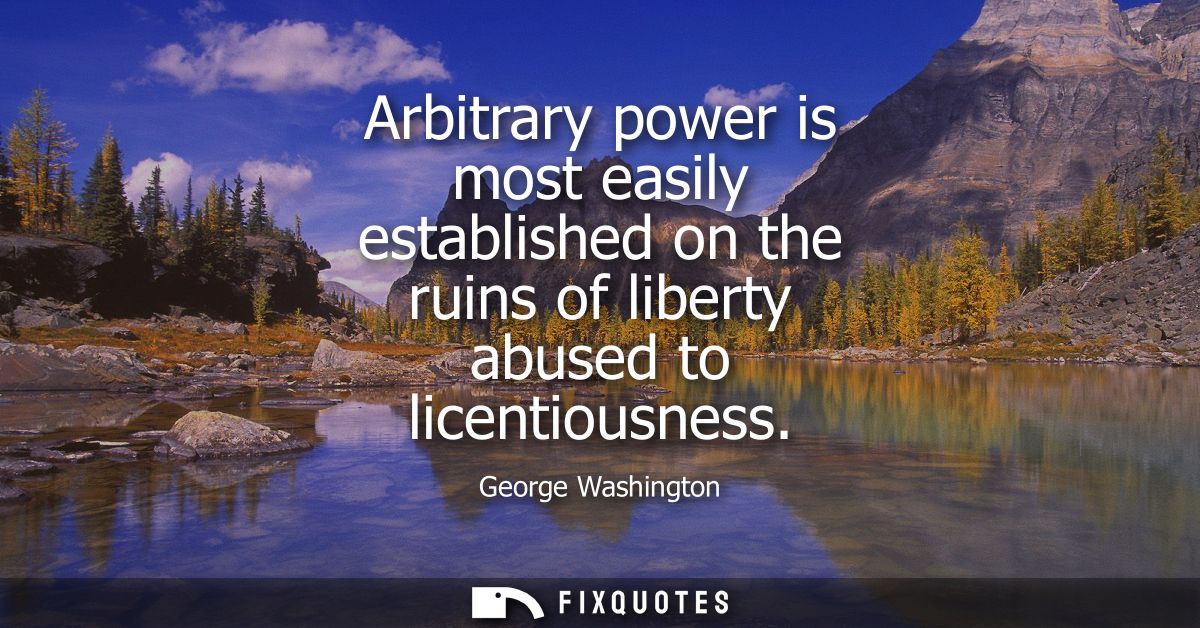
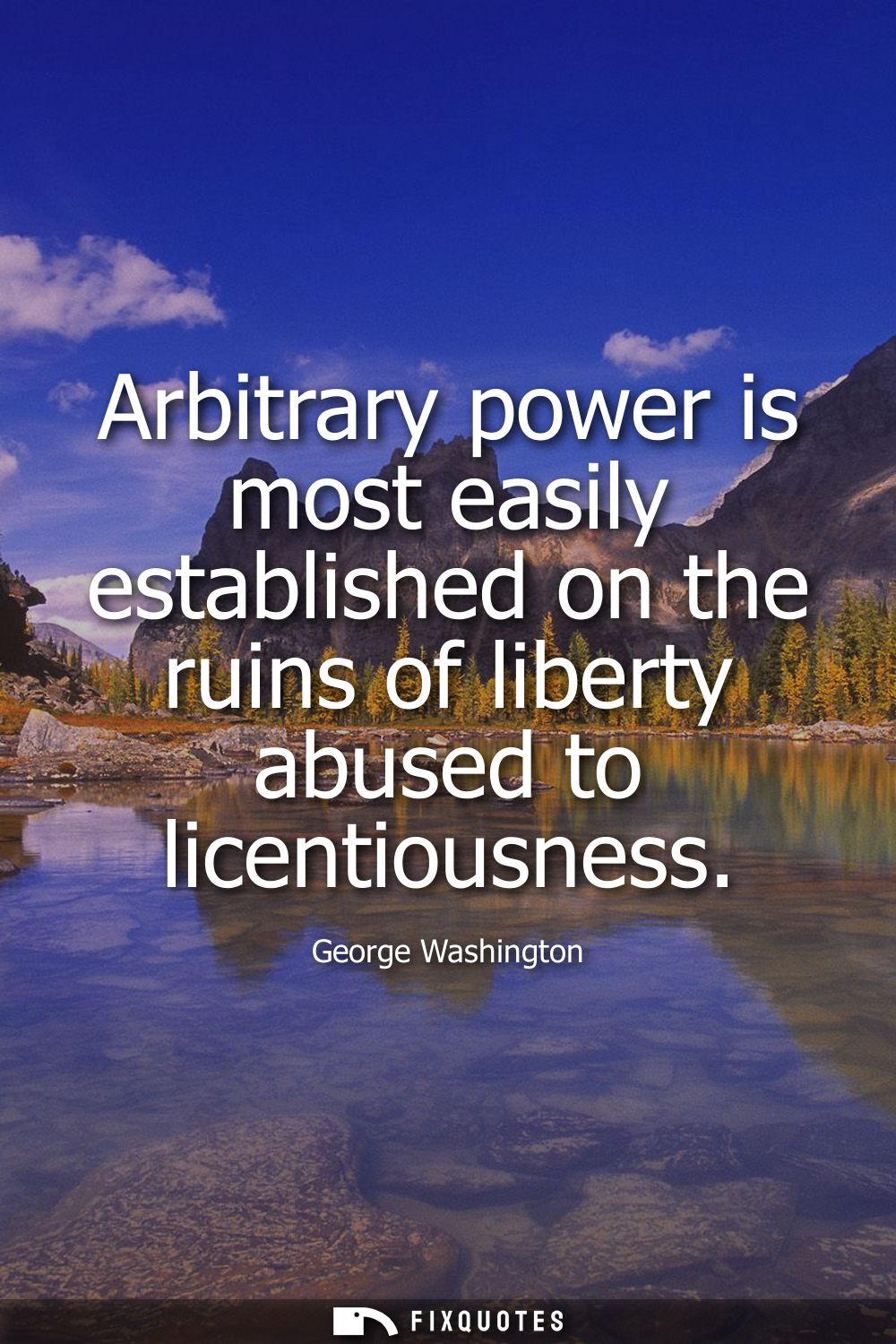
"Arbitrary power is most easily established on the ruins of liberty abused to licentiousness"
About this Quote
Washington warns that tyranny thrives not when people are free, but when freedom decays into indulgence and disorder. Arbitrary power describes authority that is unchecked by law or accountability. Licentiousness is liberty without responsibility, the idea that personal impulse outranks common standards. When a community confuses freedom with the license to do whatever one wants, the resulting chaos triggers fear, fatigue, and a longing for a strong hand. The paradox is that the abuse of liberty creates the very conditions that make liberty easiest to extinguish, because people will trade it for security.
This insight grew from the Founders broader republican outlook, which held that liberty rests on virtue, self-restraint, and the rule of law. Washington saw up close how fragile that balance can be. During the Newburgh crisis near the end of the Revolutionary War, angry officers, deprived of pay, flirted with insubordination. Washington appealed to their honor and to civilian authority, knowing that a military grab for power would destroy the republic just won. He reacted similarly to domestic uprisings like Shays Rebellion and later the Whiskey Rebellion: firm enough to uphold law, careful enough to avoid overreach. In the Farewell Address he warned that factional passion, vengeance, and zeal can erode institutions and invite despotism. The message is consistent: liberty without discipline slides toward anarchy, and anarchy invites a dictator.
History supplies examples from the fall of the Roman Republic to modern democracies strained by crisis. Public disorder paved the way for Caesars promises of order; economic collapse and street violence made Weimar Germany vulnerable to authoritarianism. The lesson is not to curtail freedom, but to anchor it. Healthy liberty lives alongside civic duty, respect for law, and institutions that channel conflict. A people capable of governing themselves leaves no ruins on which arbitrary power can be built.
This insight grew from the Founders broader republican outlook, which held that liberty rests on virtue, self-restraint, and the rule of law. Washington saw up close how fragile that balance can be. During the Newburgh crisis near the end of the Revolutionary War, angry officers, deprived of pay, flirted with insubordination. Washington appealed to their honor and to civilian authority, knowing that a military grab for power would destroy the republic just won. He reacted similarly to domestic uprisings like Shays Rebellion and later the Whiskey Rebellion: firm enough to uphold law, careful enough to avoid overreach. In the Farewell Address he warned that factional passion, vengeance, and zeal can erode institutions and invite despotism. The message is consistent: liberty without discipline slides toward anarchy, and anarchy invites a dictator.
History supplies examples from the fall of the Roman Republic to modern democracies strained by crisis. Public disorder paved the way for Caesars promises of order; economic collapse and street violence made Weimar Germany vulnerable to authoritarianism. The lesson is not to curtail freedom, but to anchor it. Healthy liberty lives alongside civic duty, respect for law, and institutions that channel conflict. A people capable of governing themselves leaves no ruins on which arbitrary power can be built.
Quote Details
| Topic | Freedom |
|---|
More Quotes by George
Add to List