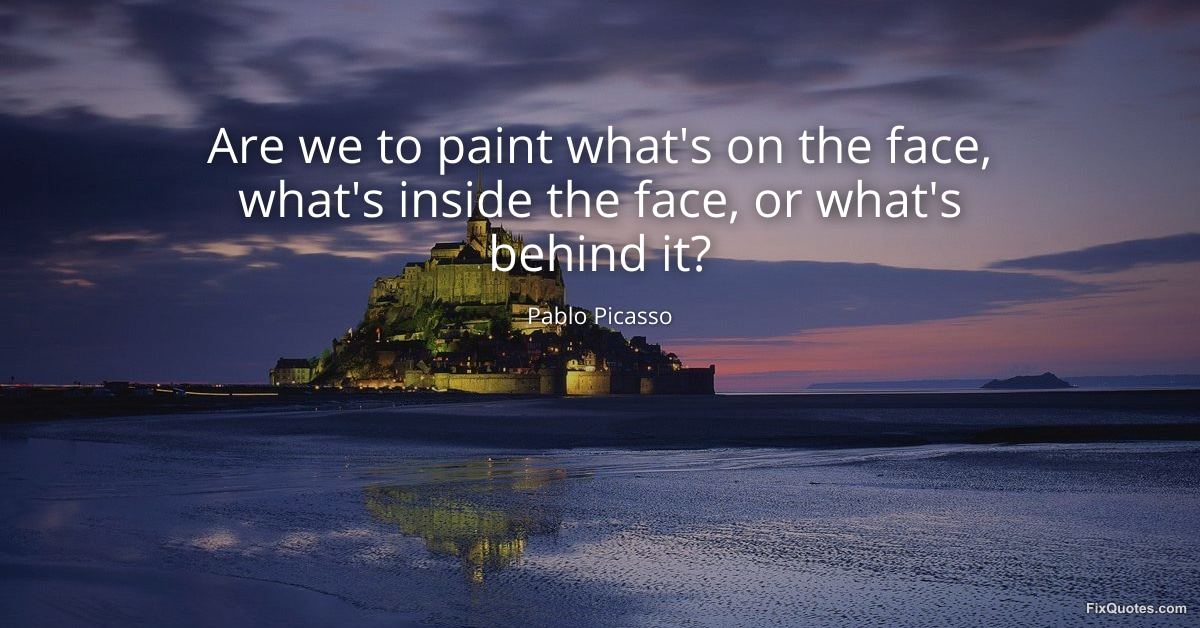
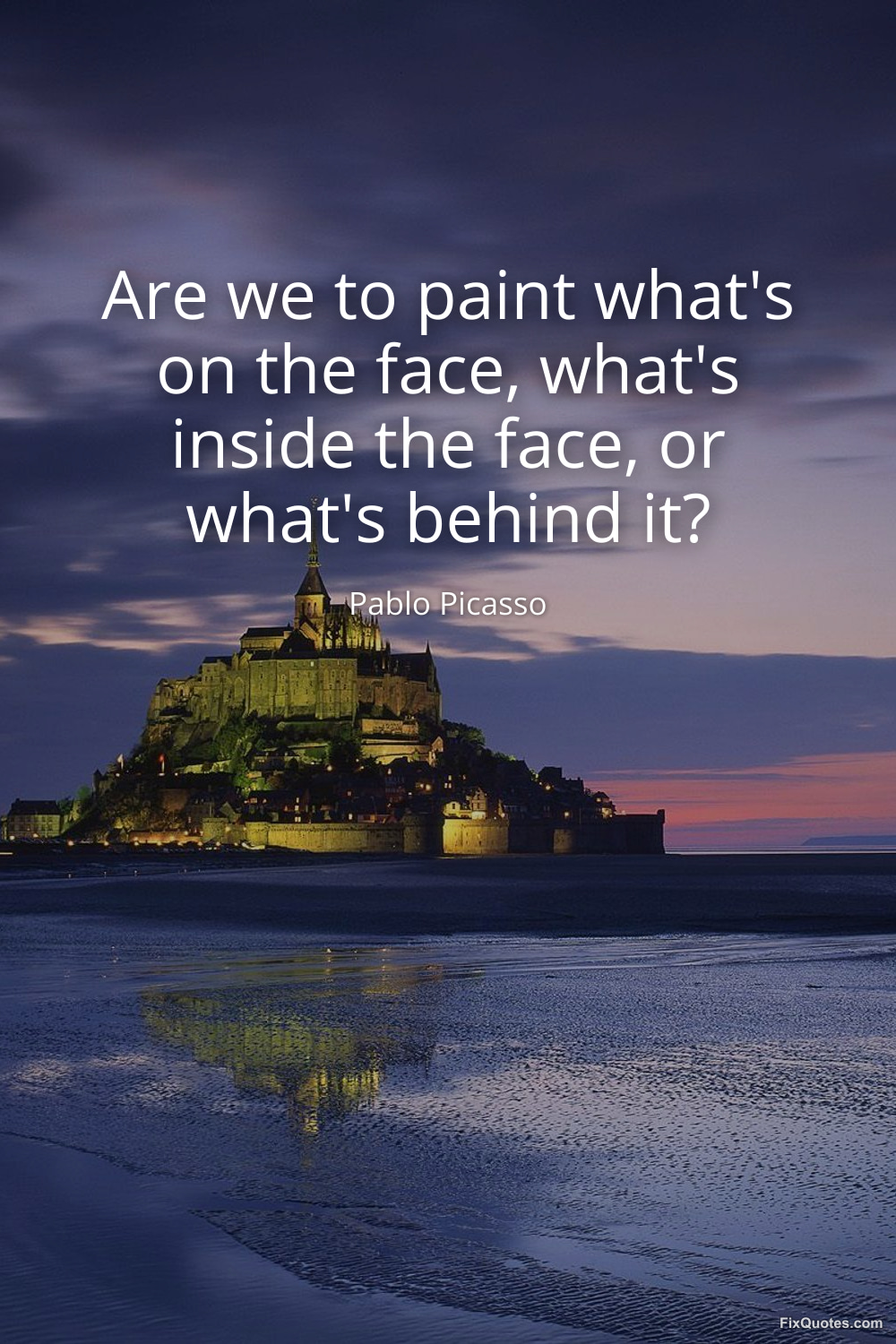
"Are we to paint what's on the face, what's inside the face, or what's behind it?"
About this Quote
It lands because it exposes how “realism” can be a kind of polite lie. A face is a social mask and a biological surface; it’s also an interface the world reads too quickly. Picasso’s question insists that representation is always an argument about what counts as truth. Cubism wasn’t just a style choice; it was a refusal to let a single angle pretend to be the whole. Multiple viewpoints, fractured planes, distorted proportions: those are visual methods for saying, “You don’t get to know someone in one look.”
The context is an era when photography could capture appearances with ruthless efficiency, forcing painters to justify their relevance. Picasso’s answer is implicit: the job of art isn’t to compete with the camera’s surface accuracy, but to make visible what the camera can’t verify - interiority, contradiction, the pressure of the unseen. The line reads like a challenge and a confession: every portrait is an attempt to paint a person and an admission that a person exceeds paint.
Quote Details
| Topic | Art |
|---|---|
| Source | Help us find the source |
| Cite |
Citation Formats
APA Style (7th ed.)
Picasso, Pablo. (2026, January 15). Are we to paint what's on the face, what's inside the face, or what's behind it? FixQuotes. https://fixquotes.com/quotes/are-we-to-paint-whats-on-the-face-whats-inside-14860/
Chicago Style
Picasso, Pablo. "Are we to paint what's on the face, what's inside the face, or what's behind it?" FixQuotes. January 15, 2026. https://fixquotes.com/quotes/are-we-to-paint-whats-on-the-face-whats-inside-14860/.
MLA Style (9th ed.)
"Are we to paint what's on the face, what's inside the face, or what's behind it?" FixQuotes, 15 Jan. 2026, https://fixquotes.com/quotes/are-we-to-paint-whats-on-the-face-whats-inside-14860/. Accessed 7 Apr. 2026.