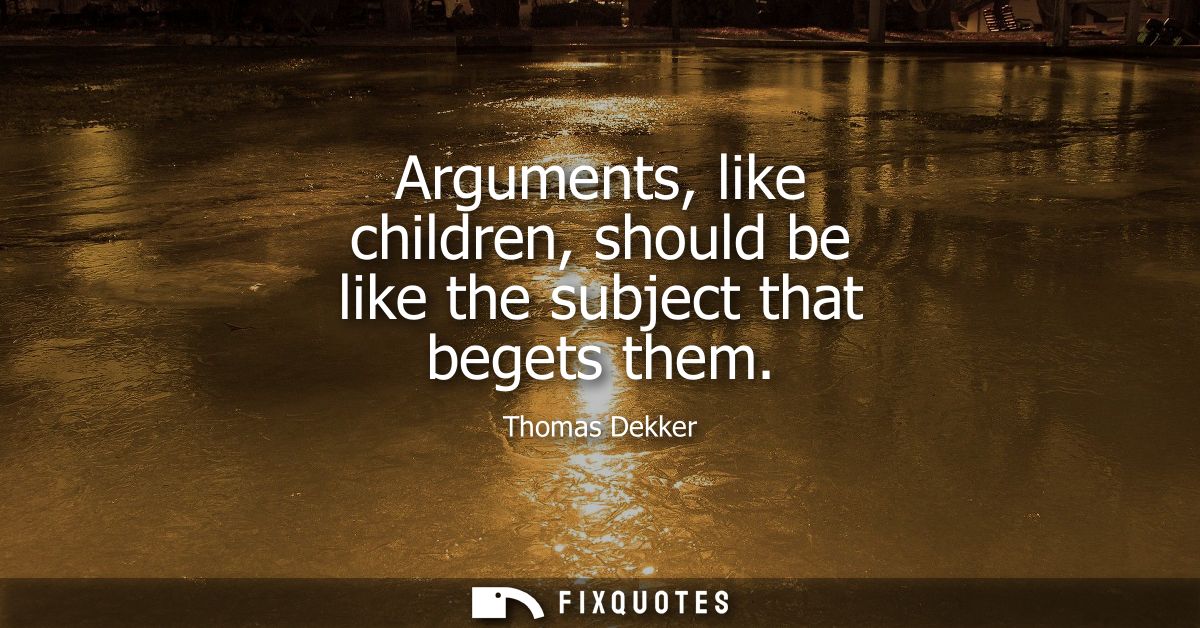
"Arguments, like children, should be like the subject that begets them"
About this Quote
Dekker turns a domestic image into a sly warning about bad thinking: an argument should resemble the subject that “begets” it, the way a child bears the marks of its parent. The line lands because it treats logic as lineage. If the topic is messy, the argument can be knotty; if the topic is small, the argument shouldn’t inflate itself into grand theory. What Dekker mocks is the rhetorical orphan: a clever speech unmoored from the matter at hand, all style and no legitimate parentage.
The phrase “like children” also carries a period-specific edge. Early modern London was obsessed with inheritance, legitimacy, and reputation; the wrong parentage could shadow a life. Dekker borrows that anxiety to police intellectual conduct. An argument that doesn’t “look like” its subject is implicitly illegitimate, maybe even a bastard of vanity, faction, or opportunism. It’s a jab at the courtroom trickster, the pulpit scold, the tavern sophist - anyone who can spin a case irrespective of facts.
As a dramatist working in a city loud with pamphlet wars and public disputation, Dekker knew how easily words detach from truth and become performance. The sentence is itself performative: a neat, memorable simile that enacts the discipline it recommends. No ornamental digressions, no imported outrage. Just a compact demand that rhetoric answer to its source.
The phrase “like children” also carries a period-specific edge. Early modern London was obsessed with inheritance, legitimacy, and reputation; the wrong parentage could shadow a life. Dekker borrows that anxiety to police intellectual conduct. An argument that doesn’t “look like” its subject is implicitly illegitimate, maybe even a bastard of vanity, faction, or opportunism. It’s a jab at the courtroom trickster, the pulpit scold, the tavern sophist - anyone who can spin a case irrespective of facts.
As a dramatist working in a city loud with pamphlet wars and public disputation, Dekker knew how easily words detach from truth and become performance. The sentence is itself performative: a neat, memorable simile that enacts the discipline it recommends. No ornamental digressions, no imported outrage. Just a compact demand that rhetoric answer to its source.
Quote Details
| Topic | Reason & Logic |
|---|---|
| Source | Help us find the source |
| Cite |
Citation Formats
APA Style (7th ed.)
Dekker, Thomas. (2026, January 17). Arguments, like children, should be like the subject that begets them. FixQuotes. https://fixquotes.com/quotes/arguments-like-children-should-be-like-the-27746/
Chicago Style
Dekker, Thomas. "Arguments, like children, should be like the subject that begets them." FixQuotes. January 17, 2026. https://fixquotes.com/quotes/arguments-like-children-should-be-like-the-27746/.
MLA Style (9th ed.)
"Arguments, like children, should be like the subject that begets them." FixQuotes, 17 Jan. 2026, https://fixquotes.com/quotes/arguments-like-children-should-be-like-the-27746/. Accessed 6 Mar. 2026.
More Quotes by Thomas
Add to List