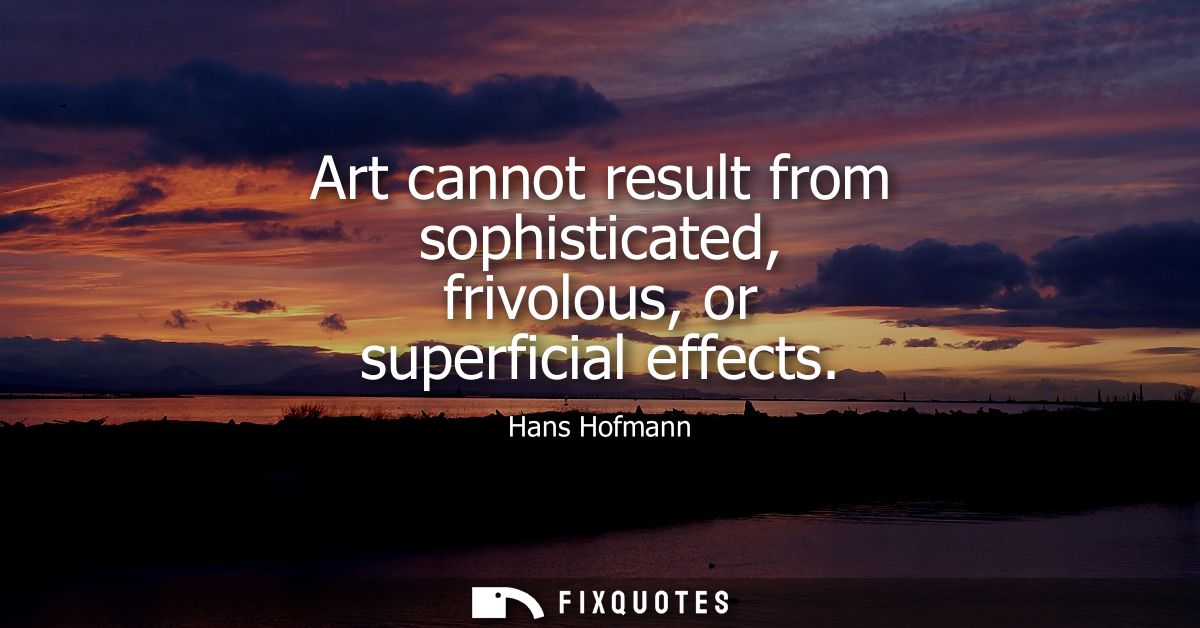
"Art cannot result from sophisticated, frivolous, or superficial effects"
About this Quote
The intent sits squarely in mid-century modernism’s fight against decoration and theatrical flourish. Hofmann, a bridge between European avant-garde ideas and American painting, taught at a moment when abstraction was being asked to prove it wasn’t just stylish pattern-making. His own “push-pull” theory emphasized real pictorial tension: forms and colors should create spatial energy that feels earned, not applied like a finish.
The subtext is pedagogical and combative: stop chasing effects that read as “advanced” and start building work from underlying structure, pressure, and risk. The word “result” matters; Hofmann isn’t banning technique, he’s arguing about causality. True art, for him, is an outcome of necessity - of grappling with materials, perception, and form - not the byproduct of cleverness or taste. It’s also a shot at the market’s seduction: sophistication sells, surfaces photograph well, novelty travels fast. Hofmann is insisting that what lasts isn’t what dazzles first, but what keeps generating meaning after the dazzle wears off.
Quote Details
| Topic | Art |
|---|---|
| Source | Help us find the source |
| Cite |
Citation Formats
APA Style (7th ed.)
Hofmann, Hans. (2026, January 17). Art cannot result from sophisticated, frivolous, or superficial effects. FixQuotes. https://fixquotes.com/quotes/art-cannot-result-from-sophisticated-frivolous-or-59456/
Chicago Style
Hofmann, Hans. "Art cannot result from sophisticated, frivolous, or superficial effects." FixQuotes. January 17, 2026. https://fixquotes.com/quotes/art-cannot-result-from-sophisticated-frivolous-or-59456/.
MLA Style (9th ed.)
"Art cannot result from sophisticated, frivolous, or superficial effects." FixQuotes, 17 Jan. 2026, https://fixquotes.com/quotes/art-cannot-result-from-sophisticated-frivolous-or-59456/. Accessed 30 Mar. 2026.