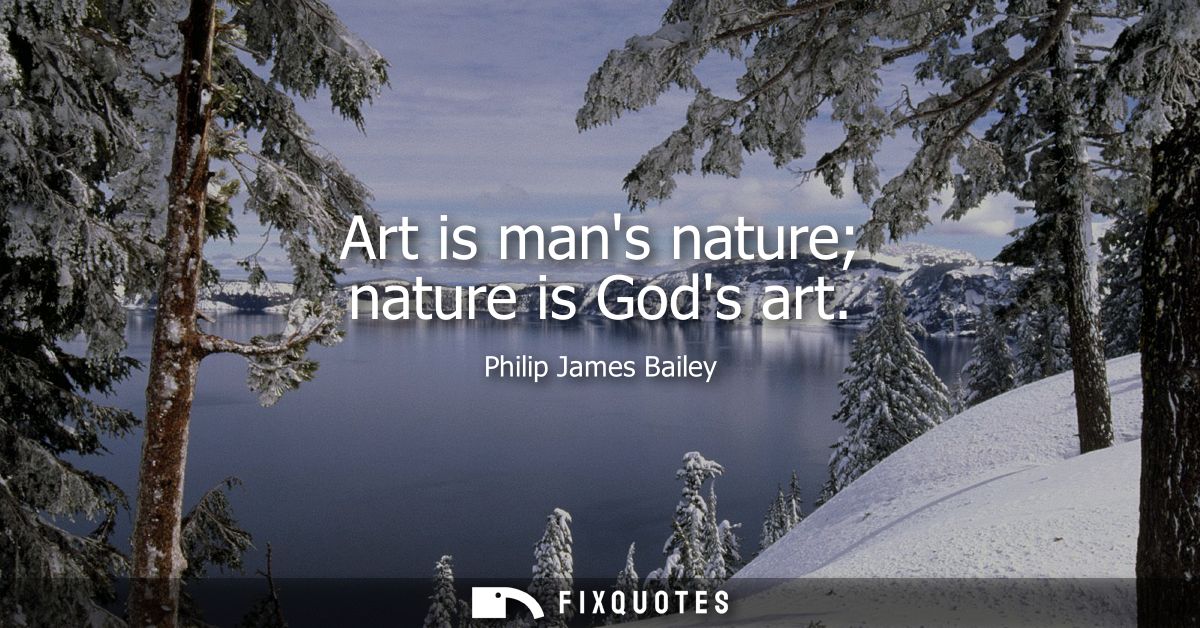
"Art is man's nature; nature is God's art"
About this Quote
Bailey folds a whole Victorian worldview into a neat chiasmus: swap the terms, keep the awe. "Art is man's nature" doesn’t just flatter human creativity; it claims making is what we are. Art isn’t a luxury or a salon pastime, it’s the species-level tell: the way we turn raw experience into pattern, meaning, and form. Then the pivot lands harder: "nature is God's art". Nature stops being mere scenery and becomes authored, curated, composed. The line’s elegance is doing philosophical work: it makes the human artist a mirror of the divine, and it makes the natural world legible as a kind of masterpiece.
That subtext matters in Bailey’s moment. Mid-19th century Britain is arguing about machinery, science, and secular modernity; Darwin is on the horizon, geology is stretching time, industry is making the man-made feel less like craft and more like extraction. Bailey answers by sacralizing both sides of the equation. He grants human creation dignity in an age that’s reorganizing labor, and he defends a theistic sense of order without needing doctrine. The quote reads like a pressure valve: if science explains mechanism, art preserves meaning.
It also carries a gentle hierarchy. Human art is "nature" - instinctive, emergent, limited. God's art is "nature" - total, immersive, unframeable. Bailey flatters human makers while quietly reminding them they work in miniature. The line endures because it gives two audiences what they want: artists get metaphysical validation; believers get a world that still feels intentionally made.
That subtext matters in Bailey’s moment. Mid-19th century Britain is arguing about machinery, science, and secular modernity; Darwin is on the horizon, geology is stretching time, industry is making the man-made feel less like craft and more like extraction. Bailey answers by sacralizing both sides of the equation. He grants human creation dignity in an age that’s reorganizing labor, and he defends a theistic sense of order without needing doctrine. The quote reads like a pressure valve: if science explains mechanism, art preserves meaning.
It also carries a gentle hierarchy. Human art is "nature" - instinctive, emergent, limited. God's art is "nature" - total, immersive, unframeable. Bailey flatters human makers while quietly reminding them they work in miniature. The line endures because it gives two audiences what they want: artists get metaphysical validation; believers get a world that still feels intentionally made.
Quote Details
| Topic | Art |
|---|---|
| Source | Festus (poem), Philip James Bailey, 1839 , line cited as "Art is man's nature; nature is God's art" (commonly attributed to Bailey; see Wikiquote) |
| Cite |
Citation Formats
APA Style (7th ed.)
Bailey, Philip James. (2026, January 14). Art is man's nature; nature is God's art. FixQuotes. https://fixquotes.com/quotes/art-is-mans-nature-nature-is-gods-art-149895/
Chicago Style
Bailey, Philip James. "Art is man's nature; nature is God's art." FixQuotes. January 14, 2026. https://fixquotes.com/quotes/art-is-mans-nature-nature-is-gods-art-149895/.
MLA Style (9th ed.)
"Art is man's nature; nature is God's art." FixQuotes, 14 Jan. 2026, https://fixquotes.com/quotes/art-is-mans-nature-nature-is-gods-art-149895/. Accessed 12 Feb. 2026.
More Quotes by Philip
Add to List