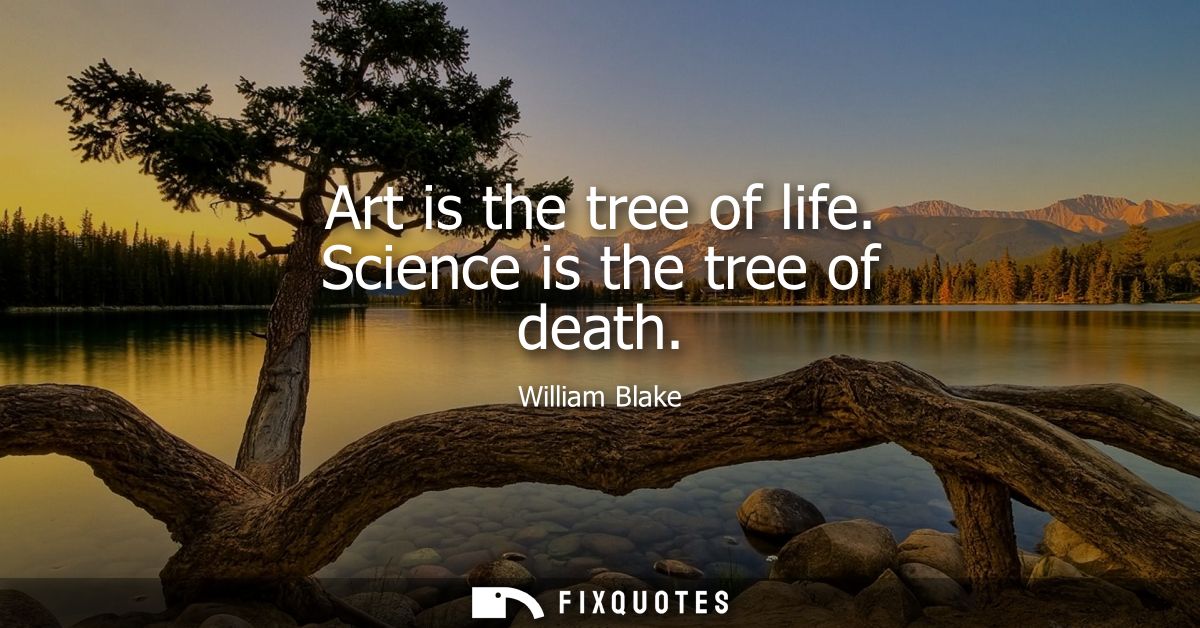
"Art is the tree of life. Science is the tree of death"
About this Quote
Blake isn’t offering a tidy arts-versus-STEM bumper sticker; he’s staging a revolt against an era that treated measurement as morality. “Tree of life” and “tree of death” piggyback on biblical symbolism (Eden’s Tree of Life, the Tree of Knowledge) to make a provocation: the modern worship of “knowledge” can become a spiritual poison. For Blake, art isn’t decoration. It’s a way of seeing that keeps the world animate, erotic, and morally charged. It restores the soul’s capacity for awe, which he treats as a form of truth, not a mood.
The sting comes from how he frames science: not as curiosity, but as reduction. Blake lived through the Industrial Revolution’s early churn and the Enlightenment’s confidence that the universe could be mastered by calculus and instruments. In his illuminated books and poems, he repeatedly mocks the “single vision” of rationalism: a mindset that dissects reality until the patient is dead, then congratulates itself on precision. Calling science a “tree of death” is less anti-experiment than anti-ideology: he’s attacking the kind of empiricism that flattens human experience into data and then uses that flattening to justify social control, factory discipline, and spiritual resignation.
The line works because it’s aggressively unfair in a way that reveals its target. Blake isn’t debating scientists; he’s naming a cultural mood. Art, for him, is generative imagination - the faculty that makes freedom thinkable. Science, when enthroned as the only authority, becomes a machine for disenchantment: it can explain the world and still drain it of meaning.
The sting comes from how he frames science: not as curiosity, but as reduction. Blake lived through the Industrial Revolution’s early churn and the Enlightenment’s confidence that the universe could be mastered by calculus and instruments. In his illuminated books and poems, he repeatedly mocks the “single vision” of rationalism: a mindset that dissects reality until the patient is dead, then congratulates itself on precision. Calling science a “tree of death” is less anti-experiment than anti-ideology: he’s attacking the kind of empiricism that flattens human experience into data and then uses that flattening to justify social control, factory discipline, and spiritual resignation.
The line works because it’s aggressively unfair in a way that reveals its target. Blake isn’t debating scientists; he’s naming a cultural mood. Art, for him, is generative imagination - the faculty that makes freedom thinkable. Science, when enthroned as the only authority, becomes a machine for disenchantment: it can explain the world and still drain it of meaning.
Quote Details
| Topic | Deep |
|---|---|
| Source | Verified source: The Laocoön (Blake’s engraved plate of aphorisms) (William Blake, 1826)
Evidence: SCIENCE is the Tree of DEATH ART is the Tree of LIFE GOD is JESUS (Not applicable (single engraved plate); transcription locates it at Erdman p. 274 (E274)). Primary source is Blake’s own engraved plate commonly titled “The Laocoön” (also called “The Laocoön, or Jehovah and his two sons Satan and Adam”), dated c. 1826–1827 in scholarly transcriptions. Many modern quote versions normalize capitalization and punctuation to: “Art is the tree of life. Science is the tree of death.” The earliest publication/spoken context is not a speech/interview; it appears as text engraved on the print itself. The ASU transcription (from Erdman’s numbering E273–E275) reproduces the inscription, placing the relevant lines at E274. A corroborating independent transcription with the same wording appears at Wikisource, also dating it c. 1826–7. Other candidates (1) The Ascent of Science (Brian L. Silver, 2000) compilation95.0% ... William Blake : " Art is the Tree of Life , Science is the Tree of Death . " No ambiguity , no mincing of words .... |
| Cite |
Citation Formats
APA Style (7th ed.)
Blake, William. (2026, February 8). Art is the tree of life. Science is the tree of death. FixQuotes. https://fixquotes.com/quotes/art-is-the-tree-of-life-science-is-the-tree-of-2355/
Chicago Style
Blake, William. "Art is the tree of life. Science is the tree of death." FixQuotes. February 8, 2026. https://fixquotes.com/quotes/art-is-the-tree-of-life-science-is-the-tree-of-2355/.
MLA Style (9th ed.)
"Art is the tree of life. Science is the tree of death." FixQuotes, 8 Feb. 2026, https://fixquotes.com/quotes/art-is-the-tree-of-life-science-is-the-tree-of-2355/. Accessed 12 Feb. 2026.
More Quotes by William
Add to List