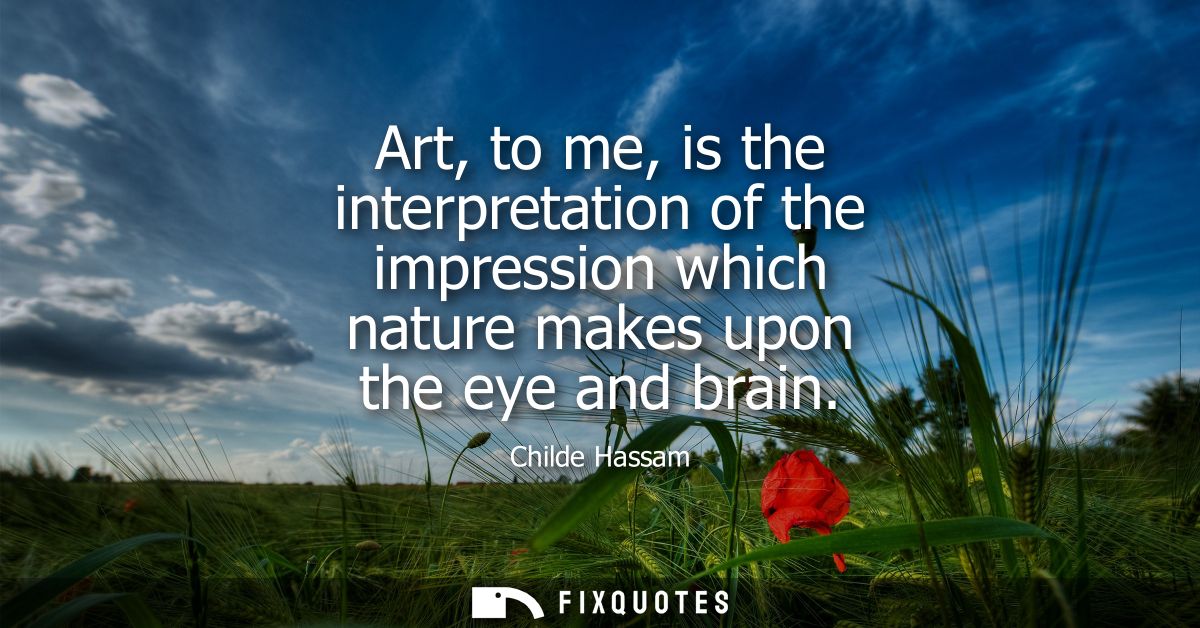
"Art, to me, is the interpretation of the impression which nature makes upon the eye and brain"
About this Quote
The real subtext is a defense of seeing as labor. Hassam isn’t arguing that art is simply “what you see.” He’s arguing that perception itself is complicated enough to deserve canvas space. By pairing “eye and brain,” he insists that vision is already cognition: selection, emphasis, mood, memory. That’s Impressionism’s trick, and its cultural provocation. It treats fleeting light and everyday scenes as worthy subjects precisely because they reveal how modern life hits us before we have time to tidy it into a story.
Context sharpens the intent. Hassam worked in an era when American art was negotiating inferiority complexes with Europe, while new technologies (photography, electric light, mass printing) were changing what “realistic” even meant. His statement pushes back against the idea that mechanical capture equals truth. Truth, for Hassam, is the human residue left on perception: not nature alone, not the artist alone, but the friction between them.
Quote Details
| Topic | Art |
|---|---|
| Source | Help us find the source |
| Cite |
Citation Formats
APA Style (7th ed.)
Hassam, Childe. (2026, January 14). Art, to me, is the interpretation of the impression which nature makes upon the eye and brain. FixQuotes. https://fixquotes.com/quotes/art-to-me-is-the-interpretation-of-the-impression-170067/
Chicago Style
Hassam, Childe. "Art, to me, is the interpretation of the impression which nature makes upon the eye and brain." FixQuotes. January 14, 2026. https://fixquotes.com/quotes/art-to-me-is-the-interpretation-of-the-impression-170067/.
MLA Style (9th ed.)
"Art, to me, is the interpretation of the impression which nature makes upon the eye and brain." FixQuotes, 14 Jan. 2026, https://fixquotes.com/quotes/art-to-me-is-the-interpretation-of-the-impression-170067/. Accessed 3 Apr. 2026.