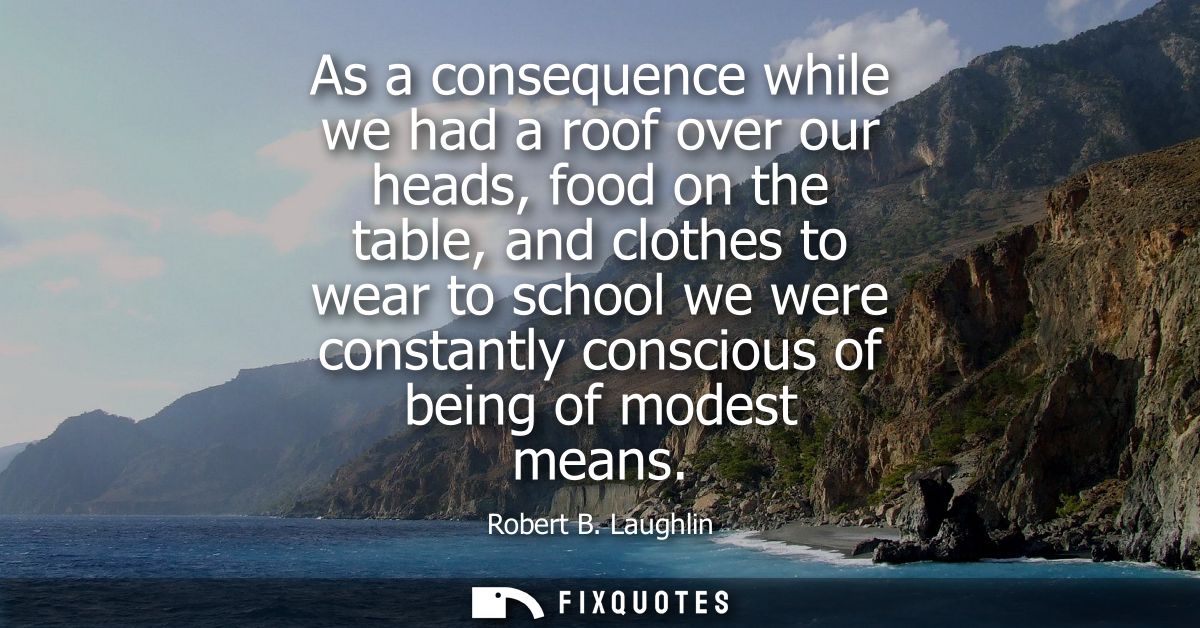
"As a consequence, while we had a roof over our heads, food on the table, and clothes to wear to school, we were constantly conscious of being of modest means"
About this Quote
The key subtext is that modesty isn’t only a number on a paycheck; it’s a lived atmosphere. School, in particular, is where “modest means” becomes legible: who has new sneakers, who takes field trips without checking the cost, whose parents speak the language of entitlement. Laughlin’s phrasing suggests a household where needs were met but margins were thin, so abundance was never assumed. That kind of vigilance trains a mind toward constraint, tradeoffs, and the hidden structure beneath everyday life - an origin story that fits a future scientist without romanticizing deprivation.
Context matters, too. Coming of age in postwar America, the country was busy selling an idea of rising prosperity as a national default. By emphasizing constant awareness, Laughlin hints at the gap between the era’s glossy promise and the quieter reality for many families: you could be “fine” and still feel outside the center of the story. The intent isn’t complaint. It’s calibration - a way of explaining how ambition and skepticism can grow from simply noticing the limits.
Quote Details
| Topic | Money |
|---|---|
| Source | Verified source: Robert B. Laughlin – Biographical (NobelPrize.org) (Robert B. Laughlin, 1998)
Evidence:
As a consequence while we had a roof over our heads, food on the table, and clothes to wear to school we were constantly conscious of being of modest means.. This sentence appears in Robert B. Laughlin’s autobiographical text hosted by NobelPrize.org on his Nobel Prize (Physics 1998) laureate page. In the Nobel biography, it appears in the early-life section immediately after he describes his father as an “artist lawyer” who prioritized correctness over profits and often worked for needy clients for free. Many quote-aggregation sites appear to have copied it from this NobelPrize.org biographical text. |
| Cite |
Citation Formats
APA Style (7th ed.)
Laughlin, Robert B. (2026, February 27). As a consequence, while we had a roof over our heads, food on the table, and clothes to wear to school, we were constantly conscious of being of modest means. FixQuotes. https://fixquotes.com/quotes/as-a-consequence-while-we-had-a-roof-over-our-28091/
Chicago Style
Laughlin, Robert B. "As a consequence, while we had a roof over our heads, food on the table, and clothes to wear to school, we were constantly conscious of being of modest means." FixQuotes. February 27, 2026. https://fixquotes.com/quotes/as-a-consequence-while-we-had-a-roof-over-our-28091/.
MLA Style (9th ed.)
"As a consequence, while we had a roof over our heads, food on the table, and clothes to wear to school, we were constantly conscious of being of modest means." FixQuotes, 27 Feb. 2026, https://fixquotes.com/quotes/as-a-consequence-while-we-had-a-roof-over-our-28091/. Accessed 27 Mar. 2026.