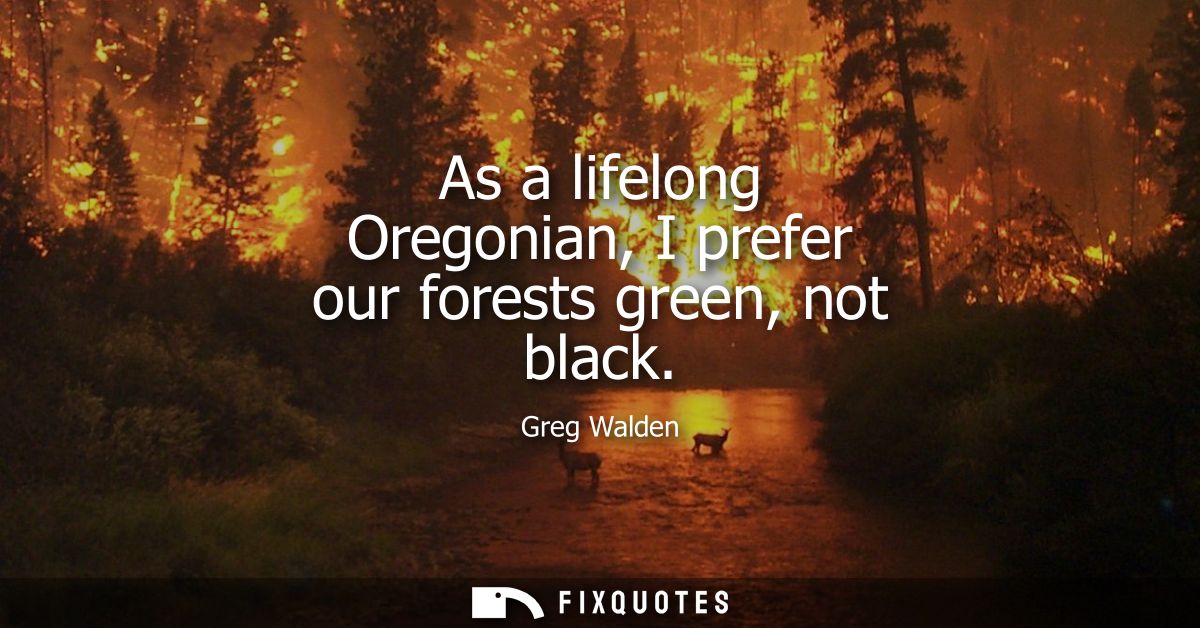
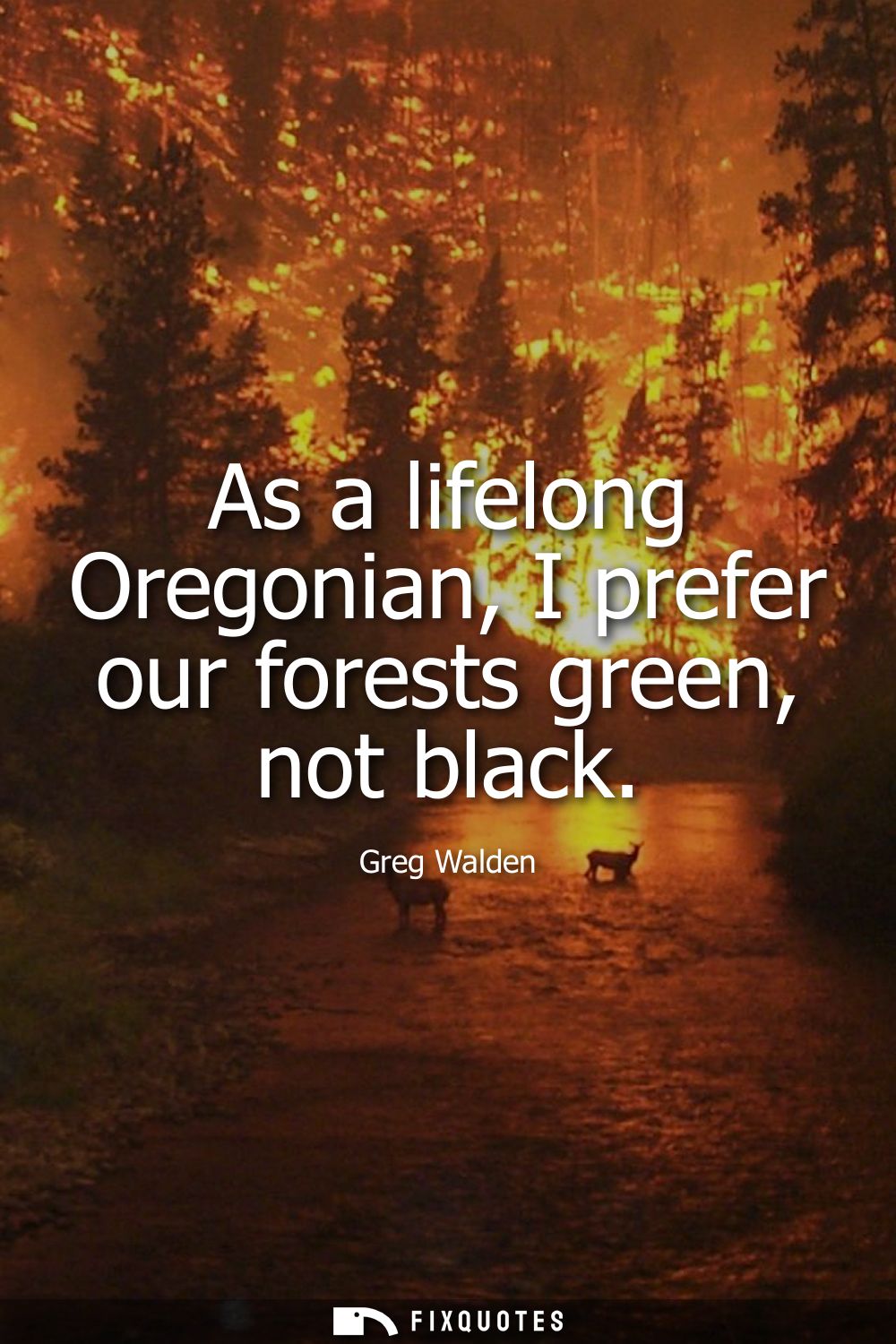
"As a lifelong Oregonian, I prefer our forests green, not black"
About this Quote
A politician invoking home isn’t just doing biography; he’s buying moral authority. “As a lifelong Oregonian” is credentialing by zip code, the softest kind of expertise and the hardest to argue with. It signals: I’m not an ideologue parachuting in, I’m family. That opening also narrows the debate to belonging. If you disagree, you’re not merely wrong; you’re out of place.
The line’s real engine is the color contrast. “Green, not black” is a brutally efficient bit of visual rhetoric, translating a technical argument about land management into a gut image of catastrophe. It borrows the emotional clarity of a postcard and pairs it with the terror of a burn scar. No acronyms, no budgets, no climate models: just a before-and-after any Oregonian can picture. The simplicity is the point; it turns complex, contested policy into a single moral preference.
The subtext is where the politics sits. “Prefer” sounds personal, almost gentle, but it implies agency: if forests go black, someone chose wrong policies. In recent Oregon wildfire debates, that implication typically aims at restrictions on logging, thinning, or controlled burns, and at federal land management gridlock. It nudges the listener toward “active management” without having to say “timber,” “regulation,” or “climate change” out loud.
It’s also a strategic dodge. By framing the issue as color and common sense, the quote invites consensus while smuggling in a specific blame narrative: the state isn’t burning because of hard global forces alone, but because we’ve mismanaged what’s ours.
The line’s real engine is the color contrast. “Green, not black” is a brutally efficient bit of visual rhetoric, translating a technical argument about land management into a gut image of catastrophe. It borrows the emotional clarity of a postcard and pairs it with the terror of a burn scar. No acronyms, no budgets, no climate models: just a before-and-after any Oregonian can picture. The simplicity is the point; it turns complex, contested policy into a single moral preference.
The subtext is where the politics sits. “Prefer” sounds personal, almost gentle, but it implies agency: if forests go black, someone chose wrong policies. In recent Oregon wildfire debates, that implication typically aims at restrictions on logging, thinning, or controlled burns, and at federal land management gridlock. It nudges the listener toward “active management” without having to say “timber,” “regulation,” or “climate change” out loud.
It’s also a strategic dodge. By framing the issue as color and common sense, the quote invites consensus while smuggling in a specific blame narrative: the state isn’t burning because of hard global forces alone, but because we’ve mismanaged what’s ours.
Quote Details
| Topic | Nature |
|---|---|
| Source | Help us find the source |
| Cite |
Citation Formats
APA Style (7th ed.)
Walden, Greg. (2026, January 17). As a lifelong Oregonian, I prefer our forests green, not black. FixQuotes. https://fixquotes.com/quotes/as-a-lifelong-oregonian-i-prefer-our-forests-67960/
Chicago Style
Walden, Greg. "As a lifelong Oregonian, I prefer our forests green, not black." FixQuotes. January 17, 2026. https://fixquotes.com/quotes/as-a-lifelong-oregonian-i-prefer-our-forests-67960/.
MLA Style (9th ed.)
"As a lifelong Oregonian, I prefer our forests green, not black." FixQuotes, 17 Jan. 2026, https://fixquotes.com/quotes/as-a-lifelong-oregonian-i-prefer-our-forests-67960/. Accessed 15 Mar. 2026.
More Quotes by Greg
Add to List