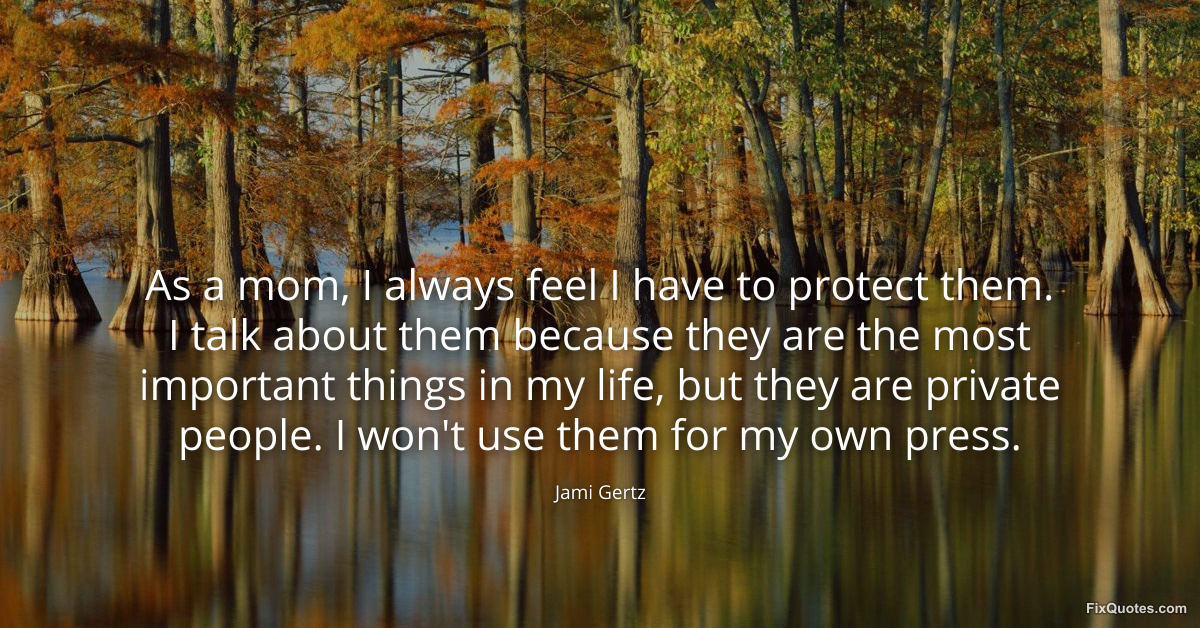
"As a mom, I always feel I have to protect them. I talk about them because they are the most important things in my life, but they are private people. I won't use them for my own press"
About this Quote
Her phrasing does quiet work. “Private people” is pointedly democratic, almost bureaucratic, stripping away the idea that proximity to a famous parent turns children into content. It rejects the soft coercion of celebrity culture, where kids become brand extensions, reality-show collateral, or paparazzi bait. “I won’t use them for my own press” is a moral claim, but it’s also a strategic one: she’s positioning herself as someone who understands how publicity operates and is choosing not to cash that check.
The subtext is about consent and power. Children can’t meaningfully opt out, and Gertz treats that as the ethical boundary, not a PR challenge to be managed. Coming from an actress whose career sits adjacent to relentless media appetite, the line reads as self-defense and critique: you can have the work, maybe even a few anecdotes, but you don’t get the family as proof of authenticity. It’s a refusal to perform “relatable” at their expense.
Quote Details
| Topic | Mother |
|---|---|
| Source | Help us find the source |
| Cite |
Citation Formats
APA Style (7th ed.)
Gertz, Jami. (2026, February 18). As a mom, I always feel I have to protect them. I talk about them because they are the most important things in my life, but they are private people. I won't use them for my own press. FixQuotes. https://fixquotes.com/quotes/as-a-mom-i-always-feel-i-have-to-protect-them-i-66391/
Chicago Style
Gertz, Jami. "As a mom, I always feel I have to protect them. I talk about them because they are the most important things in my life, but they are private people. I won't use them for my own press." FixQuotes. February 18, 2026. https://fixquotes.com/quotes/as-a-mom-i-always-feel-i-have-to-protect-them-i-66391/.
MLA Style (9th ed.)
"As a mom, I always feel I have to protect them. I talk about them because they are the most important things in my life, but they are private people. I won't use them for my own press." FixQuotes, 18 Feb. 2026, https://fixquotes.com/quotes/as-a-mom-i-always-feel-i-have-to-protect-them-i-66391/. Accessed 3 Apr. 2026.