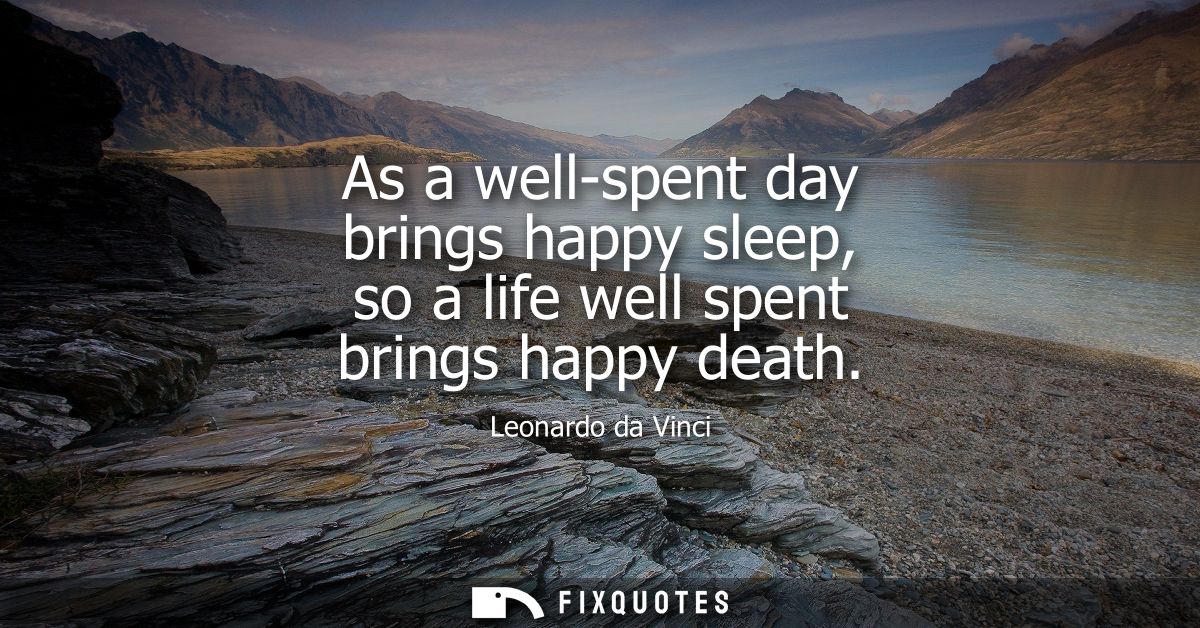
"As a well-spent day brings happy sleep, so a life well spent brings happy death"
About this Quote
The intent isn’t to romanticize death; it’s to moralize time. A “well-spent day” implies attention, discipline, and a kind of sober accounting. Da Vinci, who lived in an era where plague and political violence made endings abrupt, offers a counterweight to chaos: you can’t control the hour, but you can shape the texture of what precedes it. The subtext is quietly anti-heroic. Not “die gloriously,” but “live so thoroughly that dying feels like the body’s natural punctuation.”
It’s also an artist’s statement masquerading as philosophy. Da Vinci’s life was a long argument for curiosity as labor: drawing, dissecting, engineering, observing. “Well spent” isn’t just virtue; it’s craft. The line flatters neither ascetics nor thrill-seekers. It proposes a secular consolation: fulfillment is less a final judgment than the cumulative outcome of daily choices, repeated until the end becomes, if not painless, at least coherent.
Quote Details
| Topic | Mortality |
|---|---|
| Source | Leonardo da Vinci — aphorism recorded in his Notebooks; English translation in Jean Paul Richter, The Notebooks of Leonardo da Vinci (1883). |
| Cite |
Citation Formats
APA Style (7th ed.)
Vinci, Leonardo da. (2026, January 18). As a well-spent day brings happy sleep, so a life well spent brings happy death. FixQuotes. https://fixquotes.com/quotes/as-a-well-spent-day-brings-happy-sleep-so-a-life-22360/
Chicago Style
Vinci, Leonardo da. "As a well-spent day brings happy sleep, so a life well spent brings happy death." FixQuotes. January 18, 2026. https://fixquotes.com/quotes/as-a-well-spent-day-brings-happy-sleep-so-a-life-22360/.
MLA Style (9th ed.)
"As a well-spent day brings happy sleep, so a life well spent brings happy death." FixQuotes, 18 Jan. 2026, https://fixquotes.com/quotes/as-a-well-spent-day-brings-happy-sleep-so-a-life-22360/. Accessed 5 Apr. 2026.