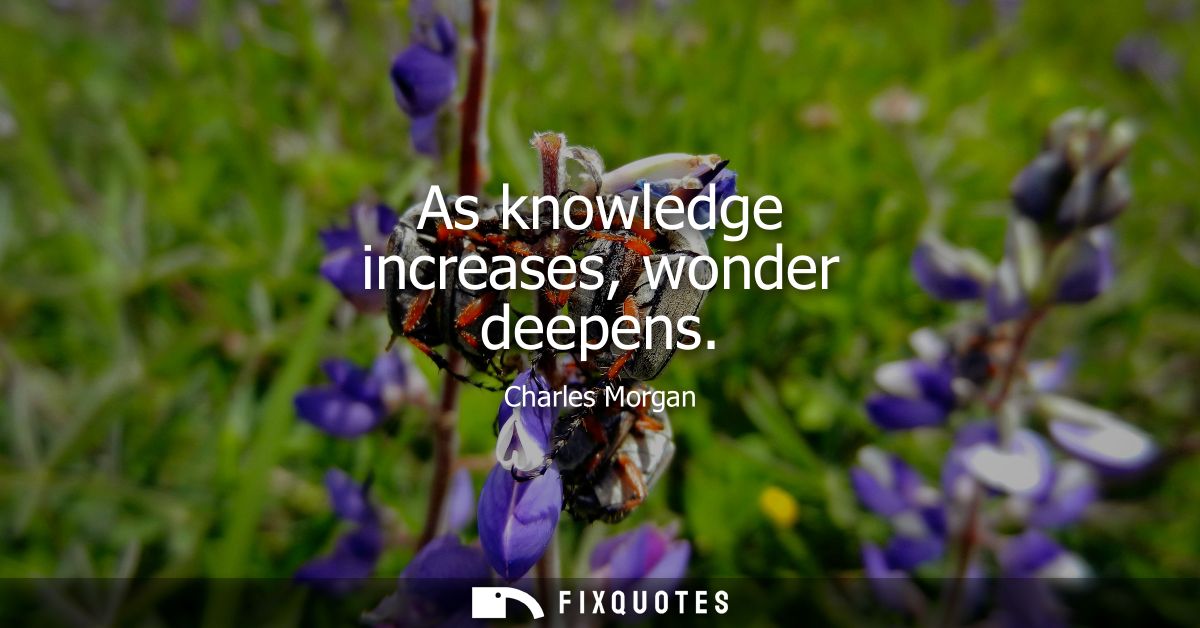
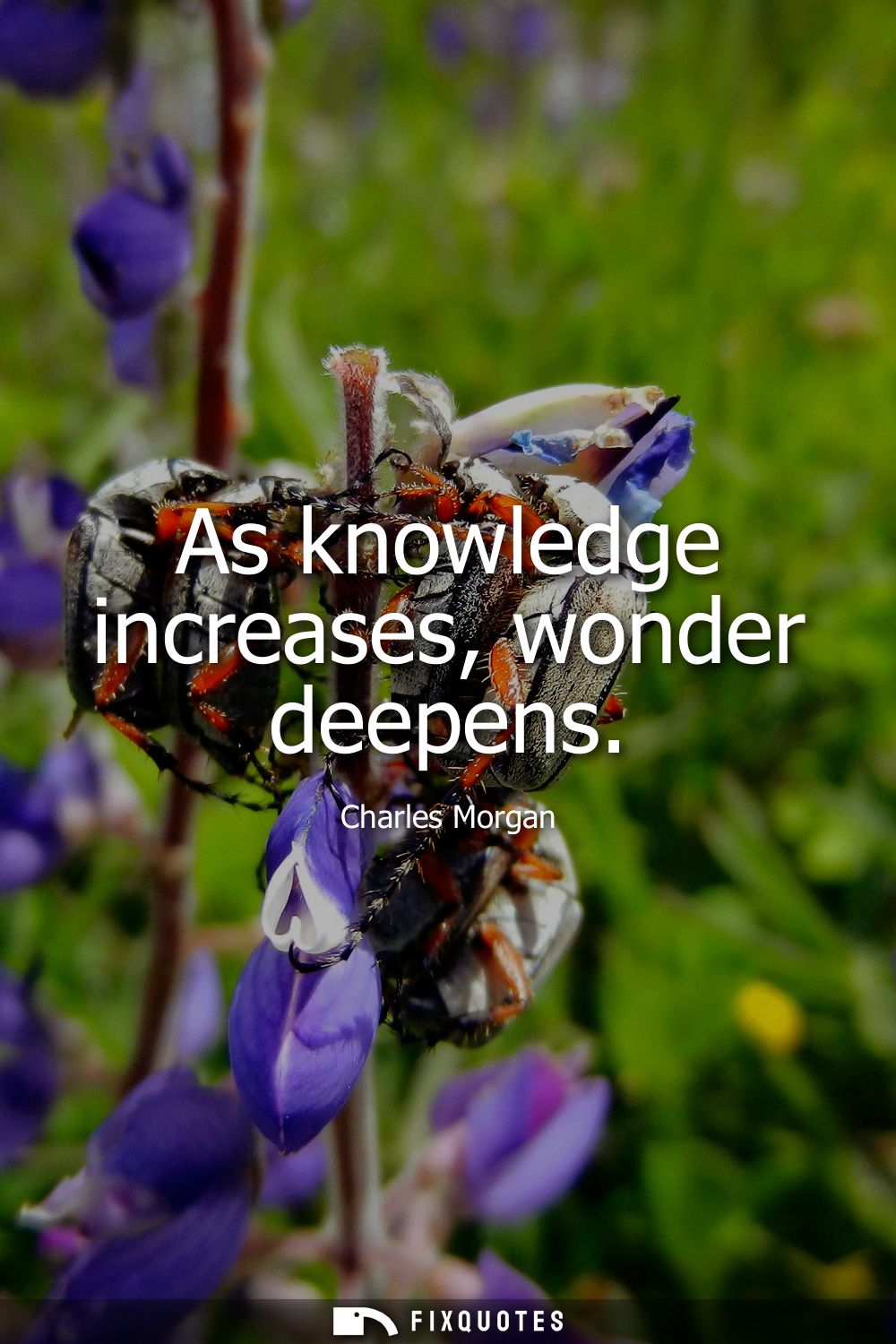
"As knowledge increases, wonder deepens"
About this Quote
Against the modern cliché that knowledge kills mystery, Morgan flips the charge: the more you learn, the less smug your certainty becomes. "As knowledge increases, wonder deepens" is built like a quiet rebuttal to the debunking impulse - the idea that naming a thing drains it of meaning. Morgan, a novelist who wrote in an era shadowed by world wars and accelerated by science, is arguing for a different kind of intellectual maturity: understanding as an enlarging force, not a closing one.
The line works because of its grammar. "Increases" suggests accumulation, the steady stacking of facts; "deepens" signals vertical motion, a plunge. He links the quantitative to the qualitative, implying that real knowledge isn't trivia or mere mastery but a widening of perception that makes the world feel stranger in the best way. There's subtextual modesty here, too: wonder deepens when you recognize how much remains unsolved, how any clear answer opens onto more intricate questions. That's not anti-rational romance; it's the emotional payoff of serious attention.
In Morgan's context - early 20th-century literary culture negotiating between faith, modernism, and scientific authority - wonder becomes a kind of ethical stance. It's a check on dogmatism, whether religious or technocratic. The intent isn't to sentimentalize awe; it's to defend curiosity as a disciplined, adult feeling that survives contact with facts.
The line works because of its grammar. "Increases" suggests accumulation, the steady stacking of facts; "deepens" signals vertical motion, a plunge. He links the quantitative to the qualitative, implying that real knowledge isn't trivia or mere mastery but a widening of perception that makes the world feel stranger in the best way. There's subtextual modesty here, too: wonder deepens when you recognize how much remains unsolved, how any clear answer opens onto more intricate questions. That's not anti-rational romance; it's the emotional payoff of serious attention.
In Morgan's context - early 20th-century literary culture negotiating between faith, modernism, and scientific authority - wonder becomes a kind of ethical stance. It's a check on dogmatism, whether religious or technocratic. The intent isn't to sentimentalize awe; it's to defend curiosity as a disciplined, adult feeling that survives contact with facts.
Quote Details
| Topic | Knowledge |
|---|---|
| Source | Help us find the source |
| Cite |
Citation Formats
APA Style (7th ed.)
Morgan, Charles. (2026, January 14). As knowledge increases, wonder deepens. FixQuotes. https://fixquotes.com/quotes/as-knowledge-increases-wonder-deepens-140137/
Chicago Style
Morgan, Charles. "As knowledge increases, wonder deepens." FixQuotes. January 14, 2026. https://fixquotes.com/quotes/as-knowledge-increases-wonder-deepens-140137/.
MLA Style (9th ed.)
"As knowledge increases, wonder deepens." FixQuotes, 14 Jan. 2026, https://fixquotes.com/quotes/as-knowledge-increases-wonder-deepens-140137/. Accessed 27 Mar. 2026.
More Quotes by Charles
Add to List