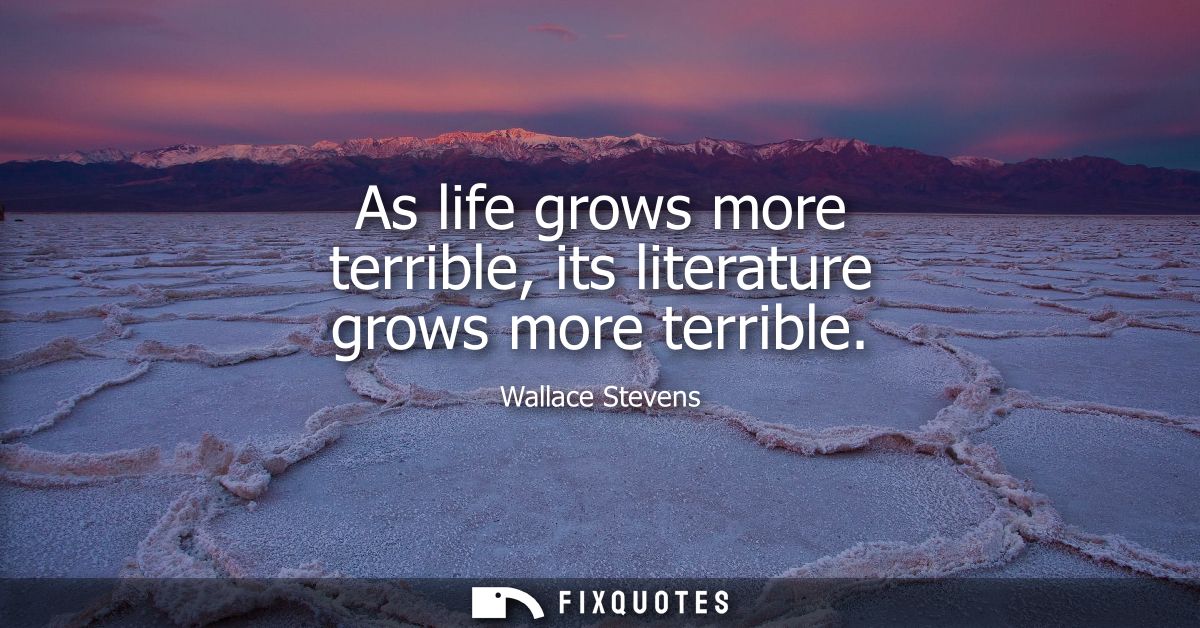
"As life grows more terrible, its literature grows more terrible"
About this Quote
Stevens delivers a neat little indictment disguised as an observation: when reality turns brutal, art doesn’t float above it - it metabolizes it. The line’s power comes from its cold symmetry. “More terrible” repeats like a drumbeat, refusing consolation. It’s not poetic hand-wringing; it’s a grim equation. Terrible in, terrible out.
The intent isn’t simply to defend dark writing as “authentic.” Stevens is also warning that literature is an instrument sensitive enough to register cultural violence - and maybe too honest to prettify it. The subtext: if you’re shocked by bleak books, you’re really recoiling from the world that produced them. Literature becomes a kind of seismograph, tracing the tremors we’d rather ignore. The sentence quietly shifts responsibility from writers to conditions. Don’t blame the poem; blame the century.
Context matters. Stevens writes as a modernist, coming of age amid World War I, the Great Depression, the rise of fascism, and then World War II - a historical stretch that made optimism feel like bad faith. Modernism’s fractured forms and tonal austerity weren’t merely stylistic fashions; they were adaptations to a world that had broken old narratives of progress and stability. Stevens, often tagged as the “ideas” poet, slips an ethical claim into a plain declarative: aesthetic choices are not immune to political and social weather.
There’s also a darker implication: terror can become the era’s dominant aesthetic, a feedback loop where catastrophe trains taste. The line doesn’t moralize about that. It just lets the chill settle.
The intent isn’t simply to defend dark writing as “authentic.” Stevens is also warning that literature is an instrument sensitive enough to register cultural violence - and maybe too honest to prettify it. The subtext: if you’re shocked by bleak books, you’re really recoiling from the world that produced them. Literature becomes a kind of seismograph, tracing the tremors we’d rather ignore. The sentence quietly shifts responsibility from writers to conditions. Don’t blame the poem; blame the century.
Context matters. Stevens writes as a modernist, coming of age amid World War I, the Great Depression, the rise of fascism, and then World War II - a historical stretch that made optimism feel like bad faith. Modernism’s fractured forms and tonal austerity weren’t merely stylistic fashions; they were adaptations to a world that had broken old narratives of progress and stability. Stevens, often tagged as the “ideas” poet, slips an ethical claim into a plain declarative: aesthetic choices are not immune to political and social weather.
There’s also a darker implication: terror can become the era’s dominant aesthetic, a feedback loop where catastrophe trains taste. The line doesn’t moralize about that. It just lets the chill settle.
Quote Details
| Topic | Writing |
|---|
More Quotes by Wallace
Add to List