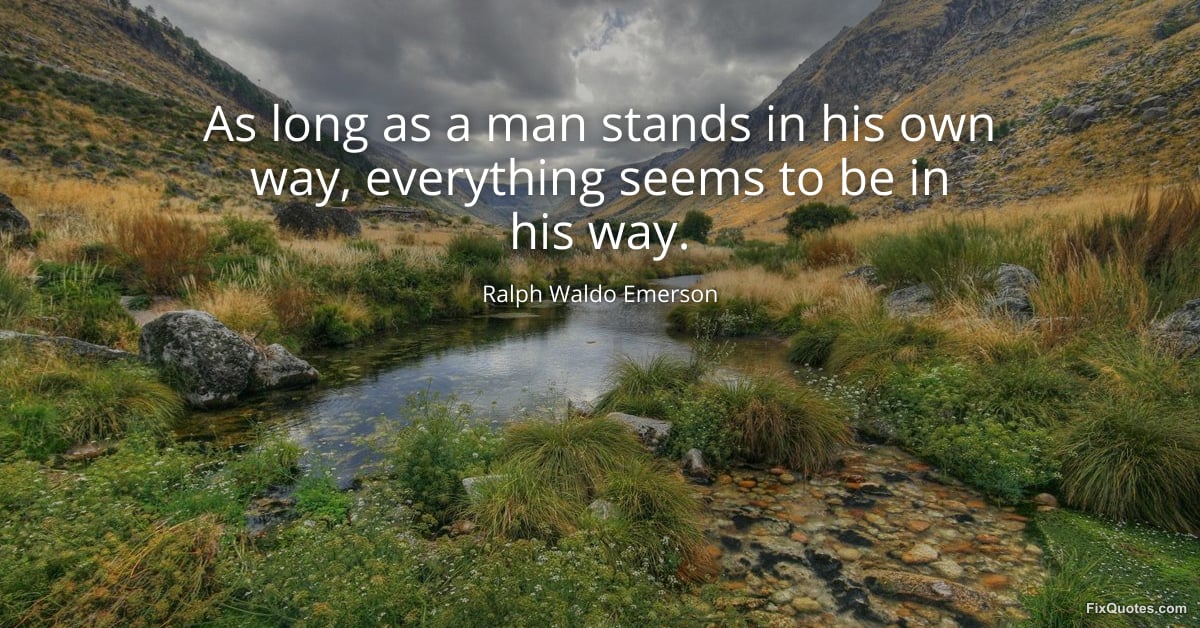
"As long as a man stands in his own way, everything seems to be in his way"
About this Quote
The subtext is classic Emersonian self-reliance, but with less celebration and more scalpel. He’s targeting the psychological theater where fear, pride, and habit dress up as external barriers. When you’re blocked by your own hesitation, every unrelated inconvenience starts to feel like a conspiracy: the email becomes an omen, the criticism becomes persecution, the bad timing becomes destiny. Emerson is saying the mind, when it refuses responsibility, recruits the entire environment as evidence.
Context matters: Emerson writes from the 19th-century American project of self-making, when the frontier myth and the emerging market society rewarded agency and punished passivity. His optimism has steel in it. The sentence is also a rebuke to the era’s taste for inherited authority, including religious and social scripts. If the true impediment is internal, then institutions lose their alibi and the individual loses theirs, too. It’s bracing, slightly accusatory, and engineered to produce motion: step aside, and the world, suddenly, stops “being in your way.”
Quote Details
| Topic | Self-Improvement |
|---|---|
| Source | Later attribution: A Poet Explains Imagination (Paul Matta, 2013) modern compilationISBN: 9781300637691 · ID: CTwbBAAAQBAJ
Evidence:
... Ralph Waldo Emerson jotted a quote about man's self destruction . Emerson quoted his friend Thoreau with these simple words , " as long as a man stands in his own way , everything seems to be in his way " ( The Heart of Emerson's ... |
| Cite |
Citation Formats
APA Style (7th ed.)
Emerson, Ralph Waldo. (2026, March 25). As long as a man stands in his own way, everything seems to be in his way. FixQuotes. https://fixquotes.com/quotes/as-long-as-a-man-stands-in-his-own-way-everything-16623/
Chicago Style
Emerson, Ralph Waldo. "As long as a man stands in his own way, everything seems to be in his way." FixQuotes. March 25, 2026. https://fixquotes.com/quotes/as-long-as-a-man-stands-in-his-own-way-everything-16623/.
MLA Style (9th ed.)
"As long as a man stands in his own way, everything seems to be in his way." FixQuotes, 25 Mar. 2026, https://fixquotes.com/quotes/as-long-as-a-man-stands-in-his-own-way-everything-16623/. Accessed 3 Apr. 2026.