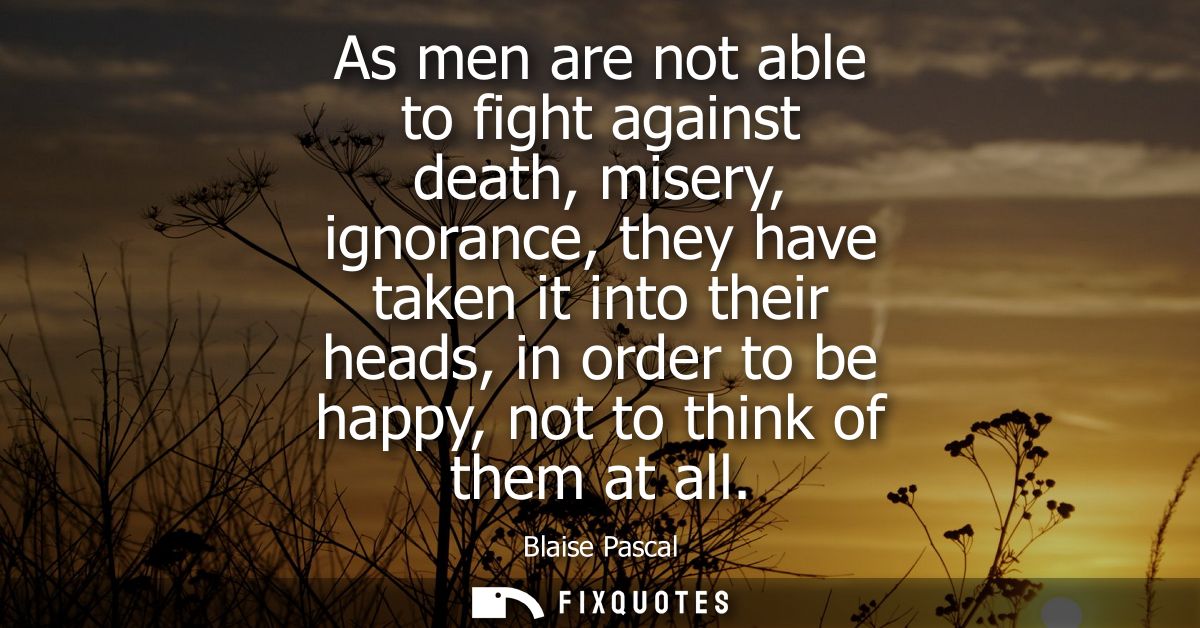
"As men are not able to fight against death, misery, ignorance, they have taken it into their heads, in order to be happy, not to think of them at all"
About this Quote
The intent is less to shame than to diagnose. Pascal is writing in a 17th-century France newly drunk on reason, science, and social polish, where the educated classes could distract themselves with salons, status, and cleverness. Against that backdrop, “not to think of them at all” isn’t just personal denial; it’s a cultural program. Diversion becomes a technology: keep the mind occupied and you can postpone the terror. The subtext is sharp: the modern self’s favorite freedom is the freedom to look away.
What makes the sentence work is its brutal symmetry. Death, misery, ignorance: a triad of unavoidable limits. Fight, taken into their heads, happy: a chain of motives that exposes the trick. Pascal’s slyest move is the phrase “in order to be happy,” as if happiness were a bureaucratic goal achieved by paperwork and omission. He’s implying that a happiness built on forgetting the worst truths isn’t happiness at all; it’s a détente with reality, purchased by attention management. In a world of constant feeds and constant noise, Pascal reads less like a theologian and more like a prophet of distraction.
Quote Details
| Topic | Mortality |
|---|---|
| Source | Help us find the source |
| Cite |
Citation Formats
APA Style (7th ed.)
Pascal, Blaise. (2026, January 17). As men are not able to fight against death, misery, ignorance, they have taken it into their heads, in order to be happy, not to think of them at all. FixQuotes. https://fixquotes.com/quotes/as-men-are-not-able-to-fight-against-death-misery-30211/
Chicago Style
Pascal, Blaise. "As men are not able to fight against death, misery, ignorance, they have taken it into their heads, in order to be happy, not to think of them at all." FixQuotes. January 17, 2026. https://fixquotes.com/quotes/as-men-are-not-able-to-fight-against-death-misery-30211/.
MLA Style (9th ed.)
"As men are not able to fight against death, misery, ignorance, they have taken it into their heads, in order to be happy, not to think of them at all." FixQuotes, 17 Jan. 2026, https://fixquotes.com/quotes/as-men-are-not-able-to-fight-against-death-misery-30211/. Accessed 10 Mar. 2026.