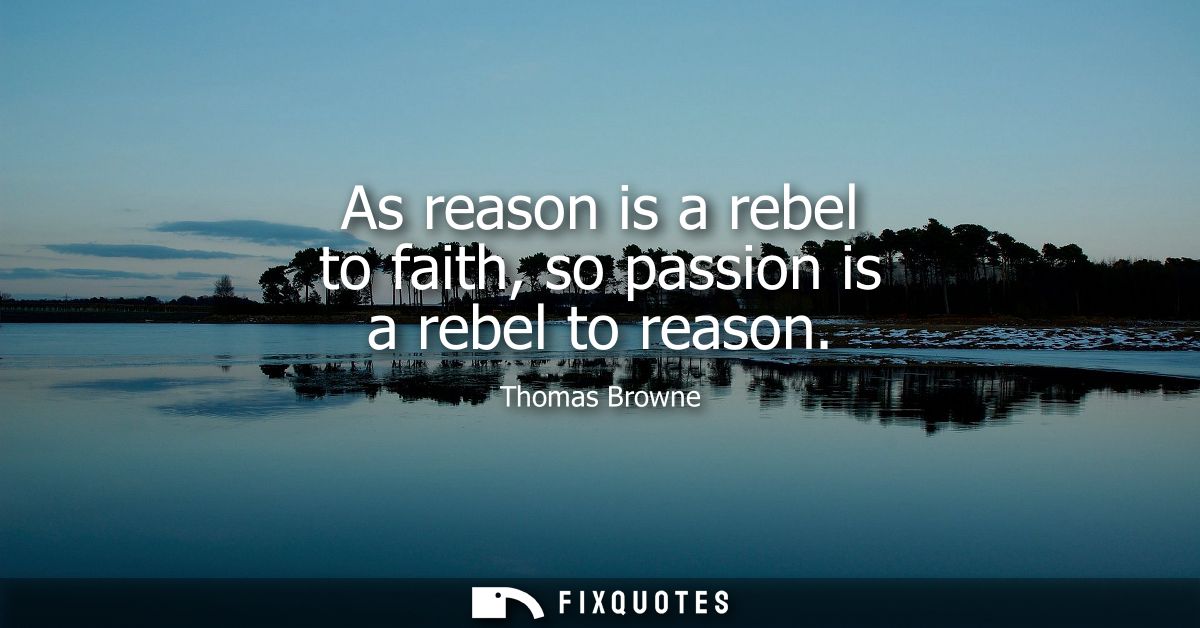
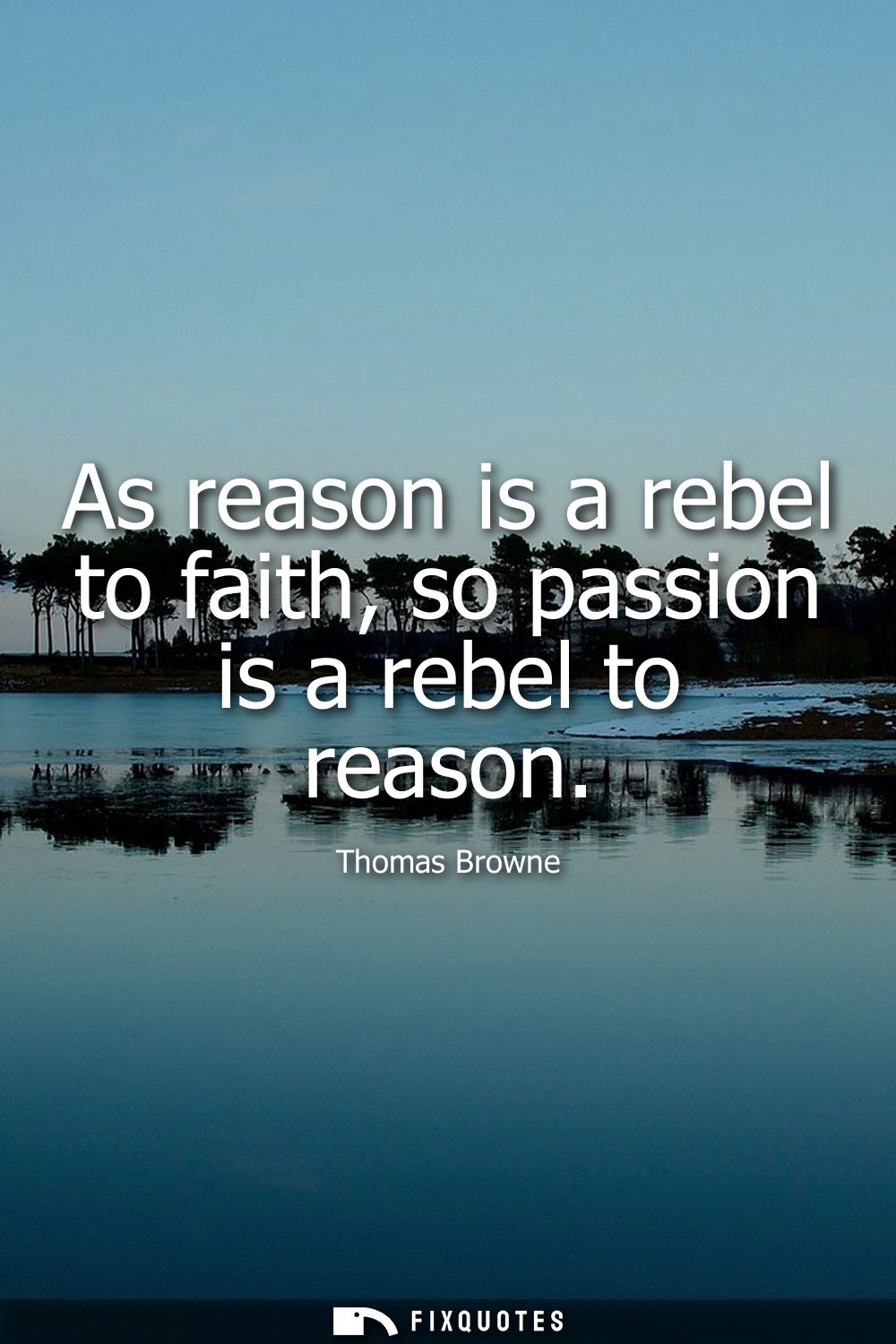
"As reason is a rebel to faith, so passion is a rebel to reason"
About this Quote
Browne’s line is built like a set of nested mutinies: reason revolts against faith, then passion revolts against reason. The sentence doesn’t ask you to pick a side; it maps a chain of insurrections that keeps any single authority from feeling permanent. Coming from a 17th-century physician and natural philosopher, that’s not just mood music. It’s a survival strategy for a mind living between collapsing medieval certainties and the rising prestige of experiment.
The phrasing matters. “Rebel” is political, not merely psychological. Browne frames belief, rational inquiry, and appetite as regimes that rule until they’re challenged. Reason, in the new scientific climate, is imagined as insurgent: it interrogates doctrine, refuses to accept inherited explanation on credit. But Browne refuses the triumphalist story that reason simply replaces faith. The second clause undercuts any Enlightenment victory lap by reminding us that rational self-government is itself fragile. Passion doesn’t politely “influence” reason; it breaks ranks.
Subtext: every worldview is provisional because humans are not consistent machines. Browne’s religious era demanded loyalty, while his scientific era demanded skepticism; he recognizes that even skepticism has an internal saboteur. The symmetry of the sentence is the trick: it feels balanced, almost axiomatic, which mimics the very rational order it’s warning you can’t count on. Read that way, it’s an early-modern diagnosis of modern life: we don’t move from faith to reason to mastery. We cycle through loyalties, each one convinced it’s the adult in the room until the next rebellion starts.
The phrasing matters. “Rebel” is political, not merely psychological. Browne frames belief, rational inquiry, and appetite as regimes that rule until they’re challenged. Reason, in the new scientific climate, is imagined as insurgent: it interrogates doctrine, refuses to accept inherited explanation on credit. But Browne refuses the triumphalist story that reason simply replaces faith. The second clause undercuts any Enlightenment victory lap by reminding us that rational self-government is itself fragile. Passion doesn’t politely “influence” reason; it breaks ranks.
Subtext: every worldview is provisional because humans are not consistent machines. Browne’s religious era demanded loyalty, while his scientific era demanded skepticism; he recognizes that even skepticism has an internal saboteur. The symmetry of the sentence is the trick: it feels balanced, almost axiomatic, which mimics the very rational order it’s warning you can’t count on. Read that way, it’s an early-modern diagnosis of modern life: we don’t move from faith to reason to mastery. We cycle through loyalties, each one convinced it’s the adult in the room until the next rebellion starts.
Quote Details
| Topic | Reason & Logic |
|---|---|
| Source | Help us find the source |
| Cite |
Citation Formats
APA Style (7th ed.)
Browne, Thomas. (2026, January 16). As reason is a rebel to faith, so passion is a rebel to reason. FixQuotes. https://fixquotes.com/quotes/as-reason-is-a-rebel-to-faith-so-passion-is-a-98190/
Chicago Style
Browne, Thomas. "As reason is a rebel to faith, so passion is a rebel to reason." FixQuotes. January 16, 2026. https://fixquotes.com/quotes/as-reason-is-a-rebel-to-faith-so-passion-is-a-98190/.
MLA Style (9th ed.)
"As reason is a rebel to faith, so passion is a rebel to reason." FixQuotes, 16 Jan. 2026, https://fixquotes.com/quotes/as-reason-is-a-rebel-to-faith-so-passion-is-a-98190/. Accessed 15 Mar. 2026.
More Quotes by Thomas
Add to List