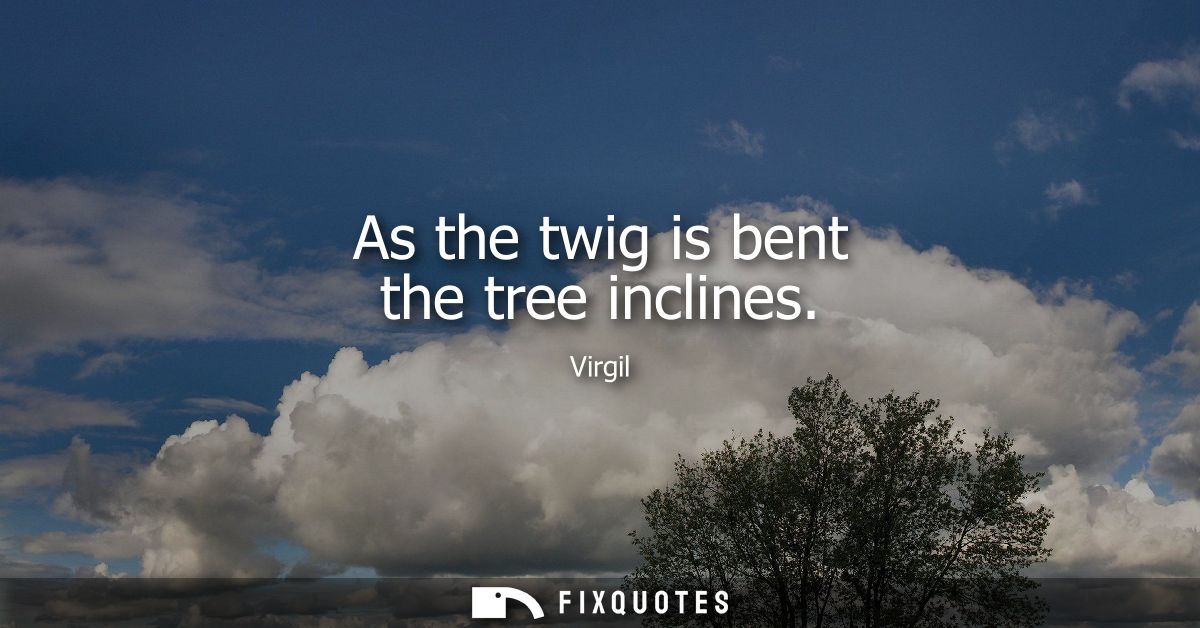
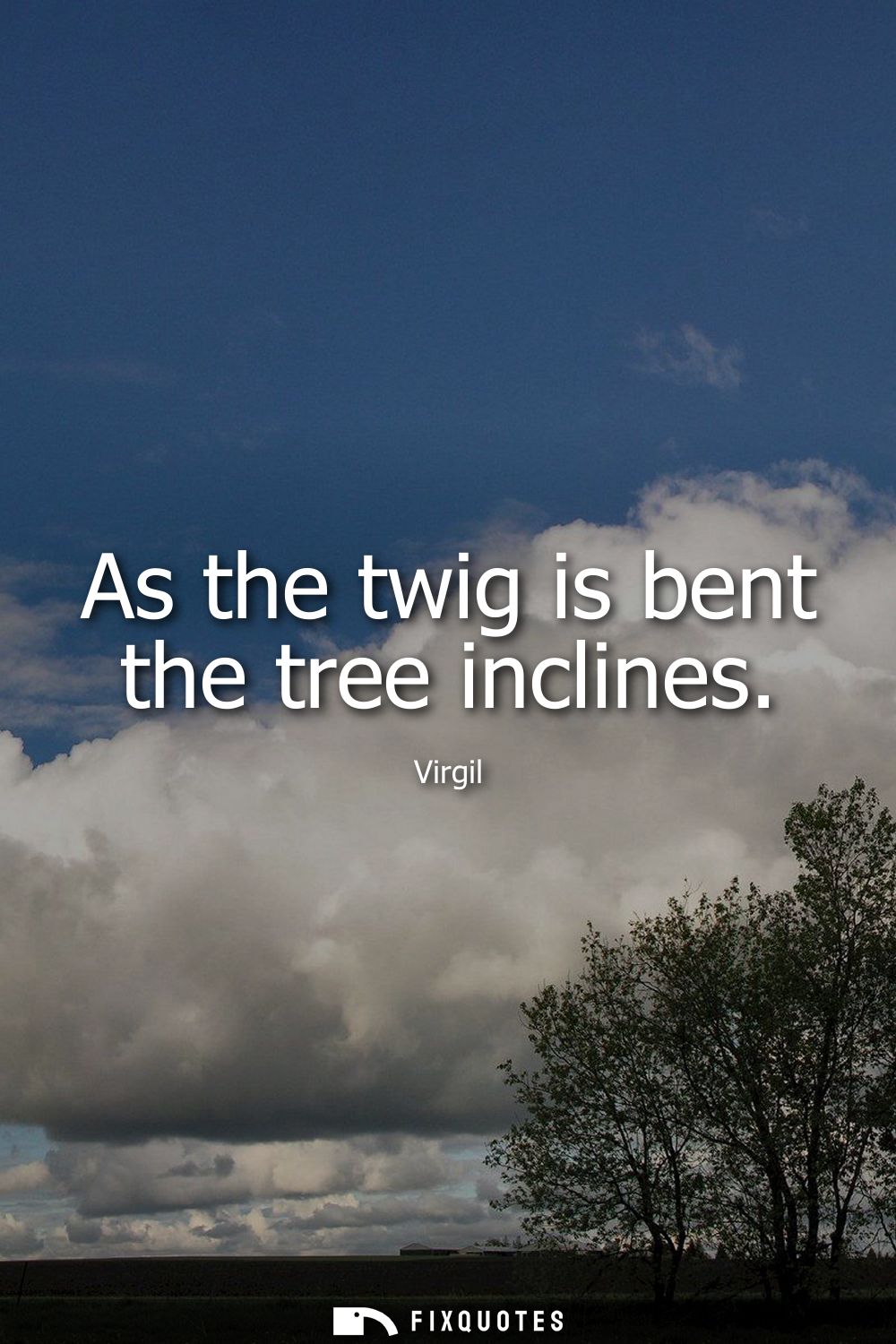
"As the twig is bent, the tree inclines"
About this Quote
A proverb with a poet’s velvet glove and a legislator’s iron fist: "As the twig is bent the tree inclines" makes nurture sound like destiny. Virgil, writing in an era obsessed with cultivation - of fields, citizens, and empire - reaches for an agricultural image that doubles as a moral technology. Bend the sapling early, and you don’t have to wrestle the grown trunk later. The elegance is how it naturalizes social engineering: what could be more innocent than a twig and a tree?
The intent is partly instructional, partly justificatory. In Roman culture, education and discipline weren’t framed as self-expression; they were framed as formation. This line flatters the adult world’s authority by casting it as horticulture rather than coercion. You’re not controlling a person, you’re "training" nature. That subtext matters because it smuggles ideology into common sense: if character is set in youth, then inequality can be explained as early bending, not present power.
It also carries a warning for empire. Virgil’s Rome was trying to turn civil chaos into Augustan order, to make stability feel organic. The metaphor implies that institutions, like people, are path-dependent: early choices tilt the entire future. It’s rhetorically efficient because it skips argument and offers inevitability. You can debate laws; you can’t argue with botany.
The sting is that the image doesn’t mention who does the bending, or to what end. That omission is the point: it makes shaping seem like care, and care seem like fate.
The intent is partly instructional, partly justificatory. In Roman culture, education and discipline weren’t framed as self-expression; they were framed as formation. This line flatters the adult world’s authority by casting it as horticulture rather than coercion. You’re not controlling a person, you’re "training" nature. That subtext matters because it smuggles ideology into common sense: if character is set in youth, then inequality can be explained as early bending, not present power.
It also carries a warning for empire. Virgil’s Rome was trying to turn civil chaos into Augustan order, to make stability feel organic. The metaphor implies that institutions, like people, are path-dependent: early choices tilt the entire future. It’s rhetorically efficient because it skips argument and offers inevitability. You can debate laws; you can’t argue with botany.
The sting is that the image doesn’t mention who does the bending, or to what end. That omission is the point: it makes shaping seem like care, and care seem like fate.
Quote Details
| Topic | Latin Phrases |
|---|---|
| Source | Help us find the source |
| Cite |
Citation Formats
APA Style (7th ed.)
Virgil. (2026, February 16). As the twig is bent, the tree inclines. FixQuotes. https://fixquotes.com/quotes/as-the-twig-is-bent-the-tree-inclines-8665/
Chicago Style
Virgil. "As the twig is bent, the tree inclines." FixQuotes. February 16, 2026. https://fixquotes.com/quotes/as-the-twig-is-bent-the-tree-inclines-8665/.
MLA Style (9th ed.)
"As the twig is bent, the tree inclines." FixQuotes, 16 Feb. 2026, https://fixquotes.com/quotes/as-the-twig-is-bent-the-tree-inclines-8665/. Accessed 10 Mar. 2026.
More Quotes by Virgil
Add to List