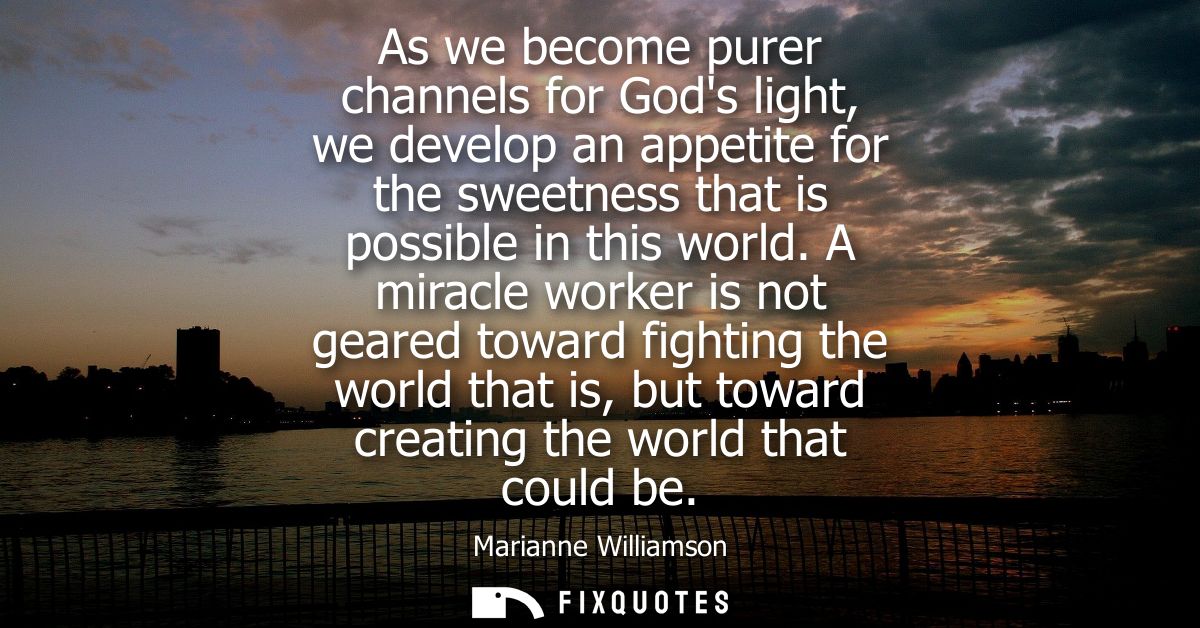
"As we become purer channels for God's light, we develop an appetite for the sweetness that is possible in this world. A miracle worker is not geared toward fighting the world that is, but toward creating the world that could be"
About this Quote
The phrase “miracle worker” is the clever pivot. A miracle isn’t just an anomaly; it’s a refusal to accept the given as final. That’s why she draws a hard line between “fighting the world that is” and “creating the world that could be.” On the surface it’s anti-combat, but the subtext is tactical: outrage can become an identity that keeps you emotionally busy while leaving reality intact. She’s wary of activism-as-resentment, the kind that feeds on enemies and ends up mirroring them.
Context matters. Williamson’s work rises out of late-20th-century New Age spirituality and its self-help-adjacent optimism, later colliding with American politics where “love” talk gets dismissed as soft. This quote anticipates that critique by making love operational: not a mood, but a method for imagination, endurance, and constructive action. It dares you to believe that hope is not naive - it’s a discipline.
Quote Details
| Topic | God |
|---|---|
| Source | Help us find the source |
| Cite |
Citation Formats
APA Style (7th ed.)
Williamson, Marianne. (2026, January 18). As we become purer channels for God's light, we develop an appetite for the sweetness that is possible in this world. A miracle worker is not geared toward fighting the world that is, but toward creating the world that could be. FixQuotes. https://fixquotes.com/quotes/as-we-become-purer-channels-for-gods-light-we-712/
Chicago Style
Williamson, Marianne. "As we become purer channels for God's light, we develop an appetite for the sweetness that is possible in this world. A miracle worker is not geared toward fighting the world that is, but toward creating the world that could be." FixQuotes. January 18, 2026. https://fixquotes.com/quotes/as-we-become-purer-channels-for-gods-light-we-712/.
MLA Style (9th ed.)
"As we become purer channels for God's light, we develop an appetite for the sweetness that is possible in this world. A miracle worker is not geared toward fighting the world that is, but toward creating the world that could be." FixQuotes, 18 Jan. 2026, https://fixquotes.com/quotes/as-we-become-purer-channels-for-gods-light-we-712/. Accessed 30 Mar. 2026.