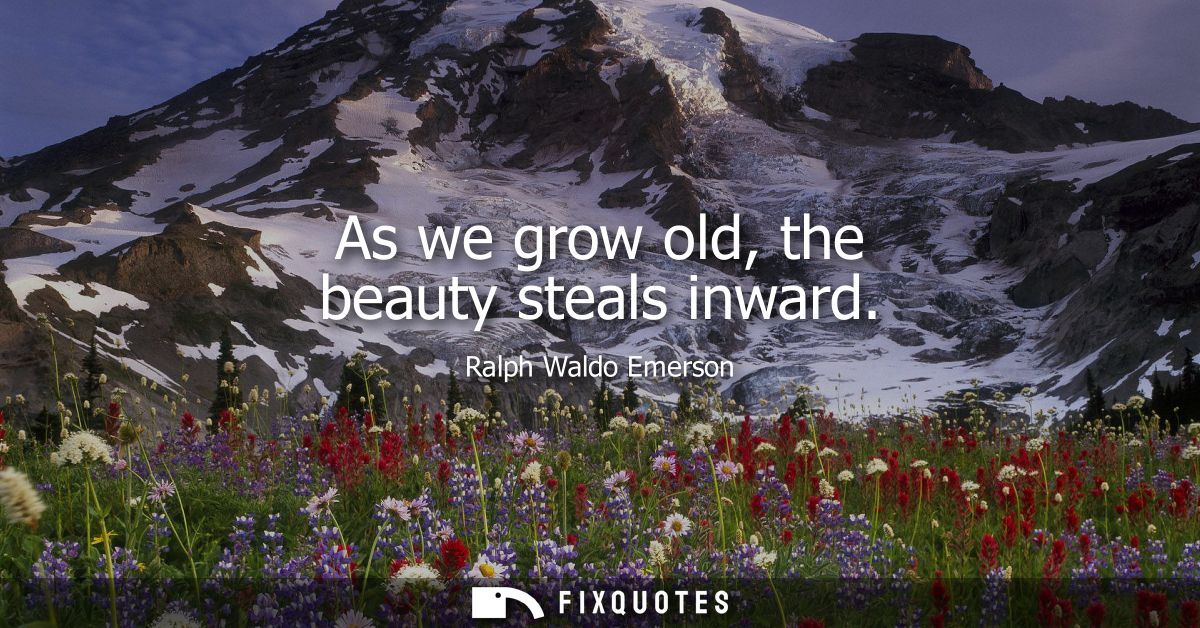
"As we grow old, the beauty steals inward"
About this Quote
Emerson’s line flatters aging without sentimentalizing it: the body doesn’t so much lose beauty as relocate it. “Steals inward” is the key bit of craft. It suggests a quiet theft, a subtle, almost conspiratorial motion away from the public marketplace of faces and toward a private reservoir of character. Beauty, in this view, isn’t an attribute you display; it’s a force you cultivate until it becomes less visible and more consequential.
The intent is partly consolatory, but also disciplinary. Emerson is a moral stylist: he wants you to treat aging as a spiritual audit. If youth is beauty as surface voltage, age is beauty as accumulated clarity - how you speak, what you notice, what you refuse to pretend. The subtext is a rebuke to a culture that confuses attractiveness with worth. Your looks, Emerson implies, were never really yours; they were on loan from biology and circumstance. What remains, if you’ve done the work, is an inward radiance: a steadier temperament, a conscience with fewer loopholes, a mind that has learned what not to chase.
Context matters. Emerson’s Transcendentalism prized the inner life as primary reality and treated the self as a site of moral and perceptual expansion. In an America obsessed with self-making in the outward sense - status, property, spectacle - he turns the arrow around. Aging becomes not decline but migration: beauty changing addresses from the mirror to the soul, from being seen to seeing.
The intent is partly consolatory, but also disciplinary. Emerson is a moral stylist: he wants you to treat aging as a spiritual audit. If youth is beauty as surface voltage, age is beauty as accumulated clarity - how you speak, what you notice, what you refuse to pretend. The subtext is a rebuke to a culture that confuses attractiveness with worth. Your looks, Emerson implies, were never really yours; they were on loan from biology and circumstance. What remains, if you’ve done the work, is an inward radiance: a steadier temperament, a conscience with fewer loopholes, a mind that has learned what not to chase.
Context matters. Emerson’s Transcendentalism prized the inner life as primary reality and treated the self as a site of moral and perceptual expansion. In an America obsessed with self-making in the outward sense - status, property, spectacle - he turns the arrow around. Aging becomes not decline but migration: beauty changing addresses from the mirror to the soul, from being seen to seeing.
Quote Details
| Topic | Aging |
|---|---|
| Source | Help us find the source |
| Cite |
Citation Formats
APA Style (7th ed.)
Emerson, Ralph Waldo. (2026, January 14). As we grow old, the beauty steals inward. FixQuotes. https://fixquotes.com/quotes/as-we-grow-old-the-beauty-steals-inward-16625/
Chicago Style
Emerson, Ralph Waldo. "As we grow old, the beauty steals inward." FixQuotes. January 14, 2026. https://fixquotes.com/quotes/as-we-grow-old-the-beauty-steals-inward-16625/.
MLA Style (9th ed.)
"As we grow old, the beauty steals inward." FixQuotes, 14 Jan. 2026, https://fixquotes.com/quotes/as-we-grow-old-the-beauty-steals-inward-16625/. Accessed 10 Mar. 2026.
More Quotes by Ralph
Add to List