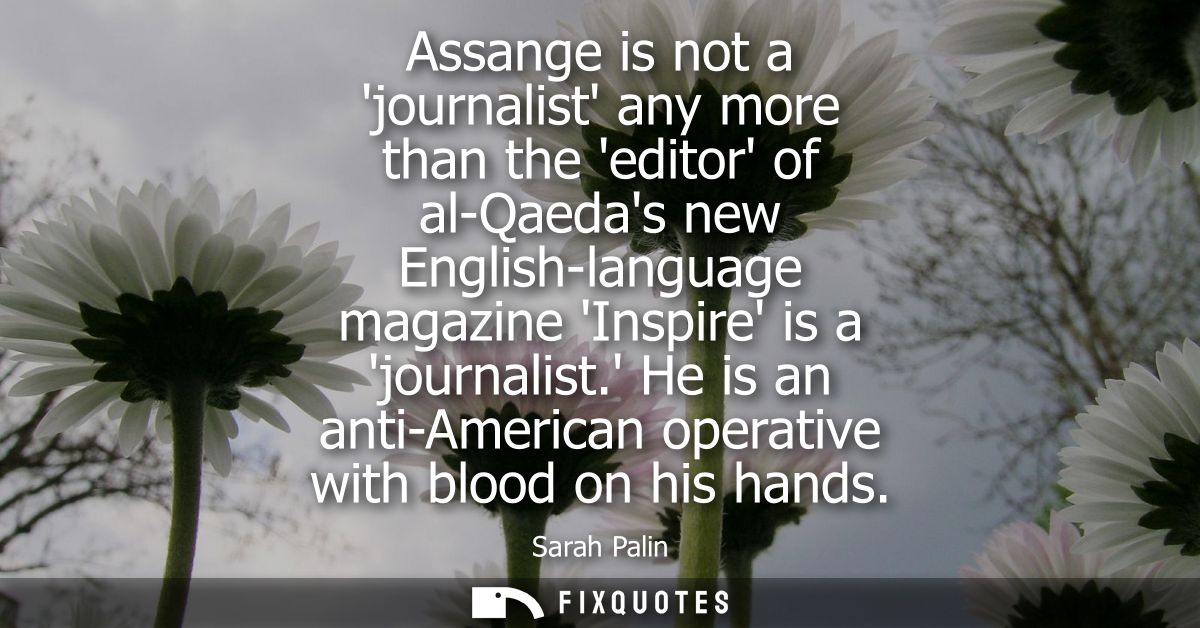
"Assange is not a 'journalist' any more than the 'editor' of al-Qaeda's new English-language magazine 'Inspire' is a 'journalist.' He is an anti-American operative with blood on his hands"
About this Quote
The subtext is about who gets First Amendment sympathy. Palin is policing the boundary of legitimate media at a moment when “the media” was already a partisan villain and the internet was scrambling old gatekeepers. Calling Assange “anti-American” shifts the debate from ethics (what should be published?) to loyalty (whose side are you on?). That move matters: loyalty tests don’t need evidence so much as signals.
“Blood on his hands” is the moral accelerant. It imports the logic of wartime culpability into an information-leak controversy, implying a direct chain from disclosure to death. Whether that causal link is provable is almost beside the point; the phrase is designed to make hesitation feel complicit. In the post-9/11 political culture Palin speaks from, national security rhetoric doesn’t merely criticize; it delegitimizes. The intent is to close the case before it’s argued, turning a messy question about transparency and power into a clean story about threat and betrayal.
Quote Details
| Topic | War |
|---|---|
| Source | Help us find the source |
| Cite |
Citation Formats
APA Style (7th ed.)
Palin, Sarah. (2026, January 18). Assange is not a 'journalist' any more than the 'editor' of al-Qaeda's new English-language magazine 'Inspire' is a 'journalist.' He is an anti-American operative with blood on his hands. FixQuotes. https://fixquotes.com/quotes/assange-is-not-a-journalist-any-more-than-the-1737/
Chicago Style
Palin, Sarah. "Assange is not a 'journalist' any more than the 'editor' of al-Qaeda's new English-language magazine 'Inspire' is a 'journalist.' He is an anti-American operative with blood on his hands." FixQuotes. January 18, 2026. https://fixquotes.com/quotes/assange-is-not-a-journalist-any-more-than-the-1737/.
MLA Style (9th ed.)
"Assange is not a 'journalist' any more than the 'editor' of al-Qaeda's new English-language magazine 'Inspire' is a 'journalist.' He is an anti-American operative with blood on his hands." FixQuotes, 18 Jan. 2026, https://fixquotes.com/quotes/assange-is-not-a-journalist-any-more-than-the-1737/. Accessed 7 Mar. 2026.