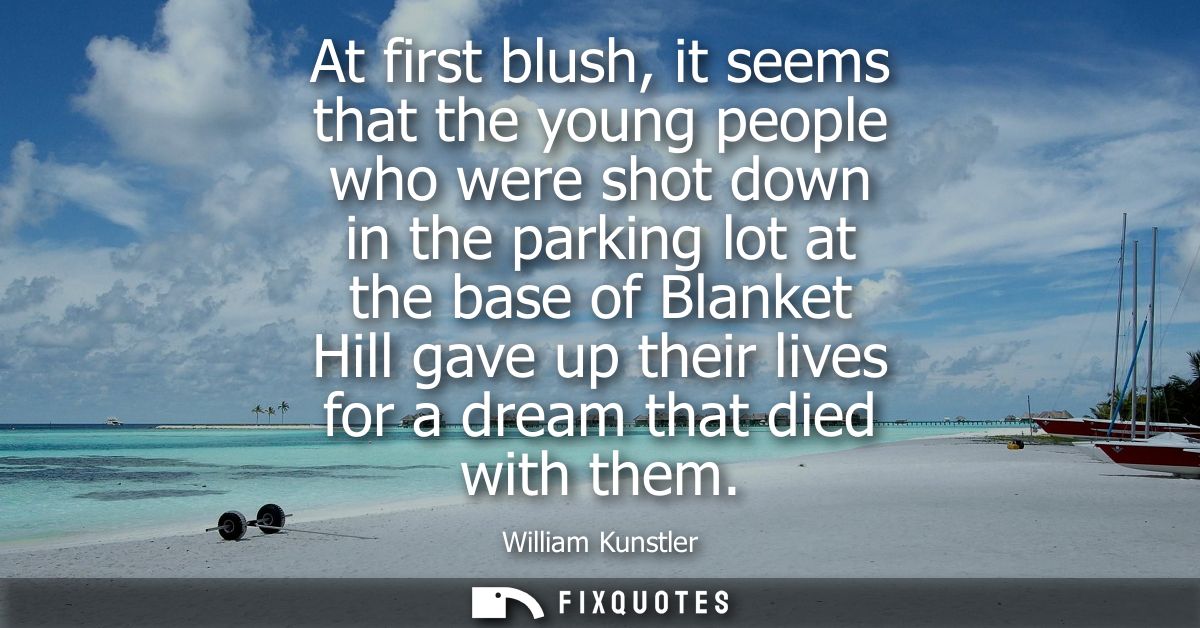
"At first blush, it seems that the young people who were shot down in the parking lot at the base of Blanket Hill gave up their lives for a dream that died with them"
About this Quote
The sentence also performs a brutal reframing of martyr language. “Gave up their lives” sounds voluntary, noble; “shot down in the parking lot” is blunt, industrial, humiliating. Parking lot and “the base of Blanket Hill” strip away the grandeur that institutions often paste onto tragedy. This wasn’t a battlefield. It was an everyday, low-rent space where power met dissent and chose force. By insisting on the mundane geography, Kunstler makes the violence feel less like history and more like policy.
Context matters: Kunstler is writing from the long shadow of Vietnam-era protest and state repression, when official reports often sought to convert bloodshed into “unfortunate incidents.” His intent is to deny that closure. The “at first blush” tells you the story you’re supposed to accept; the rest of his argument, implied here, is that this is the first lie. The dream didn’t die because it was naive. It’s declared dead so no one has to ask who killed it, and why.
Quote Details
| Topic | Mortality |
|---|---|
| Source | Help us find the source |
| Cite |
Citation Formats
APA Style (7th ed.)
Kunstler, William. (2026, January 16). At first blush, it seems that the young people who were shot down in the parking lot at the base of Blanket Hill gave up their lives for a dream that died with them. FixQuotes. https://fixquotes.com/quotes/at-first-blush-it-seems-that-the-young-people-who-97596/
Chicago Style
Kunstler, William. "At first blush, it seems that the young people who were shot down in the parking lot at the base of Blanket Hill gave up their lives for a dream that died with them." FixQuotes. January 16, 2026. https://fixquotes.com/quotes/at-first-blush-it-seems-that-the-young-people-who-97596/.
MLA Style (9th ed.)
"At first blush, it seems that the young people who were shot down in the parking lot at the base of Blanket Hill gave up their lives for a dream that died with them." FixQuotes, 16 Jan. 2026, https://fixquotes.com/quotes/at-first-blush-it-seems-that-the-young-people-who-97596/. Accessed 7 Apr. 2026.