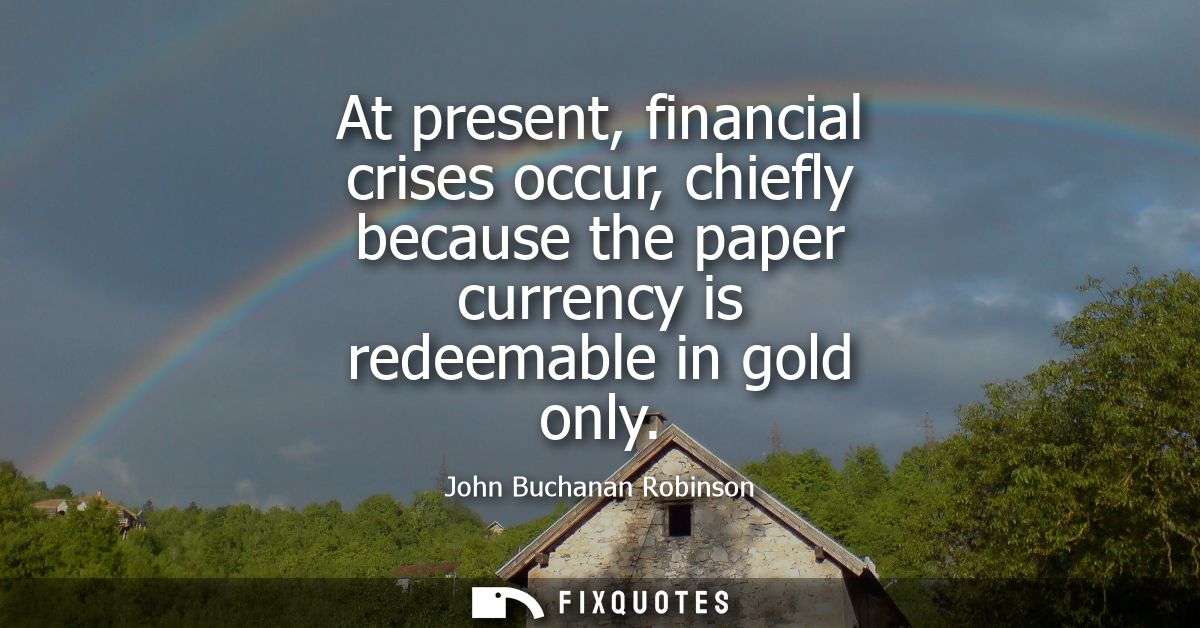
"At present, financial crises occur, chiefly because the paper currency is redeemable in gold only"
About this Quote
The subtext is a critique of the gold standard’s built-in panic button. If everyone knows paper is ultimately a claim on gold, then confidence becomes a stampede problem. The promise of convertibility invites periodic bank runs and liquidity crunches precisely because it makes the currency a negotiable ticket out of the system. Crises, in this framing, aren’t aberrations caused by irresponsible borrowers or moral failing; they are mechanical outcomes of a regime that forces contraction when demand for gold spikes.
Context matters: Robinson lived through repeated 19th-century financial panics and the long political brawl over bimetallism, central banking, and the power of Eastern finance. Politicians then were debating whether money should serve commerce and employment or serve as an altar to restraint. His phrasing, “chiefly because,” is tactical: it claims causality without sounding revolutionary, making room for reformers who wanted flexibility (more currency elasticity, lender-of-last-resort capacity) without admitting they were breaking with orthodoxy. It’s an argument for redesigning the rules, not merely blaming the players.
Quote Details
| Topic | Money |
|---|---|
| Source | Help us find the source |
| Cite |
Citation Formats
APA Style (7th ed.)
Robinson, John Buchanan. (2026, January 15). At present, financial crises occur, chiefly because the paper currency is redeemable in gold only. FixQuotes. https://fixquotes.com/quotes/at-present-financial-crises-occur-chiefly-because-142978/
Chicago Style
Robinson, John Buchanan. "At present, financial crises occur, chiefly because the paper currency is redeemable in gold only." FixQuotes. January 15, 2026. https://fixquotes.com/quotes/at-present-financial-crises-occur-chiefly-because-142978/.
MLA Style (9th ed.)
"At present, financial crises occur, chiefly because the paper currency is redeemable in gold only." FixQuotes, 15 Jan. 2026, https://fixquotes.com/quotes/at-present-financial-crises-occur-chiefly-because-142978/. Accessed 12 Feb. 2026.